
MCX cracks 26% in 34 days: Bearish sentiment or weak fundamentals? | Smart Stocks News

The stock market has been in a correction phase since December 2024, with most indices experiencing double-digit declines. Even companies that facilitate capital markets — traditionally favoured by investors — have not been spared. Brokers, depositories, and stock exchanges have all felt the pressure, with stock prices of Angel One, Motilal Oswal Financial Services, Central Depository Services Limited (CDSL), CAMS, and BSE falling more than 30% from their peaks.
Hence, the Multi Commodity Exchange of India (MCX) witnessing a 26% dip in 34 days after a staggering 400% rally over 19 months is not unexpected.
By mid-2024, analysts had warned of a potential correction as many stocks were trading at stretched valuations. Despite global headwinds, the Indian stock market continued to climb, driven by strong domestic economic activity and robust corporate earnings. Investor confidence surged, leading to increased retail participation, further supported by technological advancements and SEBI’s investor-friendly regulations.
However, concerns over US trade policies have created fresh uncertainty. Donald Trump’s retaliatory tariffs have unsettled Indian importers and exporters, raising fears of a global trade war. Foreign institutional investors (FIIs) have also been pulling out funds, adding to market volatility.
The past two years’ market rally had already stretched the valuation of stocks, making investors more sensitive to earnings growth slowdowns. As several companies reported lower-than-expected earnings, their stock prices took a hit. These combined factors triggered a much-needed correction.
Why did MCX stock fall?
After rallying more than 400% to reach an all-time high of Rs 7,048 in early December, MCX stock has seen a correction of 32% to Rs 4,794 as of March 13, 2025.
MCX Stock Price Momentum from May 2023 to March 2025
 Source: Trading View
One major factor behind the decline was a bearish outlook from Morgan Stanley. On January 21, 2025, the brokerage maintained an “Underweight” rating on MCX, setting a price target of Rs 3,715 — 21% lower than the then-current price of Rs 4,794. Morgan Stanley cited a slowdown in Average Daily Revenue (ADR) and a Q3 FY25 earnings miss amid stretched valuations. The stock subsequently dropped 26% in 34 days (5 February-10 March).
Story continues below this ad
However, this is not the first time that Morgan Stanley has given bearish commentary. It has maintained an “Underweight” stance on MCX since April 2024. Despite this, MCX stock had surged 66% by December, driven by strong earnings growth.
Did investors overreact to Q3 earnings?
MCX is a trading platform for commodities futures and options (F&O), earning 70-80% of its revenue from energy commodities (oil, natural gas, electricity) and 20-22% from bullion. The platform generates revenue primarily from transaction fees, which are a percentage of turnover.
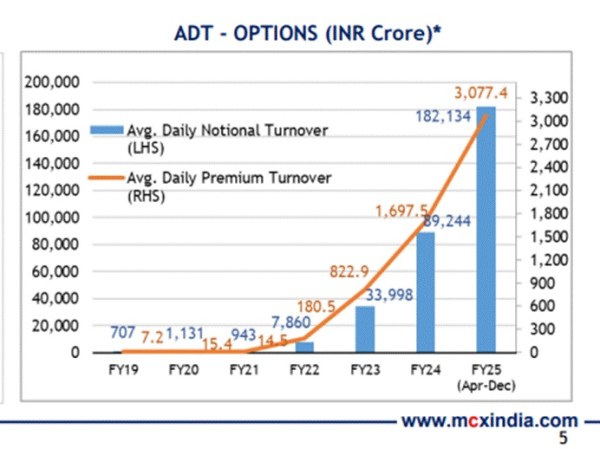
Historically, commodity derivatives were a niche market, but this changed after SEBI brought them under its regulatory purview in 2015. In 2016, the regulator allowed options contracts in commodities. Today, options contracts account for 88% of MCX’s average daily turnover.
MCX’s Average Daily Turnover for Options
 Source: MCX Q3 FY25 Earnings Presentation
In April 2023, SEBI allowed foreign portfolio investors (FPIs) to participate in Exchange-traded Commodity Derivatives, driving turnover for MCX. To ensure smooth operations, MCX has been expanding its warehouse infrastructure for physical delivery settlements and maintaining a settlement fund for cash transactions. Over the past two years, these initiatives have pushed its Average Daily Turnover (ADT) to record highs.
Story continues below this ad
New trading platform
In October 2023, MCX launched a new Commodity Derivative Platform developed by TCS. The increased software cost pulled down MCX’s net profit by 44% in FY24. As a result, comparing net profits year-over-year may not accurately reflect the company’s financial health.
The increase in technology expenses exceeded Morgan Stanley’s projections, making it “Underweight” on MCX with a target price of Rs 2,085 in April 2024. However, other analysts took a more optimistic view. Motilal Oswal upgraded MCX to a “Buy” rating, with a target price of Rs 4,300, anticipating that new product launches such as steel bar, gold serial contracts, and power contracts would drive trading volumes.
Nine months have passed, and MCX ADT has reached new highs. ADT increased from Rs 1.16 lakh crore in Q3 FY24 to Rs 2.35 lakh crore in Q3 FY25.
MCX’s Quarterly Average Daily Turnover
MCX’s Profit Margins
Story continues below this ad
MCX’s 10-year median price-to-earnings (PE) ratio is 43.4x, and the stock is currently trading at 46.6x, slightly above the median. MCX’s PE ratio surged significantly in 2023 as ADT rose, but software costs reduced the earnings per share (EPS). However, the PE ratio fell as profit margins improved.
Story continues below this ad
There is more scope for profits to grow with an increase in ADT.
Morgan Stanley is sceptical about MCX’s revenue sustainability because of a significant concentration risk (high exposure to energy and bullion). Hence, it finds MCX’s current valuations stretched. However, UBS and Motilal Oswal remain bullish on MCX and see every dip as a buying opportunity. Here’s why.
They expect increased participation and new product launches to drive MCX’s volumes between the fiscal years 2025 and 2027. In October 2024, UBS had a price target of Rs 8,000 after it raised MCX’s earnings estimates for FY25 and FY26 by 60% and 75%, respectively. In September 2024, Motilal Oswal reiterated a target price of Rs 6,500, which represents 42 times its September 2026 EPS estimate.
In conclusion
MCX shares could continue to rally as long as it gets high volumes in energy and bullion F&Os. Key factors influencing these volumes include geopolitical developments and their impact on commodity prices. MCX stock price could remain volatile amid economic uncertainties and a slowdown in trade due to tariffs in the short term. This could present an opportunity for the long term when these trade tensions ease and there is clarity on tariffs.
Story continues below this ad
Note: We have relied on data from http://www.Screener.in throughout this article. Only in cases where the data was not available, have we used an alternate, but widely used and accepted source of information.
Puja Tayal is a financial writer with over 17 years of experience in the field of fundamental research.
Disclosure: The writer and his dependents do not hold the stocks discussed in this article.
The website managers, its employee(s), and contributors/writers/authors of articles have or may have an outstanding buy or sell position or holding in the securities, options on securities, or other related investments of issuers and/or companies discussed therein. The content of the articles and the interpretation of data are solely the personal views of the contributors/ writers/authors. Investors must make their own investment decisions based on their specific objectives, and resources and only after consulting such independent advisors as may be necessary.


