Aditya Birla Fashion & Retail’s expanding wardrobe shows profit discipline, but investors still wait for returns | Smart Stocks News
Pantaloons, Van Heusen, Forever 21, Sabyasachi, Tasva – Aditya Birla Fashion & Retail Ltd (ABFRL) has dressed itself in every possible label India’s consumers might desire. It is a wardrobe bursting at the seams, from budget to luxury, mass to designer couture.
But for investors, that overflowing closet has not translated into wealth. The stock has zig-zagged wildly for a decade, with dizzying rallies and painful corrections, only to leave long-term holders almost exactly where they started.
The company’s latest quarterly numbers show energy, growth, and ambition, yet the market’s flat verdict hints at unease: is ABFRL building a fashion powerhouse or just juggling too many brands to deliver real returns?
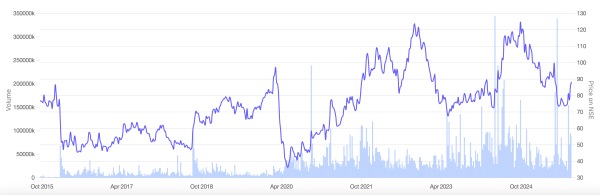 Figure 1: Stock Price Movement of ABRFL. (Source: Screener.in)
Understanding the business
Aditya Birla Fashion & Retail Ltd operates in multiple categories: value fashion through Pantaloons, formal wear through legacy brands like Van Heusen and Louis Philippe, casual wear with Allen Solly and Forever 21, designer-led luxury with Sabyasachi and Tarun Tahiliani, premium ethnic wear with Tasva and TCNS, and digital-first brands through its TMRW venture.
In total, ABFRL operates over 1,160 exclusive brand outlets across 7.4 million square feet of retail space, making it one of India’s largest lifestyle retailers.
This diversification has been both its strength and burden. Each portfolio plays to a different consumer base.
Story continues below this ad
Pantaloons captures the budget-conscious mass market, which is growing steadily but faces intense competition from Reliance Trends, Max, and online players.
The ethnic wear portfolio, built aggressively through acquisitions and partnerships, taps into India’s wedding and festive economy, a segment that has shown outsized growth in recent quarters.
Luxury and designer labels provide aspirational value and fat margins, though they remain niche.
Meanwhile, TMRW represents ABFRL’s bet on the future: young, digital-first labels that speak to Gen Z consumers but are still loss-making.
Story continues below this ad
The company claims that every business must meet strict investment filters: a path to double-digit profitability, a target of 20%+ annual return, and clear visibility of scale. That discipline explains why ABFRL has exited certain underperforming formats in the past, even as it doubled down on ethnic wear and digital-first bets. Management often frames this portfolio as a “balanced wardrobe”: some segments deliver steady cash flows (Pantaloons, legacy brands), others provide growth spikes (ethnic, designer), while a few are long-term options (TMRW).
The challenge, however, is that balancing act itself. In fashion retail, brand focus often matters as much as breadth. ABFRL is trying to prove that breadth, if managed with discipline, can be a competitive moat rather than a distraction.
Portfolio performance breakdown
The April-June 2025 quarter underlined the contrasts across ABFRL’s many portfolios.
Pantaloons: The department store chain remains the backbone of ABFRL’s value retail play. In Q1 FY26, Pantaloons reported revenue of Rs 1,094 crore, a slight decline from last year. The softness stemmed from the timing of Eid (which fell in March this year versus April in the previous year) and from store closures over the past 12 months.
Story continues below this ad
Adjusted for these factors, growth would have been around 4 percent. Same-store sales were flat, but management pointed to normalised like-for-like growth of about 3 percent. Despite muted top-line momentum, Pantaloons preserved its profitability. Segment EBITDA margin was 17.1 percent, only marginally lower than a year ago.
The company has been pruning smaller, less productive outlets and replacing them with larger-format stores, while giving the chain a new retail identity. The result is a leaner, more modern Pantaloons that is still profitable, but needs consistent same-store growth to regain investor confidence. Its value sub-format, Style Up, offered a bright spot, growing 36 percent year-on-year and expanding to 49 stores.
Ethnic businesses: If Pantaloons treaded water, the ethnic portfolio surged. Revenues rose 25 percent year-on-year to Rs 436 crore, with EBITDA turning positive versus a loss last year. Margin expansion of ~1,600 basis points was driven by strong wedding demand and tighter cost control. Designer-led brands such as Sabyasachi, Tarun Tahiliani, Shantnu & Nikhil, and House of Masaba collectively grew 79 percent. Premium ethnic labels followed suit: Tasva sales rose 72 percent with 39 percent like-for-like growth, reaching 70 stores, while TCNS Clothing (brands W and Aurelia) stabilised, posting 4 percent same-store growth despite network rationalisation. The ethnic cluster is shaping into ABFRL’s most dynamic growth engine, helped by India’s expanding wedding economy and rising consumer appetite for occasion wear.
Luxury retail: ABFRL’s luxury arm, anchored by The Collective and several international mono-brand stores, added three outlets in Q1, bringing the network to 44. Revenue grew at a modest single-digit pace, but profitability remained strong, with double-digit margins. Luxury is not about scale in ABFRL’s case, but about brand positioning and steady cash flows from affluent shoppers.
Story continues below this ad
Digital-First Brands (TMRW): The TMRW portfolio, ABFRL’s youngest venture, reported a 38 percent jump in revenue to Rs 197 crore. Brands like Bewakoof, Wrogn, and The Indian Garage Co. are scaling up through direct-to-consumer channels and have begun opening exclusive stores, reaching 25 outlets across nine cities. However, losses remain high, with EBITDA margins at –32 percent. ABFRL secured Rs 437 crore of external funding from ServiceNow Ventures during the quarter, signaling both confidence in the digital strategy and recognition that these businesses will need sustained capital before they turn profitable. Management reiterated that TMRW is on track to break even only by FY29.
Overall, the quarter showed how ABFRL’s breadth acts as a hedge. Weakness in one segment (Pantaloons) was offset by strength in another (ethnic), while luxury provided stability, and TMRW delivered growth, albeit at a cost.
Profitability and margins
ABFRL’s financial scorecard for Q1 FY26 was a study in contrasts: steady revenue growth, but a sharper improvement in profitability. Consolidated revenue from operations rose 9 percent year-on-year to Rs 1,831 crore. The bigger story was at the operating level. EBITDA jumped 38 percent to Rs 169 crore, lifting margins by 200 basis points to 9.3 percent. This was the fourth straight quarter of margin expansion, a clear sign that the company’s efforts at tighter cost management and sharper merchandising are paying off.
The ethnic wear division was the standout contributor. A 25 percent sales increase, coupled with a swing from losses to a positive EBITDA margin of 0.4 percent, added significantly to group profitability. Pantaloons, though flat on revenue, maintained margins at 17 percent-plus thanks to controlled markdowns and improved operational discipline. Luxury retail continued to deliver double-digit margins despite only single-digit sales growth, reflecting the resilience of high-end fashion in a muted consumer environment.
Story continues below this ad
The drag came from TMRW. While revenue grew by 38 percent, losses widened in absolute terms, with the portfolio recording a negative EBITDA margin of 32 percent. Management has been clear that these are intentional investments to scale up the brands and that profitability will take several years to arrive.
At the net level, ABFRL reported a loss of Rs 234 crore, broadly similar to the year-ago period. This was due to higher depreciation, employee costs, and continued investment in expansion. However, the company’s balance sheet remains solid. Gross cash stood at Rs 2,070 crore at the end of June 2025, providing a buffer to fund growth.
The clear message from Q1 is that ABFRL is extracting more profit out of each rupee of sales than it did a year ago. If that discipline sustains, the company can continue to fund expansion and absorb the losses from newer ventures without straining the overall business.
Expansion strategy and execution risks
ABFRL’s growth story is stitched together store by store. In the April-June quarter alone, more than 30 new outlets opened across its many brands. The ethnic wear portfolio is the fastest-moving piece: Tasva expanded to 70 stores, TCNS is gearing up for fresh additions after shutting 80 underperformers last year, and designer-led labels are quietly planting themselves in premium locations. The luxury format added three stores, while Pantaloons has shifted its focus from smaller shops to much larger 20,000-25,000 sq. ft. spaces that can offer a full experience.
Story continues below this ad
The playbook is clear: add scale where demand is strong and trim fat where economics do not work. Pantaloons is the best example. From a high of 460 stores, the chain has been cut down to around 405. Management calls this the “bottoming out” of closures and hints that modest additions will return this year, with net expansion likely only from FY27. TMRW, meanwhile, is taking its online-born brands offline, opening 25 stores across nine cities to build credibility and improve margins.
But the real challenge is not opening stores. It is running such a sprawling portfolio at the same time. Different businesses are at very different speeds. Pantaloons still struggles to show steady same-store sales growth, even as ethnic wear is booming. Designer brands are profitable but remain niche. TMRW continues to burn cash, with break-even still four years away. Any stumble, whether in integrating TCNS smoothly or in navigating a sudden slowdown in consumer spending, could expose the fragility of this balancing act.
Competition makes the balancing act harder. Reliance and Trent are rapidly scaling in value fashion. H&M and Zara continue to pull younger shoppers in fast fashion. In digital, TMRW is up against a flood of venture-backed start-ups chasing Gen Z. Even in ethnic wear, where ABFRL has built a lead, regional labels and local designers keep the field crowded. Add to that the risks of approval delays, heavy capital expenditure, and softer consumer demand, and the execution load looks heavy.
For now, ABFRL has the cushion. With over Rs 2,000 crore in cash on its books, the company has enough financial muscle to keep investing. The real test is whether it can keep the momentum going across all these moving parts at once. If a big piece like Pantaloons or TMRW slips, the shine of the other segments may not be enough to hold the story together.
What the numbers say about the road ahead
Story continues below this ad
ABFRL’s latest quarter sums up the company in one frame: ambitious, diversified, and sharper on execution than before. Sales moved up modestly, but profits jumped as the ethnic wear portfolio caught fire and cost discipline held across the board. Pantaloons managed to protect margins even with flat sales, luxury ticked along steadily, and ethnic labels became the real growth engine. Even TMRW, still burning cash, showed that young digital-first brands can be scaled at speed under ABFRL’s umbrella.
But investors remain unconvinced. The stock has swung violently over the past decade — soaring in rallies, sinking in corrections — only to leave long-term shareholders with little to show. That flat performance points to a deeper doubt: can one company manage such a sprawling wardrobe of brands and still deliver consistent returns?
The answer will hinge less on adding new names and more on getting the basics right. Pantaloons needs to prove it can grow same-store sales again. Ethnic wear has to hold its momentum once the wedding boom passes. And TMRW must draw a credible path to profitability rather than endless cash burn. Yes, ABFRL has the cash cushion — over Rs 2,000 crore — to keep funding expansion. But markets will reward evidence that scale translates into durable earnings, not just eye-catching quarterly headlines.
On paper, ABFRL looks like India’s most complete fashion house, dressing consumers across categories, price points, and generations. The real test is whether it can turn that impressive wardrobe into real wealth, not just for shoppers but for shareholders too.
Note: This article relies on data from annual and industry reports. We have used our assumptions for forecasting.
Parth Parikh has over a decade of experience in finance and research and currently heads the growth and content vertical at Finsire. He holds an FRM Charter and an MBA in Finance from Narsee Monjee Institute of Management Studies.
Disclosure: The writer and his dependents do not hold the stocks discussed in this article.
The website managers, its employee(s), and contributors/writers/authors of articles have or may have an outstanding buy or sell position or holding in the securities, options on securities or other related investments of issuers and/or companies discussed therein. The content of the articles and the interpretation of data are solely the personal views of the contributors/ writers/authors. Investors must make their own investment decisions based on their specific objectives, resources and only after consulting such independent advisors as may be necessary.