From airport lounges to boardrooms: Why Chalet Hotels is catching investor attention | Smart Stocks News
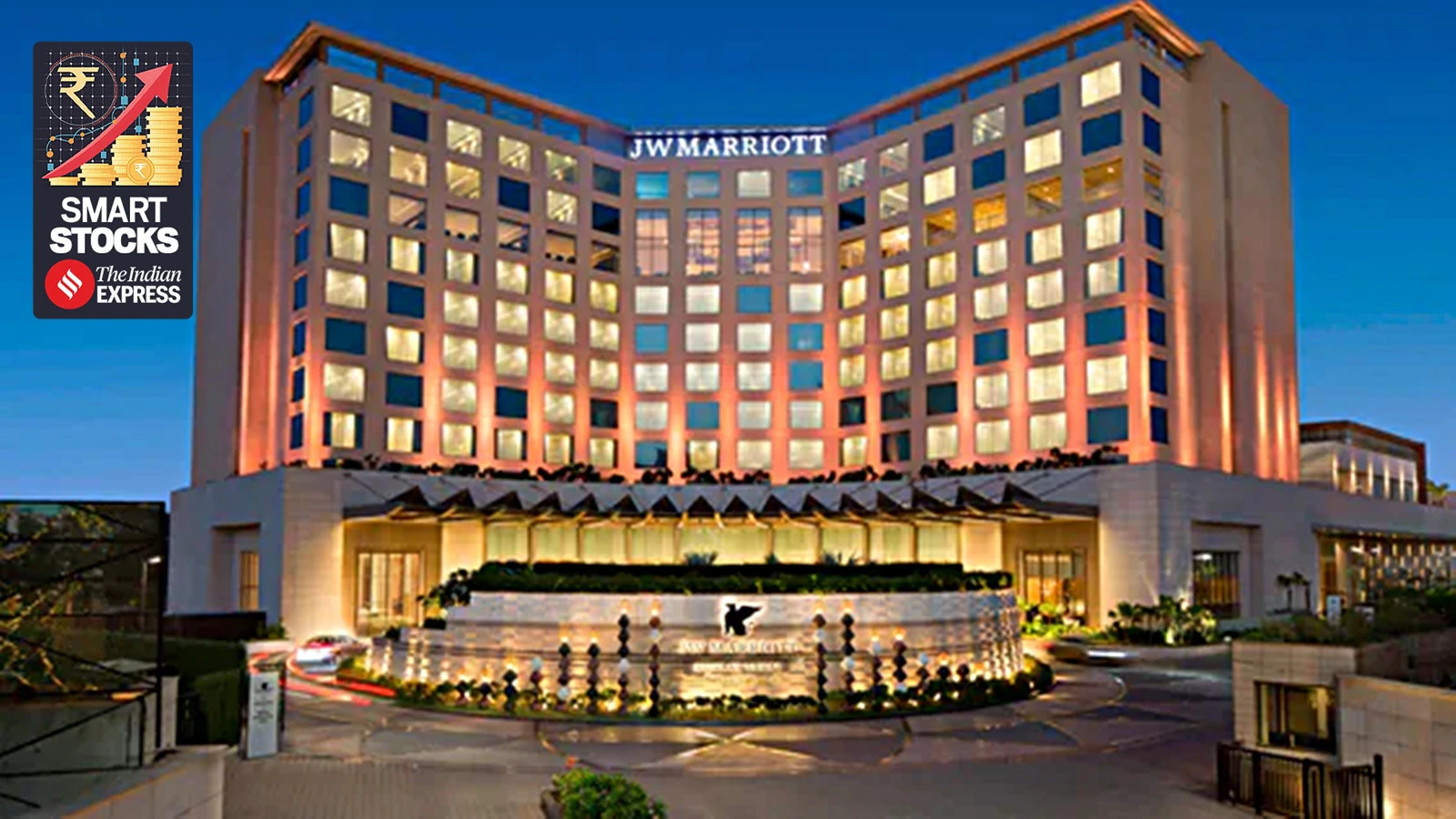
Walk past Mumbai’s international airport and you will find a hotel that tells the story of India’s changing hospitality market.
The JW Marriott Sahar, owned by Chalet Hotels, is no longer just a luxury stopover for jet-lagged travelers. It is part of a larger business model that combines premium hotels with office towers, a mix that has helped Chalet carve a distinct identity on the stock market.
In numbers, the company is at an inflection point.
Its Q1 FY26 revenues surged 146 percent to Rs 908 crore, with EBITDA up 150 percent to Rs 371 crore. Even excluding a one-time boost from residential sales in Bengaluru, its core revenue rose 27 percent and EBITDA climbed 37 percent year-on-year, with margins expanding to 44 percent.
Hotels contributed Rs 386 crore in revenue at a 41.7 percent margin, while the annuity (office leasing) business doubled to Rs 73 crore in revenue with an 83 percent margin.
On the ground, Chalet’s average daily rate rose 17 percent to Rs 12,207, while occupancy eased to 66 percent as new capacity came online. The trade-off was clear: slightly lower room fills, but higher room rates, lifting revenue per available room by nearly 10 percent.
For investors, the question is not whether Chalet is growing, but whether this dual-engine model of airports and business hubs can keep delivering quarter after quarter.
With 3,300 rooms operational and another 1,200 in the pipeline, plus 2.4 million square feet of commercial space, of which 77 percent is leased, Chalet is betting that India’s travel and office demand cycles will keep it well supplied with both growth and stability.
Story continues below this ad
 Figure 1: Stock Price Movement of Challet Hotels Ltd. (Source: Screener.in)
Understanding the business
Chalet Hotels is not a typical hotel chain. Unlike many of its peers, which rely on asset-light models of managing properties for a fee, Chalet is firmly asset-heavy. It owns its hotels, often alongside commercial towers and retail space, and extracts value from the entire ecosystem. The company’s belief is straightforward: owning the right real estate in the right location creates long-term value, even if it requires higher upfront capital.
This strategy has produced a dual engine of growth. On one side is hospitality, with more than 3,300 operational rooms across 11 hotels, most in metro hubs and near airports. These are operated under powerful global brands like Marriott, Westin, and Novotel, ensuring access to loyalty programmes and international demand streams. On the other side is commercial leasing, with 2.4 million square feet of office space, of which 1.9 million is already leased. This generates a recurring annuity income stream at EBITDA margins above 80 percent, smoothing out the cyclicality of hotels.
The company’s geography and segment mix are designed to balance demand across cycles. Hotels in the Mumbai Metropolitan Region anchor the business, but revenue contributions are now more spread out – Hyderabad, Bengaluru, and Pune have all grown meaningfully in recent years. Leisure is another growing piece: resorts in Khandala and Uttarakhand are small in scale but offer higher pricing potential and diversify Chalet beyond corporate travel.
Margins tell the story of why this model works. Hotels delivered EBITDA margins of 41.7 percent in Q1 FY26, reflecting operating leverage as room rates rise. The annuity side, with its leaner cost structure, delivered 83 percent EBITDA margins. Together, they produced a consolidated margin of 44.4 percent excluding one-offs, among the best in the industry. In other words, Chalet’s structure allows it to enjoy the upside of rising RevPARs while cushioning volatility with steady rentals.
Story continues below this ad
Business model and margins: Making sense of Chalet’s playbook
Chalet’s formula is built on scale in premium locations and a clear focus on economics. The company insists on projects that can deliver attractive returns on capital, typically targeting over 20 percent annualised returns on investments. That discipline explains why its portfolio is concentrated around airport corridors, central business districts, and premium leisure spots, locations where pricing power is strongest.
In Q1 FY26, this model was evident in the numbers. Hospitality revenue rose 18 percent year-on-year to Rs 386 crore, with an EBITDA margin of 41.7 percent.
The key driver was higher room rates: Chalet’s average daily rate (ADR) jumped 17 percent to Rs 12,207, offsetting a dip in occupancy to 66 percent. As a result, RevPAR increased nearly 10 percent to Rs 8,059. Management has been upfront that the short-term trade-off is intentional – new capacity in Bengaluru and competitive openings in Mumbai diluted occupancy, but pricing strength more than made up for it.
The other half of the business, commercial leasing, provided a powerful kicker. Revenues doubled to Rs 73 crore in Q1 FY26, with an EBITDA margin of 83 percent. Leasing momentum was strong: occupancy across the office portfolio climbed to 77 percent, up from 50 percent a year ago. With a run rate of Rs 25 crore per month already in place and visibility to reach Rs 30 crore per month by year-end, the annuity stream is now meaningful enough to smooth out hotel cyclicality.
Story continues below this ad
This dual-engine design is what makes Chalet different. Hotels generate the growth, while offices provide the stability. The result is consolidated operating margins that are consistently above 40 percent. In Q1, the company reported a 44.4 percent EBITDA margin excluding residential one-offs. Few peers in Indian hospitality can show such a blend of premium RevPAR growth and annuity-backed profitability.
Execution capability and growth pipeline
For Chalet, the next leg of growth depends on how well it delivers the large pipeline now in motion. The company already operates 3,300 rooms, but has another 1,200 rooms under development across Delhi, Goa, Navi Mumbai, and Kerala. Add to that nearly 0.9 million square feet of new commercial leasing area under construction in Mumbai, and the expansion is both ambitious and capital-intensive.
Recent quarters suggest Chalet is executing on schedule. In Q1 FY26, it added 121 rooms in Bengaluru Marriott Whitefield, taking that hotel’s capacity to 512 rooms, and operationalised 44 renovated rooms and a banquet facility at The Dukes Retreat, Khandala. These additions helped push consolidated revenues to record highs. Upcoming deliveries include the Taj-branded 385-room hotel at Delhi International Airport, targeted for H1 FY27, and the Cignus Tower II office development in Powai (0.9 msf), expected by Q4 FY27. Further out, a 190-room resort in South Goa (Varca) is on track for FY28.
In the planning stage, Chalet has lined up a Hyatt Regency at Airoli, Navi Mumbai (~280 rooms), a 170-room hotel in North Goa (Bambolim), and a 150-room property in Trivandrum, Kerala. These will ensure visibility well into FY28-29 once approvals are cleared. Management has indicated that the goal is to surpass 5,000 rooms by FY26, effectively a 50 percent expansion in less than two years.
Story continues below this ad
The company expects to spend about Rs 2,000 crore in capex through FY27 to fund these projects. Importantly, much of this is planned from internal accruals and cash from the near-complete Bengaluru residential project, which has already delivered Rs 439 crore revenue in Q1 FY26. Net debt stood at about Rs 2,018 crore at the end of June 2025, with the average cost of borrowing reduced to 8.0 percent. Chalet’s balance sheet is healthier than many peers, giving it headroom to manage expansion without slipping into over-leverage.
Risks and realities
Chalet’s story looks strong, but investors need to weigh the risks that come with an asset-heavy hospitality play.
Cyclicality of hotels is the first and most obvious risk. Hospitality demand in India is rising, but it remains vulnerable to global shocks.
New supply in metro markets is another factor. Several large hotels are scheduled to open across Mumbai, NCR, and Bengaluru in the next two years. Industry watchers note that while demand is growing at a healthy clip, execution delays are common in India, so not all announced supply may materialise. Still, the risk is that in micro markets like Sahar or Powai, too much capacity could pressure both occupancy and average daily rates. Chalet’s competitive edge is brand tie-ups and location, but these advantages can be tested when rivals undercut on pricing.
Story continues below this ad
On the annuity side, Chalet has executed well so far. But commercial real estate has its own cycles. A slowdown in office absorption, especially in tech-heavy markets like Powai or Whitefield, could delay Chalet’s ability to reach the targeted 90 percent leasing levels by FY26. Rental growth is also tied to broader corporate capex cycles, which may not always run in sync with hotel demand.
Execution risk around the expansion pipeline is another reality. Projects in the planning stage face regulatory hurdles; changes in approval timelines could push delivery back. The company has the advantage of internal funding, but the scale of commitments means any slip can show up quickly in cash flows.
Finally, there is a leadership transition to manage. CEO Sanjay Sethi steps down in January 2026, with Shwetank Singh set to take over. While the handover is structured, new leadership always introduces a degree of uncertainty. Investors will be looking for continuity in strategy, discipline in balance sheet management, and clarity on how the new CEO handles growth in both hotels and offices simultaneously.
Closing perspective
Chalet Hotels has built an unusual identity in India’s listed hospitality space. It is not just a hotel operator chasing occupancies and room rates. It is a property owner with two engines – one driven by premium hotels in airport corridors and business hubs, and another by high-yielding office towers that generate stable rentals. That mix has delivered record quarterly revenues of Rs 908 crore and EBITDA margins of over 44 percent in Q1 FY26. It has also created a degree of resilience that few hotel companies can claim.
Story continues below this ad
For retail investors, the attraction is clear. Chalet offers exposure to India’s hospitality upcycle, visible through double-digit ADR growth and rising RevPARs, while also offering the stability of an annuity income stream that grew more than 100 percent year-on-year in the latest quarter.
But it is the execution of large projects, a smooth leadership transition, and maintaining pricing power amid new supply that will decide whether Chalet can stay on its growth path. Hospitality cycles do not run in straight lines, and commercial real estate has its own swings. The challenge for Chalet is to keep both engines firing in sync.
If it succeeds, Chalet could evolve into a rare play, a company that blends the glamour and growth of hotels with the steadiness of rental income. That is a powerful narrative for investors seeking a mix of excitement and stability in one stock. The next two to three years, as new hotels open and office towers lease out, will show if this promise translates into lasting shareholder value.
Note: This article relies on data from annual and industry reports. We have used our assumptions for forecasting.
Story continues below this ad
Parth Parikh has over a decade of experience in finance and research and currently heads the growth and content vertical at Finsire. He holds an FRM Charter and an MBA in Finance from Narsee Monjee Institute of Management Studies.
Disclosure: The writer and his dependents do not hold the stocks discussed in this article.
The website managers, its employee(s), and contributors/writers/authors of articles have or may have an outstanding buy or sell position or holding in the securities, options on securities or other related investments of issuers and/or companies discussed therein. The content of the articles and the interpretation of data are solely the personal views of the contributors/ writers/authors. Investors must make their own investment decisions based on their specific objectives, resources and only after consulting such independent advisors as may be necessary.