The Legend and Labour Behind Old Delhi’s Famous Daulat Ki Chaat
When I first moved to the Capital nearly two decades ago, amid glowing accounts of the biryanis and kormas of Old Delhi — the minced mutton curry at Ashok & Ashok, the butter chicken at Kake Da Dhaba, the kakoris at Al Kauser, and the true chaat of Chandni Chowk — the only dessert people spoke of with equal reverence was daulat ki chaat. The name translates to “the savoury born of wealth.”
That daulat ki chaat has little to do with wealth — and even less with being savoury — only adds to the mystique of this dessert, which can be sampled on the streets of Delhi only at the height of winter.

I had to wait eight long months, enduring Delhi’s sweltering heat, until a crisp November finally arrived—this sweet can only be made between Diwali and Holi. I also had to brave the bylanes of Old Delhi, charming in photographs but often overwhelming in reality, clogged with crowds and traffic.
At the end of the journey, however, daulat ki chaat proved so delicate and indulgent — if not exactly wealthy — that it was well worth the effort. Almost soufflé-like in its lightness, it carried just the right touch of sweetness. The dessert cannot be packed for later; it exists only in the moment and is found on the streets of Old Delhi in the early morning hours. By late morning, daulat ki chaat disappears—quite literally, for love or money. Urban legend even has it that the sweet can only be prepared on a moonlit winter night.
What’s in the name
One explanation for its name is that the daulat comes from the foam used to make it, which is skimmed at just the right moment—when the richest part of the milk, the malai, forms before it reaches a boil. The word chaat refers to the generous sprinkling of nuts and khoya on top, much like the garnishes added to savoury chaats.
The sweet is made by hand-churning thick, full-cream milk until it turns intensely frothy. The topmost layer of foam is then gently skimmed off, again and again, and transferred to a separate bowl with the lightest touch. Over this cloud-like froth, powdered sugar and saffron-infused milk are drizzled. The belief that daulat ki chaat can only be prepared on cool, moonlit nights is not entirely fanciful: unless the milk is thoroughly chilled and maintained at a constant low temperature during churning, the froth simply will not form.
This is easily among the lightest soufflés one can find, made all the more astonishing by the fact that it is whipped entirely by hand, often over nothing more than a slab of ice to keep the vessel cool. And because this sweet is crafted by street vendors in Old Delhi — not in fancy restaurants with temperature-controlled dessert kitchens and refrigerators — it follows that such a fragile dessert can only be prepared in the depths of winter and in the early hours of the morning. As the day warms, there is always a risk that the milk will turn sour. The moonlight, then, is merely a poetic flourish added to an already creative dish.
Story continues below this ad
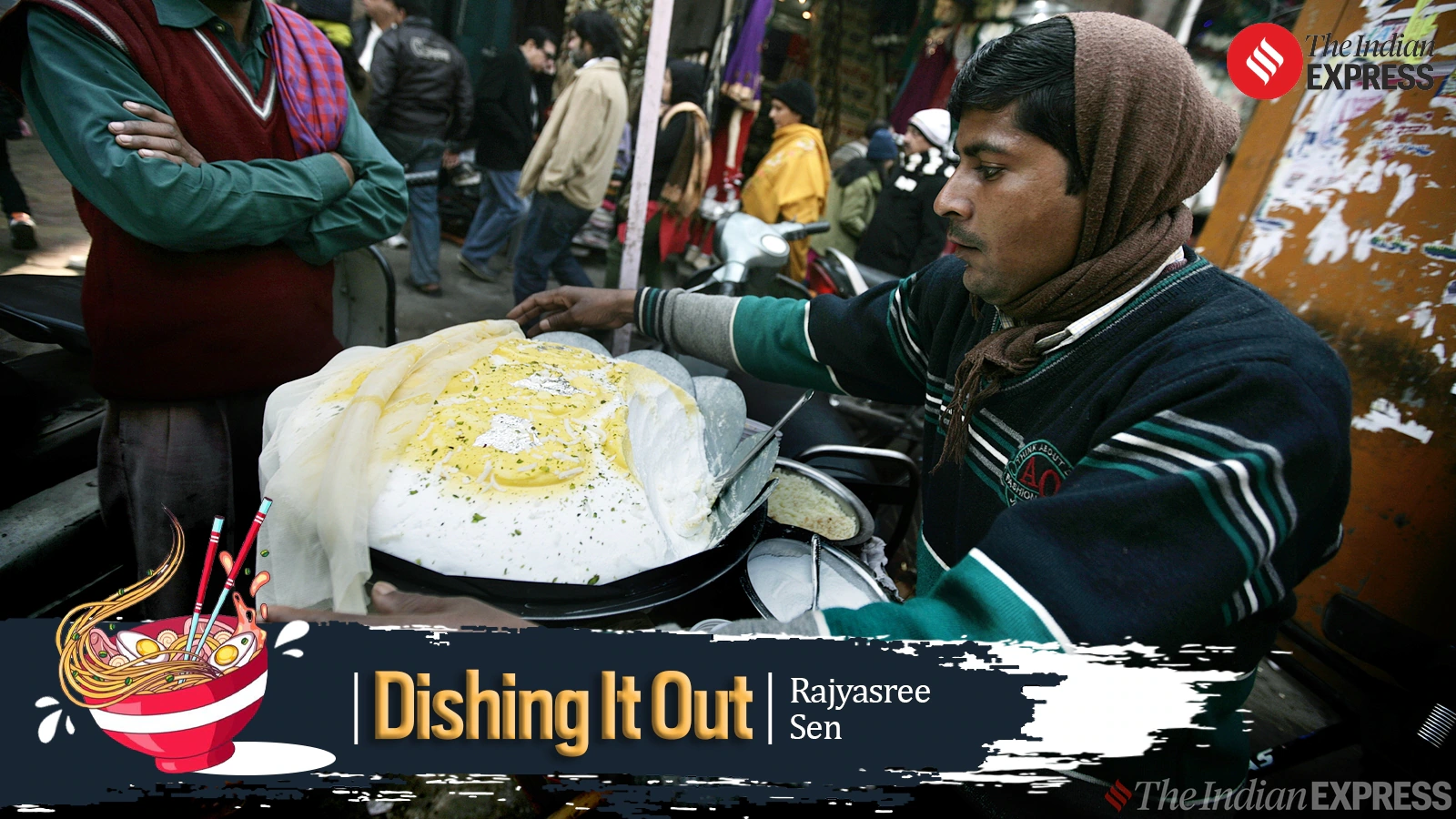
I have to say that it is quite exciting to spot the sellers — some with traditional cane or wicker stands called khomchas, others from a younger generation pushing carts fitted with ice slabs beneath — each carrying a large steel urn draped in a red cloth.
For each serving, they dip into the cool urn, spoon out a generous mound of the whipped foam onto a pattal, a plate made from dried sal leaves. The froth is then finished with a dusting of sugar and, depending on the cart or stand you have found, may be topped with condensed milk, saffron-infused milk, dried fruits, khoya, or a faint drizzle of rosewater, before being handed over. A plate costs between Rs 40 and Rs 60, while a kilogram of daulat ki chaat sells for around Rs 600. This, quite simply, is molecular gastronomy à la desi style.
Crafting a wealth of a dessert
The process, however, is laborious. According to several daulat ki chaat vendors — whose accounts of preparing the dessert are well documented — the work begins each evening around seven. This is when the first layer of cream is added to the milk, and the initial whisking begins. A thin muslin cloth is then kept over the urn, which is placed outdoors beneath the winter night sky. Makers insist this is the most crucial stage, as the overnight dew is said to work its magic on the milk.
Around four in the morning, saffron is sprinkled into the mixture, followed by vigorous hand-churning until a delicate froth rises to the surface.
Story continues below this ad
There is no definitive record of who first created daulat ki chaat, and several theories have emerged over the years. Variations of the dessert appear in other cities as well — malayo in Varanasi, malai makhan in Kanpur, and nimish in Lucknow. The origin stories attached to these sweets are as fantastical as that of daulat ki chaat itself, and their connection to verifiable history is similarly tenuous.
One credible story traces the technique of crafting milk-froth desserts to the Kyrgyz Botai tribe of Central Asia, one of the region’s most ancient communities. It is believed they may have carried this culinary practice into India while travelling along the Silk Roads, drawing on their tradition of fermenting mare’s milk to produce a drink known as kumis.
Mare’s milk was relished by the Botai for its unusually smooth texture and rich flavour, unlike that of any other dairy product. It was used to produce a fermented drink known as kumis, which men often carried with them on long expeditions. In the process of making kumis, the cream — skimmed from milk that was higher in lactose than most others — was separated out.
According to the writings of the 13th-century Flemish Franciscan monk William of Rubruck, the first European known to have visited the Mongol capital of Karakorum on the Orkhon River and to have recorded his journey, kumis was considered a prized and esteemed beverage.
Story continues below this ad
From trade routes to the Mughal court and Old Delhi streets
The technique of churning milk until it turns foamy and then collecting the cream is also found in Andhra Pradesh and Gujarat’s Surat, which were on the Mongols’ trade routes as they entered India. This connection may also shed light on the Parsi preparation of cardamom-flavoured foam and milk known as doodh na puff. Whether the technique travelled from the coast to North India through inter-kingdom trade or through warfare remains unclear.
The earliest anecdotal references to daulat ki chaat date to roughly the same period in which shahi tukda is believed to have been documented in the Mughal court, placing the dessert within a broader context of evolving royal and street food traditions.
The original shahi tukda was supposedly made by layering cream skimmed from boiling milk, then placing it on a brass tray. Once enough cream was collected, the tray was placed in a corner and chilled with blocks of ice wrapped in jute. Once set, these layers took on a soft, cheese-like consistency, and they were cut into bite-sized wedges. The earliest versions of shahi tukda were prepared in a chilled room and, much like daulat ki chaat, were sprinkled with burra (palm sugar) powder and slivers of nuts and dates.
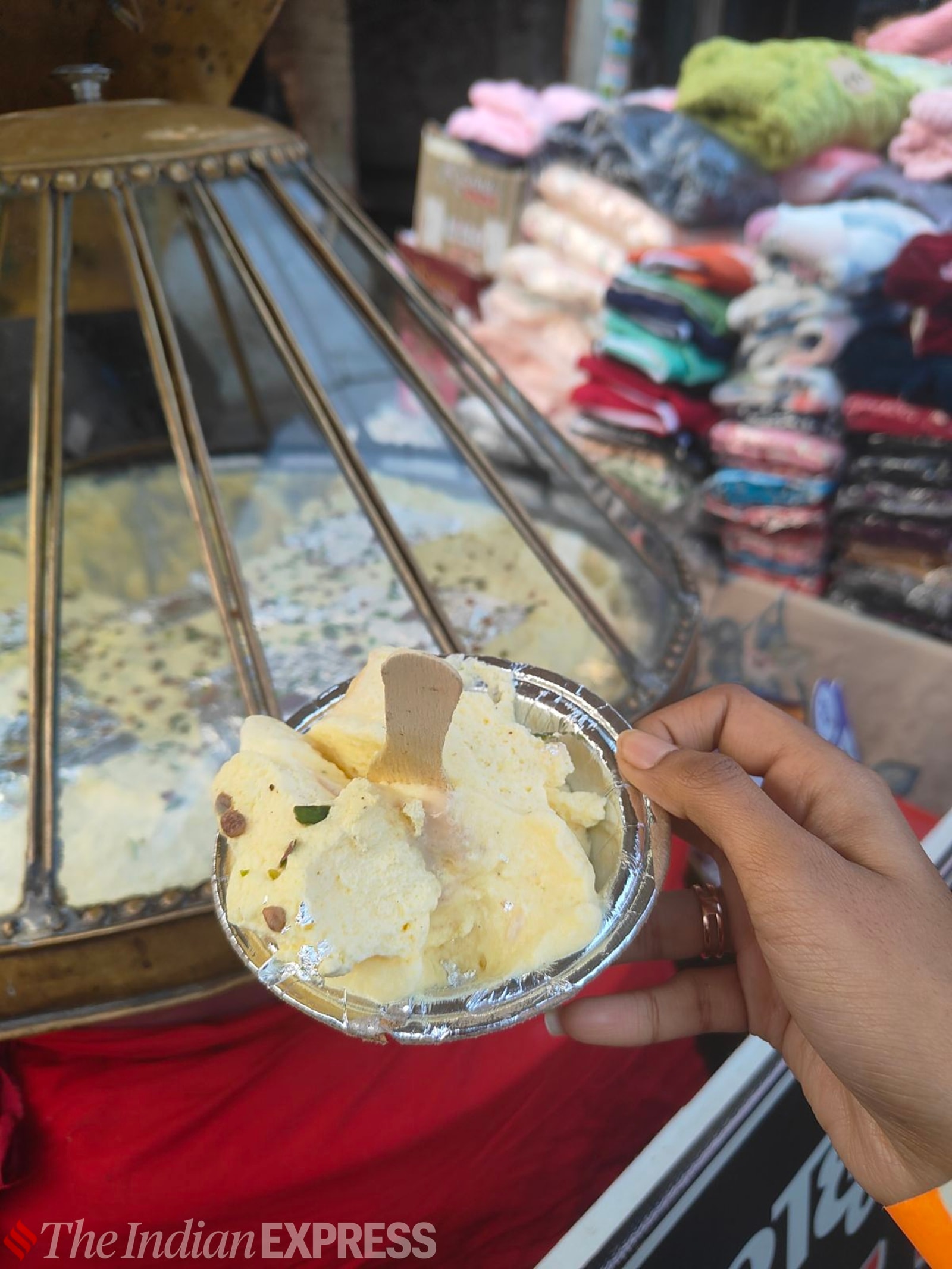 Variations of the dessert appear in other cities as well — malayo in Varanasi, malai makhan in Kanpur, and nimish in Lucknow. (Photo: Ishika Roy)
Another theory about the antecedents of daulat ki chaat credits Gujarati traders, who are said to have created it as a winter treat and introduced it to other parts of the country. Yet another version traces it to Kanpur during the construction of Shahjahanabad. The use of saffron, mawa, and dried fruits in the dessert echoes other Mughal recipes and explains the presence of makhan malai in Uttar Pradesh. A further account suggests that daulat ki chaat originated in the Awadhi kitchens of Kanpur under Sadaat Ali Khan, the Nawab of Awadh, who instructed his khansamas to whip a delicacy for the Mughal prince Murad Baksh.
Story continues below this ad
Nowadays, to meet the demand for the sweet, daulat ki chaat sellers can be spotted even in the early evenings of Old Delhi. For those unwilling to navigate the labyrinthine lanes and bustling crowds of Purani Dilli, Indian Accent at the Lodi Hotel offers a modern alternative — the only restaurant to have mastered this delicate dessert using a clever combination of nitrogen, milk, and cream. Here, you can indulge in a serving garnished with mock five-hundred-rupee notes by paying a little chunk of daulat. In the sweltering summer months, this is often the only way to satisfy a sudden craving for a little bite of heaven.
Even if the true origins of this exquisitely light dessert remain a mystery, it is worth the trek into the heart of Old Delhi just to catch sight of a daulat ki chaat vendor and his khomcha, and to savour a mouthful of this Indian soufflé — crafted under the moonlight, just as the Mongols and Mughals might have hundreds of years ago.
Next week, I will write about a wide range of vegetarian dishes —from batasha and basanti pulao to khichudi and other festive dishes traditionally prepared on Saraswati Puja.