16x PE, 20% EPS growth, Rs 1,000 crore in cash: Why is Gulf Oil still under the radar? | Smart Stocks News
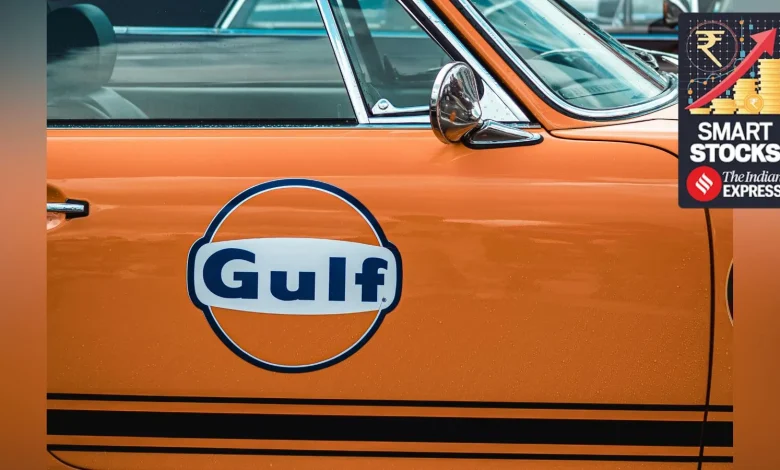
Gulf Oil Lubricants Ltd (GOLIL) delivered a record profit of Rs 362 crore in FY25, an 18% growth compared to FY24. Yet, the stock has barely moved 5% over the last year.
Behind the muted stock is the company that is quietly shifting gears. Under its ‘Unlock 2.0’ strategy, the company is expanding beyond old-school engine oils into AdBlue — an emission control oil for BS6 Diesel engines — EV chargers, and a premium synthetic relaunch fronted by brand ambassador MS Dhoni.
Yet despite this transformation and consistent operating margins, the stock trades at a modest 16x earnings, well below Castrol India’s 22x multiple.
So, the question is: for long-term investors, could this be a high-quality compounder hiding in plain sight? Or is it yet another value trap?
A cash-generating machine
Gulf Oil’s financial performance over the last 5 years tells a story of steady growth and resilience. Annual revenue has more than doubled from Rs 1,652 crore in FY21 to about Rs 3,554 crore in FY25.
 Source: http://www.screener.in
Even the Covid pandemic barely stalled its progress. FY21 sales were flat but not broken, and by FY22, the topline zoomed 33% as economic activity rebounded. By FY25, the company posted a record revenue of Rs 3,554 crore (8% YoY growth) and net profit of Rs 362 crore (18% YoY).
 Source: http://www.screener.in
This consistent growth reflects both volume increases and pricing gains despite a high-inflation environment.
Story continues below this ad
Healthy cash flow
In a market where cash-burning companies often grab investor attention, Gulf Oil lubricants is an exception.
It has minimal debt (debt-to-equity ~0.26) and over Rs 1,000 crore cash against a market cap of Rs 6,000 crore.
 Source: http://www.screener.in
Over the last decade, only Rs 454 crore has been reinvested into the business.
What’s driving growth?
 Source: GOLIL Q4FY25 Investor Presentation
With 93% of volume from the domestic market and 85% of total sales exposure to the automotive segment, the auto cycle overwhelmingly drives volume growth.
Story continues below this ad
Between FY21 and FY25, Gulf Oil Lubricants doubled its revenue from Rs 1,652 crore to Rs 3,554 crore. The lift was powered by core–lubricant shipments, which rose from roughly 1.34 lakh kilolitres (KL) in FY22 to an estimated 1.52 lakh KL in FY25, a compound clip of about 4 per cent a year, which is 2-3x faster compared to the industry.
The company has consistently increased its market share, helped by a distribution network covering over 85,000 outlets, from city service centres to rural bike stops.
However, volume alone doesn’t explain a 115 per cent revenue surge. Gulf Oil has also premiumised its mix and increased prices. Successive hikes in base-oil costs (tied to crude oil but not proportionately) — visible in FY22’s inflation spike — were passed to customers without killing demand because the company was steering customers to higher-spec passenger-car oils and long-drain diesel grades that justify a fatter rupee per litre.
The company projects revenue to grow at a 9-12% CAGR over FY23-33, even as decarbonisation trends intensify.
Story continues below this ad
 Source: GOLIL Q4FY25 Investor Presentation
Revenue growth drivers: Change in product mix and AdBlue®
AdBlue®, a urea-based fluid that helps diesel vehicles meet BS-VI norms by reducing NOx emissions, is now a significant revenue contributor.
Why does it matter for Gulf Oil?
With BS-VI emission rules kicking in from April 2020, every new diesel truck, bus, and many SUVs now require AdBlue. This created a fast-growing market — Gulf entered this space and scaled quickly, from zero to 1.4 lakh kilolitres in FY25.
With a total volume of 1.4 lakh KL at Rs 45-50/litre, AdBlue contributed an estimated Rs 600-700 crore to total revenue (Rs 3,600 crore) in FY25. However, its mid-single-digit margin is lower than the overall margin profile of the company.
Management expects AdBlue volume growth to continue at 10-15% annually from this base.
Story continues below this ad
This partially explains why, over FY21 to FY24, the overall margin profile of GOLIL has declined.
 Source: http://www.screener.in
EV-related portfolio
GOLIL is actively expanding its presence in the e-mobility ecosystem. The current investment in the EV segment stands at Rs 148 crore. However, most of these businesses are in the incubation stages, except Tirex Transmission, which hit EBITDA profitability in Q4FY25.
GOLIL’s EV-related portfolio includes:
- EV Fluids: Launched globally and in India in 2021, these are specialised fluids (transmission lubricants, coolants, greases, brake fluids) for hybrid and fully electric vehicles. GOLIL has partnerships with over 10 OEMs in this segment, though it is currently a small business in terms of volume.
- Tirex Transmission: GOLIL acquired a 51% majority stake in this DC fast charger manufacturer in October 2023 for Rs 102.51 crore. Tirex has deployed over 1,000 units and holds an 8-10% market share for DC fast chargers in India. Its revenue grew 300% to ~Rs 79 crore in FY24, and the business became EBITDA positive in Q4 FY25. GOLIL aims to reach revenue of Rs 450-500 crore in the next 3-4 years from this segment.
- Indra Renewable Technologies: An investment of ~Rs 30 crore (~7.5% stake) was made in 2021. This UK-based company specialises in slow AC home chargers and is exploring local manufacturing for the Indian market.
- Techperspect Software (ElectreeFi): GOLIL acquired a 26% stake (~Rs 15 crore) in this IoT-based e-Mobility SaaS provider in 2022. It offers solutions for EV charging, fleet management, and battery swapping, with 50K+ app downloads.
The company views these ventures as crucial for future growth, leveraging its brand strength, OEM relationships, and distribution network.
Valuations
GOLIL paid out 65% of its profits in dividends in FY25, offering a 2.95% yield.
Story continues below this ad
It has Rs 1,000+ crore cash on a market cap of about Rs 6,000 crore and is consistently gaining market share.
It trades at 16.6x price-to-earnings, and has growth EPS of 20% in the last 3 years.
 Source: http://www.screener.in
However, if we remove ‘other income’, which is primarily interest income from the large cash balance (Rs 1,000 crore+), EPS growth is 16% compared to 20% pre-adjustment.
If we further account for the fact that revenue growth has a high linkage with auto cycles, and that auto sales are showing signs of slowing down over the last few quarters, and that ICE to EV transition might render a bulk of lubricants the company’s currently sells as obsolete, a multiple of 16.6x might not be ‘cheap’, unless the company deploys its large cash pile strategically — whether through buybacks or special dividends. So far, management has offered no clarity on this front.
Story continues below this ad
Despite consistent growth over the last 3 years, robust cash balance, and an optically low PE, GOLIL is reasonably priced. Yet, without ‘triggers’ such as sustained 16-18% EPS growth, and/or substantial dividends or buyback, the stock might remain stuck in neutral.
Note: We have relied on data from http://www.Screener.in and http://www.tijorifinance.com throughout this article. Only in cases where the data was not available, have we used an alternate, but widely used and accepted source of information.
Rahul Rao has helped conduct financial literacy programmes for over 1,50,000 investors. He also worked at an AIF, focusing on small and mid-cap opportunities.
Disclosure: The writer or his dependents do not hold shares in the securities/stocks/bonds discussed in the article.
Story continues below this ad
The website managers, its employee(s), and contributors/writers/authors of articles have or may have an outstanding buy or sell position or holding in the securities, options on securities or other related investments of issuers and/or companies discussed therein. The content of the articles and the interpretation of data are solely the personal views of the contributors/ writers/authors. Investors must make their own investment decisions based on their specific objectives, resources and only after consulting such independent advisors as may be necessary.