
Battle of the conglomerates in fashion retail: Where does Trent stand? | Smart Stocks News
Trent, among the star performers of 2024, took a sharp turn in 2025, with its stock tumbling 37% since mid-October. But it’s not alone — shares of fashion retail stocks across the board have struggled. Aditya Birla Fashion and Retail (ABFR) and Shoppers Stop have plunged 27% and 44%, respectively.
Despite a strong first half in FY25, these stocks lost momentum in the second half as Diwali consumption did not pick up as expected.
The third quarter is typically a favourable season for fashion retailers, driven by festivals and weddings. However, in FY25, sales growth slowed amid weak consumer spending. Despite this, Trent’s growth rate outperformed its peers thanks to Zudio’s success in fast fashion segment.
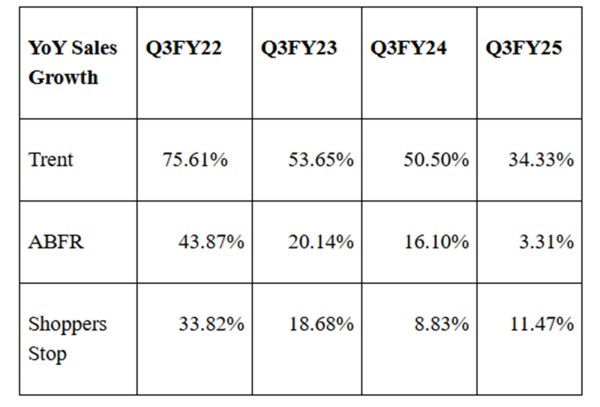 Fig. 2: Q3 Sales Growth Rate of Fashion Retailers (Source: Screener.in)
While other retailers tried their hands at youth-targeted fast fashion – ABFR’s Style-Up, Reliance Retail’s Yousta, and Shoppers Stop’s InTune – they couldn’t replicate the success of Zudio.
The economics of fast fashion
What makes fast fashion so successful? Unlike traditional fashion brands that launch 2-3 collections in a year, which results in higher inventory days, a fast fashion brand launches over 50 collections and has a quick turnaround and lower inventory days. The overall process of designing, producing, introducing in stores, and selling is efficient and agile.
Trent cracked the economies of fast fashion with an end-to-end in-house ecosystem. It uses the franchisee-owned company-operated (FOCO) model to open new stores while keeping capital spending low.
Taking a leaf from D-Mart’s book, Trent relied more on word-of-mouth publicity and avoided marketing and e-commerce for Zudio to keep costs down. In online space, there is a high return rate that increases the logistics costs, which impacts the margins. Hence, Tata relied on its brick-and-mortar (B&M) store model, bringing fast fashion, faster to the customers.
Story continues below this ad
You see it, you try it, you buy it, and wear it, instead of waiting for the delivery, trying it, returning it, or exchanging it, thereby lengthening the process. In fast fashion, the time it takes for a sale to complete plays an important role in profit margins.
The fast fashion industry even changed the economics of other retailers, and that was visible in their inventory days — the number of days in which a retailer replenishes its inventory.
 Fig 3: Inventory days of fashion retailers. (Source: Screener.in)
After Trent introduced Zudio in 2018, its inventory days gradually reduced while that of Shoppers Stop and ABFR increased. The cost of holding inventory is high. Higher sales growth and lower inventory days improve profit margins. Trent improved its operating margin from 9% in FY19 to 16% in FY24.
Fast fashion brings fast returns
Between February 2021 and October 2024, Trent’s stock surged 1,098%. However, since mid-October, the stock has tumbled 37%.
Story continues below this ad
Such declines aren’t unusual. Trent has seen a 20-30% drop earlier. There are periods of profit-booking as valuations stretch, there is seasonality, bear market, macroeconomic weakness and analysts’ price targets. Yet, the stock has always rebounded.
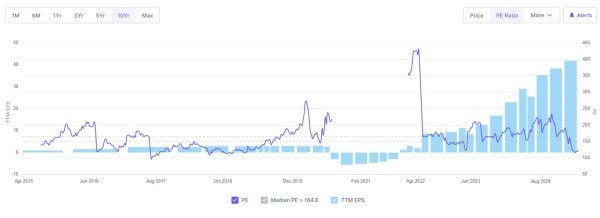 Fig 4: Trent’s 10-year PE Ratio (Source: Screener.in)
Despite concerns over Trent’s 123x price-to-earnings (PE) ratio, the lowest PE in the last decade, excluding the pandemic period, was 96.7x.
Driving the 100+ PE ratio is the high EPS growth rate. Trent’s profit grew at a compounded annual growth rate (CAGR) of 59% in the last 10 years. The highest EPS growth came in the last three years at a 101% CAGR. The 2024 calendar year EPS growth has slowed to 83%, but it is still above the 10-year average. Moreover, Trent’s 123x PE ratio is below Shoppers Stop’s 158x, even after the latter’s nine months FY25 net profit fell 71% year-over-year.
Trent is trying to replicate its fast fashion business model in other high-margin FMCG categories. It has built the beauty and personal care concept store (Misbu) and lab-grown diamonds brand (Pome).
Story continues below this ad
How big is the fast fashion opportunity?
India’s fast fashion industry is booming, fueled by Gen Z’s demand for affordable fashion. In FY24, the fast fashion industry surged 30-40% compared to a 6% rise in the broader fashion industry.
With the Union Budget 2025 expected to boost consumer spending, a retail sector revival could be on the horizon.
Currently valued at $10 billion, India’s fast fashion industry is still one-third the size of global giant ‘Shein’. However, it has the potential to grow to $50 billion by FY31, according to a report by Redseer Strategy Consultants. While Zudio is taking the lead in offline fast fashion, Myntra, Newme, Urbanic and Snitch are targeting online channels.
Can Shein slow Trent’s fast growth in fast fashion?
Shein has solidified its presence in markets like France, with its sales surpassing that of H&M, Primark, and Kiabi. In the United States, it is competing with Amazon. But can it replicate this success in India, where it re-entered in January 2025 through a partnership with Reliance Retail?
Story continues below this ad
Unlike other countries, India’s fashion trends vary across regions. Shein’s re-entry in India is based on the condition that it manufactures locally. Moreover, it has to compete with already established home-grown brands.
Shein’s strategy is to tap the online channel and attract shoppers with free shipping and a no-questions-asked return policy. However, Goldman Sachs noted that unit economics of online-only affordable fashion retail are weak.
- Any price above Rs 1,000 could slow the sale
- Gross margins are 30-40%
- The delivery cost is Rs 120-130 per order
- The return rate is 30-40% in fashion
What analysts have to say
Trent’s stock price has dipped to Rs 5,138 and is trading at a PE ratio of 123x. Despite this valuation, brokerages remain positive about growth, store expansion, and consistent consumer demand. However, they have reduced their price target as they expect normalisation in growth rates.
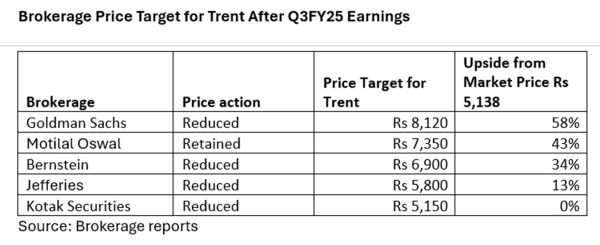 Fig 5: Brokerage Price Target for Trent After Q3FY25 Earnings. (Source: Brokerage reports)
Motilal Oswal has retained its target price for Trent as the company delivered 36% Q3FY25 revenue growth, added 58 net Zudio stores, and reported high-single-digit like-for-like sales growth despite weak discretionary demand.
Story continues below this ad
Kotak became bearish on Trent and reduced its revenue and EPS growth expectation for Westside stores for FY26 and FY27 as the retailer moved towards larger format stores. The brokerage stated that larger-sized stores take longer to mature and report lower throughputs than smaller stores.
While analyst opinions vary, the overall outlook remains optimistic.
Where does Trent stand?
In fashion retail, there are brands, there are channels, and there are conglomerates that make their brands and channels. The channel loses its bargaining power when it depends too much on other brands and the same happens with brands when they depend a lot on other channels.
Trent’s model has removed this dependence, thereby reducing supply chain risk. An end-to-end control of the entire supply system right from designing to procurement to distribution gives Trent an advantage over other fashion retailers in faster and more efficient execution of trends.
Its unique position as both brand and channel in fashion retail and its ability to capture changing trends makes Trent a potential long-term investment opportunity.
Story continues below this ad
Whether this opportunity shows up in the share price over time, only time will tell.
Note: We have relied on data from http://www.Screener.in throughout this article. Only in cases where the data was not available, have we used an alternate, but widely used and accepted source of information.
Puja Tayal is a financial writer with over 17 years of experience in the field of fundamental research.
Disclosure: The writer and her dependents do hold the stocks discussed in this article.
Story continues below this ad
The website managers, its employee(s), and contributors/writers/authors of articles have or may have an outstanding buy or sell position or holding in the securities, options on securities, or other related investments of issuers and/or companies discussed therein. The content of the articles and the interpretation of data are solely the personal views of the contributors/ writers/authors. Investors must make their own investment decisions based on their specific objectives, and resources and only after consulting such independent advisors as may be necessary.