Contracts, capex, and chemistry: Is Aether Industries building an Asian Paints of specialty chemicals? | Smart Stocks News
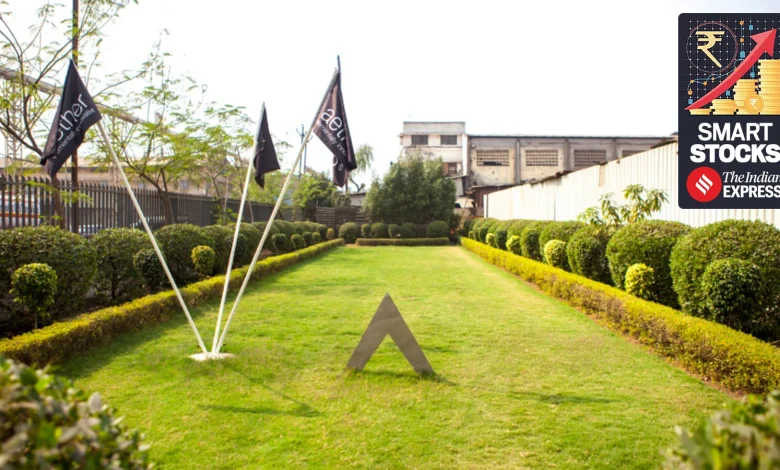
It’s young, R&D-driven, and already counts global giants like Baker Hughes and Saudi Aramco as its clients. The company is growing fast, expanding capacity, and shifting focus toward high-value contract manufacturing, a space investors tend to favour.
But here’s the catch: since its IPO in 2022, the stock has been flat. It had a brief 45% rally post-listing, but has since given up those gains. Over the last three years, it’s essentially delivered no returns, even as the broader market moved up and peers like SRF or PI kept compounding.
So the big question is: does Aether finally have the pieces in place to break out? Or is it another story where the promise is strong, but the execution needs to catch up?
Let’s dive in.
 Figure 1: Stock price movement of Aether Industries Ltd. Source: Screener
Market, model, and the moat: Where Aether fits in
India’s specialty chemicals industry has been one of the quiet compounding stories of the last decade. With China-plus-one tailwinds, a rising export share, and increasing focus on complex chemistries, Indian players like PI Industries, Navin Fluorine, and SRF have created enormous wealth. Aether wants to be part of that club, and it’s playing a differentiated game to get there.
The business model: Three engines of growth
Aether Industries operates through three distinct verticals:
1. Large-Scale Manufacturing (LSM) – its high-margin products manufactured at scale.
2. Contract Manufacturing (CM) – long-term, exclusive agreements with global companies like Baker Hughes.
Story continues below this ad
3. CRAMS – custom research and manufacturing services, where Aether helps clients take molecules from lab to plant.
This structure gives it both a foundation of predictable own-product revenue and optionality from custom or contract-led growth. Notably, the company is actively shifting its mix away from its own products toward higher-value exclusive manufacturing, which contributed 38% of revenues in Q4FY24.
 Figure 2: Business Vertical Split of Aether Industries Ltd. Source: Quarterly Report Dec’24
The moat: Deep chemistry, not just capacity
Unlike peers who often scale on volumes or single chemistry platforms, Aether’s moat lies in its deep chemistry capabilities and R&D intensity. The company works on complex chemistries like Grignard, organolithium, and cross-coupling reactions, processes that aren’t easy to replicate at scale. That gives it an edge in attracting high-tech clients who need reliability and IP protection, not just capacity.
Aether also spends 7-9% of its revenues on R&D, among the highest in the industry, and runs a proprietary ‘8×8 matrix’ to filter new molecules it wants to develop. This keeps its innovation pipeline sharp while reducing the risk of chasing low-margin products.
Story continues below this ad
Scale and complexity, not just volume
What makes Aether different is its focus on low-volume, high-complexity molecules. While some competitors chase scale through commoditised intermediaries, Aether prefers molecules that are difficult to make, harder to qualify, and stickier once approved. This is reflected in its customer list, which includes Saudi Aramco (Converge polyols), Baker Hughes (pour point depressants), and a range of Japanese and European firms in the pharma and materials space.
In FY24, over 50% of revenue came from exports, and the company isn’t just shipping to emerging markets; it’s supplying critical molecules to innovation-driven sectors like oilfield services and sustainable polymers.
Financial snapshot: A growth story paused?
Aether’s revenue grew from Rs 1,092 million in FY18 to Rs 6,511 million in FY23, a six-year CAGR of over 35%. EBITDA margins hovered between 25% and 29%, aided by differentiated products and internal backward integration. However, FY24 was a pause:
Revenue fell 3% to Rs 6,374 million,
EBITDA dropped to 25%, and
PAT slipped to 12% to Rs 824 million.
The dip was largely due to a fire-related shutdown at its Site-2 plant and overall sluggishness in its LSM business. That said, the company bounced back sharply in FY25 YTD, with Q3 FY25 revenue growing 25% YoY, and margins improving to 29.8%, driven by better mix and operating leverage.
Story continues below this ad
 Figure 3: Business of Aether Industries Ltd. Source: Quarterly Report Dec’24
Capital-heavy, but with purpose
As of FY24, Aether had already invested over Rs 1,000 crore into capex. Sites 3+, 3++, and 5 (Panoli) are all under expansion, with Site-4 commissioned for the Baker Hughes contract. While this puts pressure on return ratios (RoE just 5% in FY24), the hope is that as contract manufacturing scales up, asset turns and ROIC will improve materially.
So far, the ingredients are niche products, credible global clients, capacity to scale, and a strong innovation culture.
What remains to be seen is whether this structure translates into sustained financial performance.
 Figure 4: Business of Aether Industries Ltd as per Q3FY25. Source: Quarterly Report Dec’24
Growth levers: From contracts to carbon capture
The Baker Hughes breakthrough
In late 2023, Aether Industries signed a strategic, exclusive supply agreement with Baker Hughes, one of the world’s leading oilfield service providers. Under this deal, Aether will manufacture six specialty pour-point depressants — chemicals essential in transporting crude oil more efficiently.
Story continues below this ad
These are high-spec, high-margin products, and not something many Indian players have traditionally supplied at scale. To support this contract, Aether has already commissioned Site-4, with commercial production expected to begin by the end of FY25.
At full ramp-up, the deal is expected to contribute over Rs 3,000 million annually, significant for a company that reported over Rs 6,000 million in revenue last year.
More than just numbers, this partnership signals Aether’s arrival as a serious player in global contract manufacturing.
Betting on green chemistry
While the Baker Hughes contract provides near-term growth, Aether is also placing a longer-term bet on sustainable materials. Through a licensing partnership with Saudi Aramco’s Converge business, Aether has secured exclusive rights to manufacture CO₂-based polyols in India.
Story continues below this ad
These materials, used in coatings, adhesives, and elastomers, are partially derived from captured carbon dioxide, making them part of a growing push toward carbon-neutral chemistry. The company has built a 2,000 TPA production line for these polyols and is in early-stage discussions with global buyers. This segment may not drive immediate revenue, but it positions Aether well in a future where green chemistry could become the norm, not the niche.
Export-led diversification
Aether’s growth isn’t limited to marquee contracts. The company is also steadily expanding its global footprint. Over 50% of FY24 revenues came from exports, spanning Japan, Europe, the US, and the Middle East. These exports aren’t commoditised APIs or bulk intermediates, but niche, high-spec molecules used in pharmaceuticals, materials science, and oilfield services.
In just the first nine months of FY25, Aether added 31 new customers, many of them global names. This export momentum adds a layer of resilience to the business, reducing dependence on any single sector or geography.
Backing growth with capacity
To meet rising demand, Aether is deep into a capex cycle. The company has recommissioned Site-2, which was temporarily shut due to a fire, and is on track to launch extensions at Site-3 (3+ and 3++) by the end of FY25. A new greenfield plant — Site-5 at Panoli — is also expected to be operational by December 2025.
Story continues below this ad
These expansions are not just about volume, but about building modular, high-spec facilities that can cater to complex chemistry needs. Over time, they will form the backbone of Aether’s CRAMS and contract manufacturing push.
Valuation: Pricing in perfection?
Since its IPO in 2022, it rallied around 40% at one point, only to give up most of those gains. Over the last three years, the stock has largely moved sideways, even as the company kept expanding its capacity and client base.
Today, the stock trades at nearly 65 times forward earnings, a valuation that reflects high expectations. That multiple places it well above several established players in the specialty chemicals space.
The market, in effect, is betting that Aether’s next phase, driven by the Baker Hughes contract, export growth, and premium products like Converge polyols, will translate into steep revenue and profit growth over the next few years.
Story continues below this ad
If Aether executes to plan, with revenue compounding at 25-30% and margins holding or improving, the current valuation may be justified in hindsight, especially if return ratios improve as operating leverage kicks in and high-margin contracts ramp up. In that case, investors could see earnings catch up with the stock price, and possibly more.
But that’s a scenario built on smooth execution. Any delays in capacity utilisation, hiccups in contract scale-up, or margin pressures could result in the valuation looking stretched. What’s clear is that this is a stock priced for growth, not for safety.
The risk-reward trade-off
Aether’s biggest strength is its ambition, which can also be its key risk.
The company is executing multiple large-scale projects simultaneously, and while that sets it up for growth, it also creates room for delays, cost overruns, or slower-than-expected ramp-ups. Contracts like the one with Baker Hughes, while exclusive, are volume-based and don’t guarantee offtake, which means execution and demand will both have to line up.
Then there’s the issue of operating leverage. Aether’s margins have historically been healthy, but with capacity expansions and a shifting product mix, they’ll have to fight to maintain those levels, especially as competition increases and client expectations tighten.
Investors should also keep an eye on working capital cycles. Specialty chemicals is a cash-intensive business, and with an expanding client base, receivables can stretch. Any mismatch in execution could lead to pressure on cash flows, especially when capex commitments remain high.
In short, this is not a business priced for stability, it’s priced for growth. And while the building blocks are impressive — deep R&D, global clients, and a differentiated product mix — investors will need to watch execution closely over the next 12-18 months.
Final take: A high-conviction bet, not a no-brainer
Aether Industries has all the ingredients of a potential long-term winner: a differentiated business model, global contracts, high R&D intensity, and a leadership team that’s thinking 5-10 years ahead. In many ways, it represents what the new wave of Indian manufacturing can look like: niche, knowledge-driven, and globally relevant.
But at the same time, the stock market isn’t waiting for all the proof. At 65x forward earnings, it’s already giving Aether the benefit of the doubt. That makes it less of a value pick and more of a high-conviction, high-expectation story.
If the execution plays out, especially on the Baker Hughes ramp-up, Converge polyol scale-up, and consistent export growth, the upside could be meaningful. But if things fall short or take longer than expected, the valuation leaves little room for disappointment.
For investors, this may not be a stock to back blindly, but it’s definitely one to watch closely. And for those with a long-term horizon and the patience to ride out short-term volatility, Aether could still turn into a quiet compounder, just not on autopilot.
Errata: In the article, there are six instances where the currency unit was incorrectly stated as ‘crores’ instead of ‘millions’. We regret the oversight and apologize for any confusion caused. The corrected unit should be read as ‘million’ in all such references.
Note: We have relied on data from the annual report and industry reports for this article. For forecasting, we have used our assumptions.
Parth Parikh currently heads the growth and content vertical at Finsire. He holds an FRM Charter along with an MBA in Finance from Narsee Monjee Institute of Management Studies. Previously, he has held research positions at various companies.
Disclosure: The writer and his dependents do not hold the stocks discussed in this article.
The website managers, their employees(s), and contributors/writers/authors of articles have or may have an outstanding buy or sell position or holding in the securities, options on securities or other related investments of issuers and/or companies discussed therein. The content of the articles and the interpretation of data are solely the personal views of the contributors/ writers/authors. Investors must make their own investment decisions based on their specific objectives, resources and only after consulting such independent advisors as may be necessary.