India’s PLI scheme for electronics components: Is it a new growth chapter for EMS stocks? | Smart Stocks News
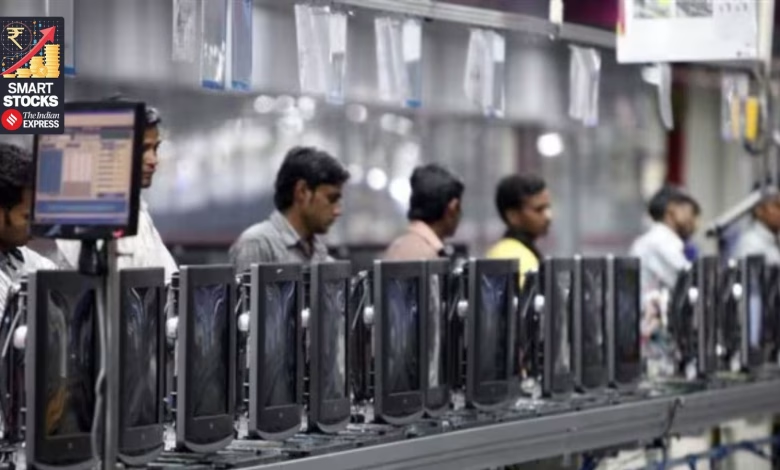
India’s electronics manufacturing sector (EMS) is entering the next phase of growth. Following the success of the 2020 Product Linked Incentive (PLI) scheme for electronics, the government is focusing on developing the electronics supply chain.
On March 28, the Union Cabinet approved a Rs 23,000 crore PLI scheme for electronics components manufacturing.
Several EMS players that experienced exponential growth over the past five years are now looking at backward integration strategies to sustain their high valuations. Among them are Dixon Technologies and Kaynes Technology India.
However, the two stocks fell 28% and 47%, respectively, in the first three months of 2025 as a temporary slowdown in revenue and earnings made investors cautious. These stocks were trading at over 200x price-to-earnings (P/E) ratio as of January 3, 2025. Such stretched valuations prompted several analysts to downgrade their ratings despite the firms’ strong revenue and earnings growth.
 Dixon Technologies and Kaynes Technology Share Price Momentum in 2025 (Source: Trading View)
Several developments unfolded during the fourth quarter of FY25. Investors and industry were anticipating the launch of a new PLI scheme or high-budget outlays for electronics components and semiconductors. However, uncertainty over the rollout of the new PLI scheme, combined with the existing electronics PLI nearing the end and no signs of any extension, led to investor unease. Meanwhile, Dixon and Kaynes started investing in manufacturing capacities to build electronics components.
All these factors pulled down EMS stocks. The situation improved after the March 28 approval of the new Electronics Components Manufacturing Scheme (ECMS). However, market sentiment remained cautious due to concerns around potential retaliatory tariffs from the US under President Donald Trump. Hence, when retaliatory tariffs were paused for 90 days on April 8, the share price of Dixon and Kaynes jumped 32% in two weeks.
Will the new PLI scheme open a new growth chapter for EMS stocks?
The new ECM PLI scheme
The 2020 PLI for large-scale electronics manufacturing made India the second-largest mobile phone manufacturer in the world in FY 2025. According to a PIB press release on March 26, the scheme attracted a cumulative investment of Rs 10,905 crore, a cumulative production of Rs 7.16 lakh crore, and cumulative exports of Rs 3.9 lakh crore as of February 2025.
Story continues below this ad
Apple’s contract manufacturers (Foxconn, Tata Electronics, and Pegatron), Samsung, and Dixon were the biggest beneficiaries as they opened facilities and produced Made in India mobile phones. The 5-year PLI scheme helped them set up manufacturing capabilities. While the scheme will end next year, PLI incentives account for a small portion of the profits.

Despite domestic electronics production jumping from Rs 5.54 lakh crore to Rs 9.52 lakh crore in FY21-FY25, India does not make phones from scratch. Most components are imported from the US and other countries, assembled in India’s over 300 manufacturing units, and used domestically and for exports.
Hence, the materials cost of Dixon and Kaynes accounted for 89% and 70% of their revenue in FY25. However, these companies grew exponentially on the back of strong volumes. With the sector maturing, they ought to look for the next growth driver, and a promising alternative is electronics components, which they import.
The Electronics Industries Association of India (ELCINA) highlighted that non-semiconductor electronics components constitute 60% of the total cost of finished products. The new ECMS PLI scheme will give EMS companies the boost they need to build electronics components in India and reduce their reliance on imports. The new scheme will give incentives based on turnover, investments in factories, and job creation.
Story continues below this ad
Like the 2020 PLI, the 2025 ECMS PLI will be open to both domestic and international stakeholders and is expected to attract Rs 59,350 crore in investment, generate Rs 4.56 lakh crore in production, and create 91,600 direct jobs.
While it is too early to gauge the value the ECMS PLI will bring to India’s electronics manufacturing sector, we can keep a watch on the possible beneficiaries.
The two likely beneficiaries of the new PLI scheme
Apple’s contractors, Samsung, and Dixon got a boost from the 2020 PLI, and now they are self-sufficient to make smartphones profitably and stay competitive. Apple is at the forefront of building a supply chain in India. Its manufacturing contractor, Foxconn, has announced plans to invest $1.5 billion in a display module plant in India.
Meanwhile, Dixon is building a display module plant for mobile phones, laptops, and TVs it manufactures, and later expand to cater to external market requirements. It is also looking to apply for the new PLI scheme to manufacture camera modules, mechanical enclosures, and lithium-ion batteries, and use them in the electronics it makes for end clients.
Story continues below this ad
Is ECMS the new growth chapter for Dixon Technologies?
Dixon Technologies has been rapidly growing in the smartphone space, with its mobile and other EMS divisions’ revenue up 203% to Rs 33,043 crore in FY25. It now accounts for 85% of the company’s revenue.

Dixon manufactures smartphones for Motorola, Xiaomi, Oppo, Realme, Vivo, Transsion, and Nothing. According to the company’s CEO and Managing Director, Atul Lall, Dixon plans to double smartphone production from 28.3 million in FY25 to 40-44 million in FY26 and 60-65 million by FY27, and export a significant portion to North America. To achieve this target, the company is constructing a one-million-square-foot facility in Noida.
With the 2020 PLI scheme coming to an end, Dixon will lose production incentives and could see a temporary slowdown in margins. It is likely to make up for it by taking a higher share of customers’ wallets, new customer additions, and margin expansion through operational efficiencies and backward integration.
Dixon has ventured into laptop manufacturing for HP, ASUS, and Lenovo. However, the volumes are yet to pick up, and investors have already priced in high growth. The stock trades at a 116x P/E ratio, which is supported by its high return on equity (ROE) of 33% and a 110% growth in profit.
Story continues below this ad
Can Dixon stock continue to grow at the same pace?
While laptops are a good business, their volumes may not be as high as smartphones. However, electronics components and display modules could help Dixon reduce material costs and supply chain risk. A push to higher margins could bring more upside, but share price growth would be moderate because of stretched valuations.
Analyst Rating and Price Target on Dixon Technologies after Q4 FY25 Earnings
|
Dixon Technologies |
Revised Price Target (Rs) |
Previous Price Target (Rs) |
Upside Potential from Market Price Rs 14,849 |
Ratings |
|
Nomura |
21,202 |
22,005 |
42.8% |
Buy |
|
Motilal Oswal |
20,500 |
38.1% |
Buy |
|
|
CLSA |
19,000 |
28.0% |
Buy |
|
|
Anand Rathi |
18,775 |
26.4% |
Buy |
|
|
BNP Paribas |
17,910 |
20.6% |
Buy |
|
|
Yes Securities |
15,741 |
16,566 |
6.0% |
Reduce |
|
JM Financial |
15,650 |
16,500 |
5.4% |
Hold |
Source: Brokerage Reports
Motilal Oswal expects Dixon Technologies stock to surge to Rs 20,500, a 38% upside from the current market price of Rs 14,849, as it expects the 2025 ECMS PLI to improve its margins. BNP Paribas expects Dixon to succeed with the IT Hardware PLI, capturing 10% laptop market share over the next 3-4 years.
JM Financial is bearish on the stock due to delays in production with Vivo and display sub-assemblies with China’s HKC, and increasing competition after the end of the electronics PLI.
Story continues below this ad
What does the new ECMS PLI mean for Kaynes Technology?
While Dixon operates in a low-margin, high-volume consumer electronics business, Kaynes operates in a high-margin, low-volume industrial electronics business.
Kaynes is already an electronics component manufacturer that helps design and manufacture high-density printed circuit boards (HD-PCB) for smart metres, railways, automotive, industrial, aerospace, defence, medical, and the internet of things. The company launched its IPO in November 2022 to repay debt and build manufacturing facilities, and has surged 912% till December 2024.
The share price rally was driven by consistent revenue and earnings growth. Its FY25 revenue surged 57% to Rs 2,722 crore, and earnings before interest, taxes, depreciation, and amortisation (EBITDA) surged 61.5% to Rs 410.7 crore.

Kaynes expects to maintain its 60% revenue growth and expand margin by 0.5% in FY26 as it works on its Rs 6,500 crore order book, which has a higher EBITDA. Some noteworthy orders include the Kavach system for Indian Railways and satellites and defence orders for ISRO.
Story continues below this ad
Like Dixon, Kaynes is also expanding through backward integration, but in the Outsourced Semiconductor Assembly and Test (OSAT) and PCB.
Kaynes’ stretched PE ratio of 131x has reduced its short-term upside. However, CLSA believes timely completion of the OSAT/PCB facilities could act as a catalyst and drive the stock price upwards.
Analyst Price Target on Kaynes Technology India After Q4 FY25 Earnings
|
Kaynes Technology India |
Revised Price Target (Rs) |
Previous Price Target (Rs) |
Upside Potential from Market Price Rs 6,038.5 |
Ratings |
|
CLSA |
6230 |
5400 |
3.2% |
Hold |
|
Morgan Stanley |
6,155 |
6,633 |
1.9% |
Equal-Weight |
Source: Brokerage Reports
The beginning of a new EMS growth chapter
The last five years were all about volumes and smartphones. Many small-cap companies saw a surge in demand and order books due to PLI. Apple and Samsung were the main beneficiaries.
Story continues below this ad
The ECMS PLI scheme comes at a time when India is negotiating trade tariffs with the US. The next five years would see a more integrated supply chain. The two companies will begin initial production from backward integration in FY26. Weak global macro environment and tariff war could slow down growth.
Nevertheless, it would be interesting to see how the vertical expansion in the supply chain improves profit margins.
Note: We have relied on data from www.Screener.in throughout this article. Only in cases where the data was not available, have we used an alternate, but widely used and accepted source of information.
Puja Tayal is a financial writer with over 17 years of experience in the field of fundamental research.
Disclosure: The writer and his dependents do not hold the stocks discussed in this article.
The website managers, its employee(s), and contributors/writers/authors of articles have or may have an outstanding buy or sell position or holding in the securities, options on securities or other related investments of issuers and/or companies discussed therein. The content of the articles and the interpretation of data are solely the personal views of the contributors/ writers/authors. Investors must make their own investment decisions based on their specific objectives, resources and only after consulting such independent advisors as may be necessary.