
Knowing when to sell a stock: Key signals investors shouldn’t ignore (Part 1) | Smart Stocks News
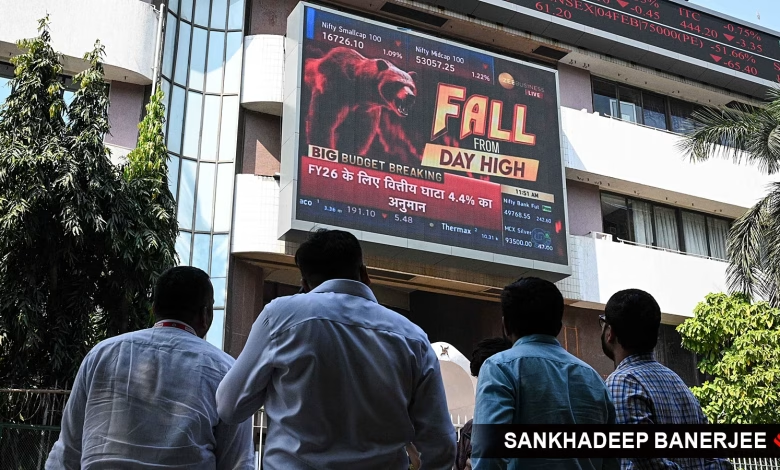
Among investment decisions, knowing when to sell a stock is often the most challenging. Buying feels exciting. You do the research, find a promising company, maybe even get in early. But when it comes to selling, investors can fall into traps of either holding too long or panicking and exiting too soon.
The challenge is visible across both sides.
Investors who held on to Yes Bank from Rs 300 down to Rs 30, hoping it would bounce back. Others who sold Infosys in 2020 after a modest 25% gain, only to watch it double in 18 months.
And then there’s Arrow Greentech, a stock that was around Rs 400 in 2015. It even touched Rs 600 briefly. But then came the crash. No earnings visibility, corporate opacity, and eventually, the stock slipped to Rs 50.
From multibagger hopes to massive wealth erosion, all because no one knew when to sell.
It’s confusing, right?
Should you sell when the stock doubles, when valuations go crazy, when the business model weakens, or just when something feels off?
There’s no one-size-fits-all rule. But there are clear signals that experienced investors look for and act on.
Whether it’s governance red flags, irrational valuations, or fundamental cracks, knowing when to exit is as important as knowing what to buy.
Story continues below this ad
Because here’s the truth: If you never sell, you never book profits. And if you hold through every decline, even the best companies can destroy your capital.
We break down the 5 scenarios when it’s okay, even smart, to sell, using real Indian examples and logic-backed frameworks.
1. The valuation trap: When great companies become expensive bets
Let’s say you bought a fundamentally strong stock. The business is growing, the story is intact, and you’re already sitting on 2x or 3x returns. What do you do?
Most retail investors hold. After all, it’s a good company.
Story continues below this ad
But here’s the reality: even great companies can become terrible investments at the wrong price.
Take Infosys in 2000. It was the poster child of India’s IT boom with world-class leadership, rapid revenue growth, and a massive export tailwind.
Yet, at the peak of the dot-com bubble, Infosys traded at a P/E of over 100x. That means investors were paying Rs 100 for every Rs 1 of profit, pricing in years of future growth upfront.
Over the next few years, Infosys’s profits continued to rise. But the stock? It went nowhere for nearly five to six years. Why? Because even though the business did well, the market had already overpriced the future. The stock needed time to “cool off” before earnings caught up.
Now compare that to more recent examples.
Story continues below this ad
In 2021, IRCTC shot up over 300% in a year, trading at 120x earnings. Everyone wanted a piece of the monopoly. Then came a swift 40% correction after the government announced a revenue-sharing plan. Fundamentals were still strong, but the stock had gotten ahead of itself.
Or think about Dixon Technologies, a well-run electronics manufacturer that traded at 150x earnings in early 2021. Great business, but once growth expectations normalised, the stock corrected by 35-40%.
Valuation is like gravity. It might not matter in the short term, but it always catches up eventually.
So, how do you know when to sell based on valuation?
Here are a few real-world cues:
Story continues below this ad
- The P/E ratio is 50-100% above the stock’s historical average. (If a company usually trades at 25x and is now at 50x, that’s a flag.)
- The price has surged much faster than earnings growth. If EPS grows 15% but the stock is up 80%, check if sentiment is overdoing it.
- Everyone is talking about it
- You can’t find a logical reason for the price surge. No new product, no big deal, just price action feeding itself.
This doesn’t mean you sell the moment a stock becomes expensive. But it does mean you re-evaluate your holding. Sometimes, it makes sense to book partial profits, recover your capital, and let the rest ride. Other times, it’s better to exit completely and rotate into undervalued opportunities.
2. When the story slows: Recognising growth fatigue before the market does
You bought a stock because the company was growing fast. Revenue was climbing, profits were expanding, and every earnings call sounded like a victory lap.
But a few quarters later, the numbers start to look ordinary.
Now what?
Story continues below this ad
For many retail investors, the instinct is to wait it out. After all, great businesses can have bad quarters, right?
That’s true, but when a slowdown extends over multiple quarters, it often signals that the business has entered a mature phase. If the market was pricing it as a high-growth stock, the result would be almost always a P/E de-rating and a falling stock price.
Case in point: HUL between 2012 and 2016
Despite being a high-quality FMCG brand, its revenue growth during those years was stuck around 4-6% CAGR, while valuations remained rich. The stock largely underperformed the broader market during that time, not because the company was bad, but because expectations were too high and growth didn’t match.
Another example is Eicher Motors.
From 2014 to 2017, the company was growing at 25-30% CAGR. Investors priced it like a hyper-growth tech stock and the P/E touched over 50x.
Story continues below this ad
But by 2018-19, volume growth stalled, competition increased, and growth slowed to single digits.
Result? The stock fell from approximately Rs 3,200 in 2017 to around Rs 1,200 by 2020. That’s a ~40% drop, despite the brand and balance sheet still being solid. (Stock prices adjusted for split)
So what should you watch for?
Here’s a practical checklist:
- Revenue growth dips below the historical average for 2-3 consecutive quarters. If a company used to grow at 20% and is now at 8–10% without explanation, dig deeper.
- Margins start compressing due to rising input costs or competitive pricing. This often indicates that the company’s moat is weakening.
- Capex slowdown or fewer product launches. Indicates the company may be struggling to find new growth avenues.
- Same-store sales/volume growth stagnation in retail, auto, or FMCG sectors.
- Earnings revisions by analysts are turning consistently negative. Watch for downgrades or cuts in forward guidance; the smart money often moves early.
Here’s a practical scenario:
Suppose you’re holding a midcap company that reported Rs 500 crore in revenue in FY21, Rs 600 crore in FY22, and Rs 650 crore in FY23. That’s a slowdown from 20% growth to just 8%. Meanwhile, costs are going up, and the P/E is still high at 35x.
Story continues below this ad
At this point, the stock might be priced for perfection, but the business is showing fatigue. This is the ideal time to consider reducing exposure.
Markets don’t wait for full-year results. They react to forward guidance. If a management team suddenly stops offering future outlook or sounds vague on upcoming plans, that’s usually a yellow flag.
The core lesson
Growth stocks are priced for momentum. Once that momentum fades, the stock tends to fall faster than you expect.
Selling when you sense the slowdown before everyone else does can save you a lot of pain and protect your returns.
- Red flags: When to run, not just reconsider
Sometimes, the problem isn’t valuation or slowing growth. It’s something deeper, a crack in the company’s foundation.
While investors often forgive a bad quarter, the market is far less forgiving when trust breaks down. Because once a company’s governance is in question, all bets are off.
Let’s break this down with two familiar stories.
Yes Bank: From market darling to cautionary tale
In 2017, Yes Bank was the poster child of private sector growth. With fast loan book expansion and flashy earnings, everything looked good on paper.
Until it didn’t.
By late 2018, the first red flag appeared: the RBI denied Rana Kapoor’s term extension. Shortly after, reports emerged of evergreening of loans, dodgy corporate exposure, and poor risk practices.
What followed was a slow-motion collapse:
- Between September 2018 and March 2020, the stock fell from Rs 380 to Rs 16, resulting in a 95% wealth erosion.
- Depositors panicked, withdrawals were capped, and the RBI had to orchestrate a bailout.
The signs were there:
- Auditors raised flags.
- Key board members resigned.
- The loan book looked increasingly risky, but the bank maintained a clean headline NPA number… until it couldn’t.
Investors who exited early, when the cracks first appeared, were criticised for being “too conservative.” But in hindsight, they preserved capital while others got wiped out.
Arrow Greentech: The forgotten multibagger that wasn’t
Here’s a lesser-known example that still stings for many retail investors.
Around 2015, Arrow Greentech was being touted as a futuristic green-tech play. The stock shot up to Rs 600. Many retail investors entered between Rs 350 and Rs 450.
But the problem wasn’t the product, it was the lack of business execution and opaque disclosures.
- Revenue never scaled meaningfully beyond Rs 100 crore.
- Profit growth stalled, R&D spending dropped, and key clients never materialised.
- Promoter holding was constantly pledged, and investor communication turned vague.
By 2023, the stock had crashed to around Rs 50-60, and investor interest had completely dried up.
It wasn’t a blow-up like Yes Bank, but the result was the same: capital erosion due to inaction.
So, how do you spot these red flags early?
Here’s a simple checklist:
Frequent changes in auditors or resignations of independent directors. These are rarely “routine” events. They often precede deeper issues.
Promoter share pledging or continuous stake dilution. A high percentage of pledged shares means promoters are using their holdings as collateral, risky if markets turn.
Unexplained changes in accounting policies or delays in filings. Transparency is non-negotiable. If numbers start looking “managed,” treat it seriously.
Aggressive growth in receivables or ‘other income’ swelling disproportionately. Sometimes, companies use financial engineering to inflate profitability.
Too much reliance on jargon, too little real execution. A company that talks endlessly about technology but shows no operating cash flow is a red flag, not a moonshot.
Bottom line
In investing, it’s better to be early and wrong than late and broke.
Most governance blowups don’t happen overnight, as they start with small cracks. And if you’re paying attention, you’ll almost always see them before the collapse.
Conclusion: A pause, Not the End
So far, we’ve covered three powerful cues that tell you when it might be time to sell:
- When the stock runs ahead of its fundamentals
- When growth loses steam
- And when cracks begin to show inside the company
And each of these alone is reason enough to exit.
But sometimes, the warning doesn’t come from the company, as it comes from the world around it.
An entire sector might be losing relevance, or the company may still be great, but no longer worth holding forever.
That’s where we’ll pick up in Part 2 next week. We’ll explore what to do when the industry is changing, and why ‘hold forever’ sounds great in theory, but can quietly destroy wealth in practice.
Note: This article relies on data from annual and industry reports. We have used our assumptions for forecasting.
Parth Parikh has over a decade of experience in finance and research and currently heads the growth and content vertical at Finsire. He holds an FRM Charter along with an MBA in Finance from Narsee Monjee Institute of Management Studies.
Disclosure: The writer and his dependents do not hold the stocks discussed in this article.
The website managers, its employee(s), and contributors/writers/authors of articles have or may have an outstanding buy or sell position or holding in the securities, options on securities or other related investments of issuers and/or companies discussed therein. The content of the articles and the interpretation of data are solely the personal views of the contributors/ writers/authors. Investors must make their own investment decisions based on their specific objectives, resources and only after consulting such independent advisors as may be necessary.