Anomie movie review: Bhavana-starrer is a bloated, routine thriller | Movie-review News
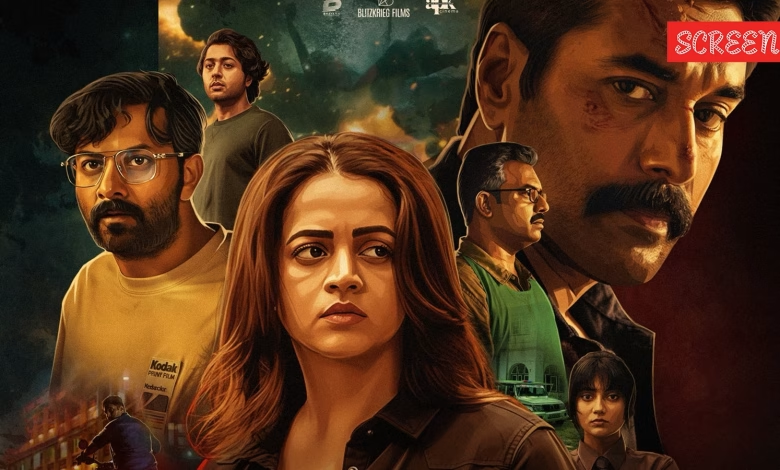
Anomie movie review: There are so many red herrings scattered across Anomie that the mystery-thriller nearly forgets to tell us the very reason it exists.
What starts as a bereaved sister’s quest for reasons behind her younger brother’s apparent suicide gradually takes the shape of a serial killer hunt that carries a very specific and bizarre modus operandi. Writer-director Riyas Marath throws in a few additional subplots – including one about a cop trying to revive his now-lacklustre career – to bloat up a narrative that rides on cliches for an excruciating length, before reaching a moment that it had overestimated and relied a bit too much on. The answers to the central mystery eventually come wrapped in high-concept science and futurism, but all the packaging barely covers the blandness that the majority of the film endures.

Bhavana plays Zaara Philip, a forensic employee who is slowly coming to terms with her parents’ death at the start of the story. Zaara, though, has no time to tend to her personal wounds because her brother, Ziyan, is battling sinister demons in his head and has already attempted suicide a few times.
When Ziyan goes missing one day, her life is turned upside down as she soon becomes entangled in a curious labyrinth of crime and deception, prompting a journey that promises no light at the end. Turns out, there are more incidents involving young people fighting psychological battles like Ziyan, and it doesn’t help anyone that slacker police officer Ghibran (Rahman) has botched each of those investigations. While Ghibran, now disgraced because of a court case, looks to redeem himself, Zaara does her sisterly duties to avenge her brother.
Also Read – Aashaan movie review: Indrans leads an amiable but overly convenient ode to the underdog
The novelty of a mystery-thriller, particularly in the whodunnit category, couldn’t simply stem from a fresh story in the post-modern world, given the gobsmacking number of entries into the genre. What separates the good ones from the rest (at least in a rudimentary sense) is the gaze with which they explore humanity and the necessities of crime around it. In Anomie, however, the very act of crime becomes a perfunctory tool to launch a probe that tirelessly rides on cliches and seems interested at no point in building a world that is lived-in, attractive or believable.
The plot is nudged along with self-fulfilling discoveries in the case. Cops take cold showers or nearly drown themselves in bathtubs, mulling over the investigations in hand. Sticky-sweet flashbacks whoosh by as montages, potential culprits are teased with passing glimpses, the background score does its best to adapt to the constant shift in moods, and this way, bit by bit, the film goes about justifying its 152-minute runtime.
Story continues below this ad
It isn’t that Anomie doesn’t have that clincher element; it boasts one that appears to be a part of the plotting, while it actually resides in a kind of commentary about death and the poignancy around it. Riyas Marath attempts to shed light on dealing with loss and the desires that most of us carry to live in an altered state of consciousness, where the idea of the said loss potentially doesn’t exist. Could those altered visions be trapped after all? If so, what does it take for humanity to embrace the idea? These are some of the key questions Anomie (meaning a condition of a lack or breakdown of social and ethical standards) asks of itself, before setting off on a path that not only doesn’t provide befitting answers, but also exasperates its co-participants the whole time.
The only silver lining in the film would be the finale stretch that does attempt to tie all loose ends and reveal the tapestry that was in the works. Although the tone or temperament of the storytelling here, just as in the rest of the film, is kitschy, the concepts relayed do feel refreshing in contrast to the run-of-the-mill investigation that was on display till then. The various aspects of filmmaking – the cinematography, editing and music included – too come together well here, and somehow, Riyas Marath manages to close things off on a positive note.
Also Read – With Love movie review: A love letter to every love you never confessed
Bhavana is earnest in the initial parts of the film, imbuing Zaara with tenderness as well as defiance. Rahman, on the other hand, struggles to breathe life or charisma into Ghibran, and it doesn’t help either that the film’s focus frantically moves all over; the shot duration is considerably short, and both the cinematography and editing are made restless to create a semblance of a mood.
Story continues below this ad
Would Anomie be a missed opportunity in that regard? Well, that would have been the case had the makers realised the essence of their story early on, and there were glimmers of effort in that pursuit. What the film ends up being is routine at best, with a few dashes of genuine curiosity. It’s rather like a meal that underwhelms with its main course so as to hype up its dessert; it sounds intriguing, but that approach rarely works, does it?
Anomie movie cast: Bhavana, Rahman
Anomie movie director: Riyas Marath
Anomie movie rating: 2.5 stars