Nasa’s Perseverance rover drives on Mars using AI-planned routes | Technology News
4 min readNew DelhiFeb 11, 2026 06:06 PM IST
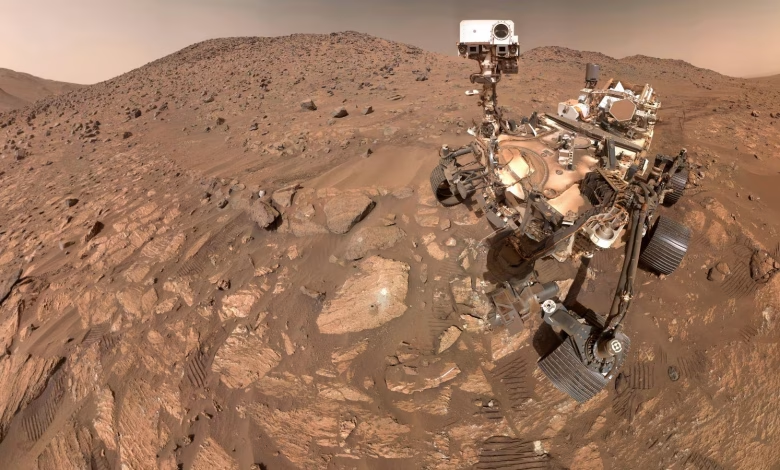
Nasa has taken another step towards making its Mars rovers more independent. In a recent test, the Perseverance team used artificial intelligence to help plan the rover’s route across the red planet without direct human control.
During the demonstration in December, waypoints generated with artificial intelligence guided Perseverance over two separate drives. In total, the rover travelled 456 m (about 1,496 ft) on its own.

“This demonstration shows how far our capabilities have advanced and broadens how we will explore other worlds,” said Nasa administrator Jared Isaacman. He added that autonomous systems can help missions operate more efficiently, especially as spacecraft travel farther from Earth.
Why autonomy matters on Mars
Mars is so far away that there is a delay of about 25 minutes for a round-trip signal between Earth and the planet. That delay makes real-time control impossible. For short periods, rovers must rely on their own systems.
Normally, engineers on Earth study images and terrain data sent back by the rover. They then map out a route using waypoints, usually spaced no more than 100 m apart. These instructions are transmitted through NASA’s Deep Space Network to orbiters around Mars, which relay them down to Perseverance.
But in this latest trial, AI took on part of that planning work.
How the AI system chose the path
The AI system analysed high-resolution images from the Mars Reconnaissance Orbiter’s HiRISE camera, along with digital elevation models. Based on that information, it identified possible dangers such as sand traps, large boulders, rocky outcrops, and uneven terrain.
Story continues below this ad
The system, built using technology related to Anthropic’s Claude AI, then created a safe route marked by waypoints that avoided those hazards.
Before the new route was uploaded to Mars, it was tested on Earth using a “twin” rover called the Vehicle System Test Bed at Nasa’s Jet Propulsion Laboratory. This engineering model allows teams to simulate challenges safely before sending commands to the real rover.
Once the route was approved, it was transmitted to the rover, where Perseverance’s auto-navigation system implemented it as it became operational. The rover is able to operate independently because it is able to interpret images while in motion. The rover can look at images while it is driving, unlike some earlier rovers.
The future of AI in space exploration
Nasa has been working on autonomous navigation for years, largely because communication delays make it necessary. Nevertheless, the process is still limited in one aspect, that is, the rover is less aware of its position. That is presently corrected from Earth. However, it is a time-consuming process.
Story continues below this ad
Researchers are now seeking to find a way to use AI to perform this relocalisation operation too, which could conceivably allow longer and more ambitious drives without the need to wait for human intervention.
Looking ahead, AI could play an even bigger role in space missions from future Mars rovers to the upcoming Dragonfly mission to Saturn’s moon Titan. Nasa officials say intelligent systems may become essential for building a sustained human presence beyond Earth.
With each test, the space agency is moving closer to robots that can think and explore more on their own.
© IE Online Media Services Pvt Ltd