‘Tastes like chemical’: Namita Thapar slams beverage brand 3 Sisters; Viraj Bahl-Varun Alagh question ‘cluttered’ vision | Television News
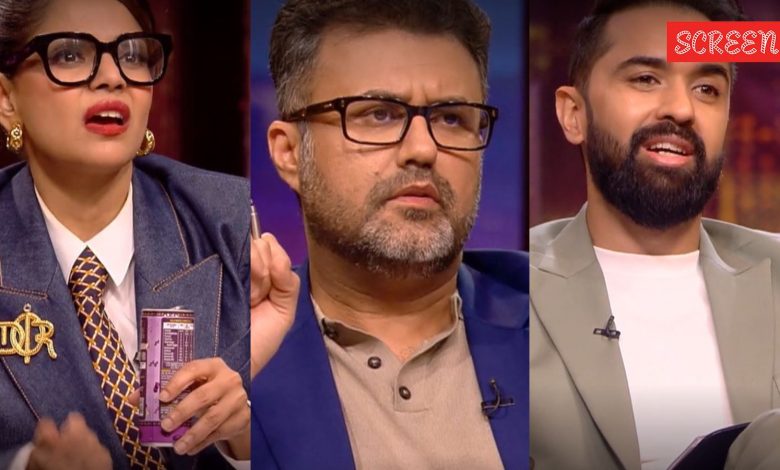
The ‘sharks’ of Shark Tank India have adopted a far more scrutinising approach this season. That cautious stance was evident in the latest episode, where two of the three pitchers left without a deal. Among them were the founders of beverage brand 3 Sisters, who appeared on Shark Tank India Season 5 to showcase their product range but failed to convince the ‘sharks’ to invest in their company. In fact, the brand’s product variations drew sharp feedback and pointed criticism from Varun Alagh, Viraj Bahl, Vineeta Singh, Namita Thapar, and Kunal Bahl.
3 Sisters is a new-age beverage brand specialising in non-alcoholic beers. The company began with three flavours and has since expanded its portfolio to include multiple sub-brands. It has also diversified into party mixers and flavoured sodas.

Founded by Mumbai-based entrepreneurs Manish Kanunga, Nimish Solanki, Akshay Solanki, and Sanjay Prasad Bari, the team entered Shark Tank India seeking an investment of Rs 3 crore for 2.5% equity, valuing the company at Rs 120 crore.
Given the brand name, the ‘sharks’ expected women entrepreneurs in the pitch. However, when four men walked in, Vineeta quipped, “Hamare saath dhokha hua hai,” with Varun adding, “Itna bada dhokha.”
Later in the pitch, the ‘sharks’ were visibly impressed upon learning about Sanjay Prasad Suri’s journey. Sanjay, who owns 42 percent stakes in 3 Sisters, shared, “I have lived in Mumbai for 20 years; my hometown is Benaras. It’s not easy to live in Mumbai. In the beginning, when you come here, no one knows you, there is no place to live, and it’s an expensive city. I came here to do something else, but the city had other plans for me. No matter how many times I saw defeat in business, this city always uplifted me. I worked hard, drove an autorickshaw, then started my own shop. Whatever I am today is because of my hard work and this city. It is truly a city of dreams that kept me on my toes. Who knew that a boy who came from Benaras in a general compartment would own such a big business today?”
He added, “After driving an autorickshaw, I started a soda stall in Ghatkopar, and later I owned 12 such stalls. With the money I made there, I set up a manufacturing plant and would do contract manufacturing, where I met my co-founders.” In 2021, Manish Kanunga and Akshay Solanki incorporated the brand and brought Sanjay on board as a partner. This move impressed Varun Alagh and Viraj Bahl. Elaborating on his growth trajectory, Sanjay revealed that his manufacturing plant generated Rs 80 lakh in its first year, Rs 1.8 crore in the second year, and Rs 3.8 crore in the third. When asked about the profits in the fourth year, he laughed and remarked that the figure was so large even his chartered accountant would struggle to calculate it.
Varun and Kunal objected to the variants the brand offered
While the founders appeared confident about their growth, what concerned the ‘sharks’ was the sheer breadth of products under the brand umbrella.
Story continues below this ad
While Namita criticized the taste of the beverage and said, “Instead of authentic fruit taste, I can taste chemicals,” Varun questioned their expansion strategy, asking, “Have you reached Rs 500–600 crore in revenue? If not, why have you launched so many products?” Kunal echoed the concern, pointing out that they seemed to be spreading themselves thin by introducing multiple brands simultaneously.
Varun further shared, “I worked with Coca-Cola for 3 years. I was heading the Coke brand, and I know the brands that crossed sales of Rs 8000 crore. Lahori Jeera is worth Rs 1000 crores today; you could have focused on non-alcoholic beer and made it a Rs 1000 crore brand.”
Namita also said, “When my father started Emcure, he started with contract manufacturing. He didn’t have so much money. He started his own brands, but even then contract manufacturing was still going on because, like you, contract manufacturing was a cash cow for him, which subsidized the brand. Own brands were different. When he worked on those, he didn’t do 50 other things.”
Viraj Bahl offered similar feedback, stating, “I feel hurt seeing such good company founders not understand the problem. I have 4 brands. Until my first brand, Veeba, didn’t make Rs 800 crore, I didn’t launch a second one. Brand building takes time.”
‘I just don’t like the brand’: Varun Alagh
The founders then revealed that the company recorded revenue of Rs 2.35 crore in FY 2022–23. In FY 2023–24, revenue rose to Rs 6.34 crore, with an EBITDA of Rs 34.5 lakh. For FY 2024–25, the brand reported revenue of Rs 11.89 crore and an EBITDA of Rs 86 lakh. On a year-to-date basis, revenue stands at Rs 10.66 crore, with projections of Rs 27-28 crore for the full year and an expected EBITDA of Rs 1 crore.
Story continues below this ad
While the ‘sharks’ opted out of the deal, they advised the founders to focus on the ‘less is more ‘ strategy.
Giving her final feedback, Vineeta Singh said, “I feel this entire brand piece is a distraction. Business should stay focused on what it knows how to do best. In my opinion, that is manufacturing, so for that reason, I am out.” Namita added, “I would strongly urge you to think through the strategy and about your brand-building approach a bit more. For that reason, I am out.”
Viraj Bahl shared his feedback: “I have made a roadmap for your company, where I am telling you what exactly needs to be done. This company in India should be beer and contract manufacturing. Export your Indie soda where the marketing is zero, tie up with good distributors, I will make you meet some of them. As of now, I cannot get into this company’s clutter. I am out, but I wish you guys all the best.”
Varun went on to say, “I am genuinely interested in the premium beverage market, but I just don’t like the brand. You are in a consumer brands business. frst understand what your consumer wants, and how you provide that. I find that story missing.” Kunal Bahl added, “Your team is good, your financial discipline is nice, there are many things to like. But we are not laser focused to grow non-alcholic beer, so I wish you all the best, today I am out.”