
₹1.56 crore assets for ₹1.34 crore? Why the market is still discounting GE Shipping despite a 25% CAGR
9 min readFeb 18, 2026 06:30 AM IST
Imagine a house worth Rs 1 crore.

Not the owner’s guess, but the builder’s estimate, based on today’s prices for every brick, pipe, and tile.
Someone offers to sell it to you for Rs 85 lakh. Do you take the deal?
That is roughly what GE Shipping looks like today.
The company’s investor presentation, published on February 2, puts consolidated Net Asset Value (NAV) at Rs 1,542-1,590/share. At a market price of Rs 1,340 on February 12, the stock trades at roughly 0.86x NAV.
In other words, the market is valuing GE Shipping at a 14-16% discount to what its assets are worth if every ship and rig were sold at current market prices. Six months ago, that discount was closer to 30-33%. But a gap still exists.
The real question is: will that gap close further, and how quickly?
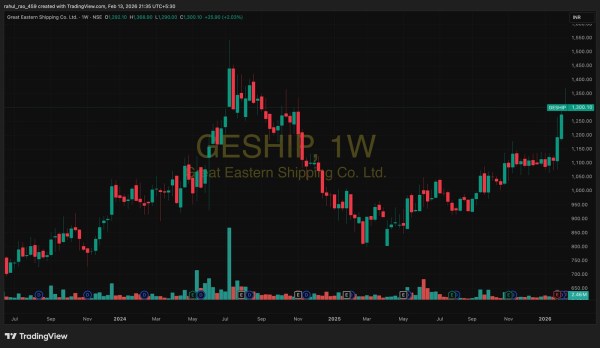 Source: http://www.tradingview.com
GE Shipping operates two businesses under one stock ticker.
Story continues below this ad
1. Shipping: The cyclical engine
GE Shipping owns 40 vessels with a total capacity of about 3.2 million deadweight tonnes (DWT): crude tankers, product carriers, gas carriers, and dry bulk ships. This is largely a spot-market business. Ships earn voyage by voyage. When freight rates rise, profits jump. When rates fall, profits fall just as fast. But asset values follow with a lag.
The management has a clear strategy: buy ships when no one wants them, sell when everyone does, and never borrow heavily at the top of the cycle.
In FY18 and FY19, the company levered up to $361 million of net debt to buy vessels at near-cycle-bottom prices. As shipping rates surged through 2021, the company deleveraged. Today, the balance sheet shows zero net debt and over $500 million in net cash.
2. Greatship: The offshore side most investors miss
The second business is Greatship (India) Ltd, the offshore division. It operates 4 jack-up drilling rigs (oil exploration) and 19 support vessels.
Story continues below this ad
This is a time-charter business, with contracts lasting months to years. Revenue is steadier. Greatship is also a net cash company.
While the two businesses are at different points in their cycles, the NAV discount applies to both.
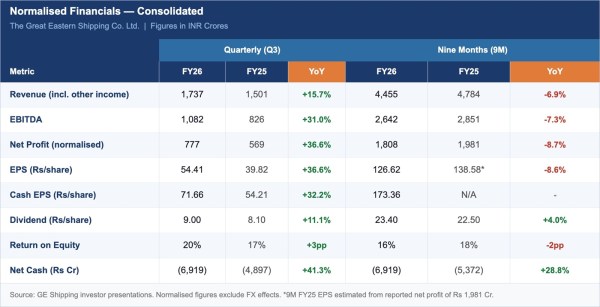 Source: GE Shipping Analyst Presentation, February 2, 2026
What the company says its assets are worth
The most important number in this story comes from GE Shipping’s February 2026 investor presentation, which reports consolidated NAV of Rs 1,542-1,590 per share.
Standalone NAV (shipping only, excluding Greatship) stands at Rs 1,233 per share.
Story continues below this ad
Management publishes a historical chart showing the stock price as a ratio of consolidated NAV. At the January 29 closing price of Rs 1,187, the stock traded at 0.76x. At the current price of Rs 1,340, it has moved up to 0.85-0.87x.
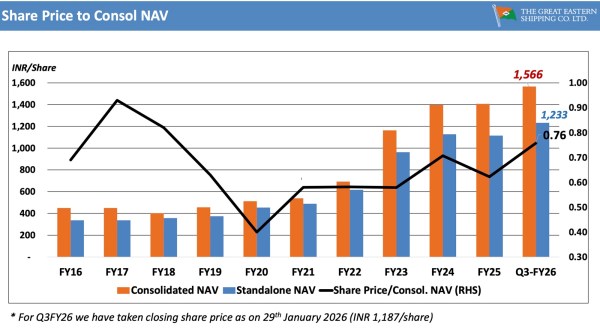 Source: GE Shipping Analyst Presentation, February 2, 2026
NAV growth
NAV has compounded at 25% per year over five years, rising from Rs 538 per share in FY21 to Rs 1,566 per share by Q3 FY26 (consolidated). This growth did not come simply from ships getting more expensive.
Between December 2024 and December 2025, fleet values fell by Rs 44 per share and dividends of Rs 28 per share were paid out. NAV still increased because the business generated cash profit that more than covered both.
The cash drag
One reason why the discount persists is cash.
Story continues below this ad
GE Shipping holds Rs 6,919 crore in net cash (roughly $574 million). That cash earns about 3% in dollar terms.
On the January 30 earnings call, CFO G. Shivakumar said: “Cash is a drag on the returns… we hope this cash will go from earning 3% in dollars to earning to a ship which earns more than 10% in dollars.”
Management is waiting for the next shipping downturn to deploy capital. With a capex potential of $1.3 billion at a net debt/equity of 0.5x, buying vessels at distressed prices adds significant value. Until then, the cash sits as dry powder. It is not earning much, but it adds comfort to the balance sheet until opportunities show up.