AI startups reimagine healthcare access with smart diagnostics
4 min readNew DelhiUpdated: Feb 21, 2026 04:42 AM IST
A few start-up creators at the AI Impact Summit showcased tools and technology that can ease the process of medical diagnostics as well as offer emergency help. There was a wide range of AI-powered healthcare products catering to people facing mental health issues, athletes looking to perform better, cancer patients, etc.
ARTICLE CONTINUES BELOW VIDEO
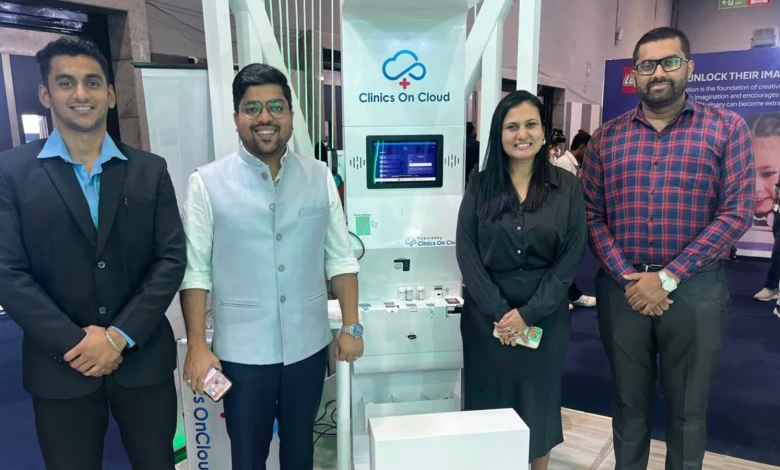
Health startup Clinics on Cloud focuses on primary healthcare access in remote areas. The company has developed a decentralised network of healthcare services, combining physical kiosks called Health ATMs with AI-enabled digital infrastructure. These provide instant health screenings for over 60 conditions, along with real-time tele-doctor consultations and cloud-based medical records. CEO Abhay Agarwal says, “Just as ATMs decentralised banking by allowing people to perform basic transactions without visiting a bank branch, health ATMs aim to decentralise preventive healthcare. This is designed to make preventive healthcare accessible everywhere, reduce hospital overload, and increase public awareness about health risks.”

Agarwal claims accuracy comparable to laboratory results (90–95% accuracy). “Over 40 health parameters can be measured in about 10 minutes, with only five blood tests required, and results are instantly delivered via WhatsApp or printed on site. Non-invasive tests such as ECG and spirometry are performed quickly, making the system fast and convenient for users,” he adds.
A young founder from NIT Vellore is turning his personal struggles with mental health into technological innovation.
Arihant Bhardwaj shared how his own and other co-founders’ experience with stress and mental health challenges sparked the creation of Tranquil AI, a mental health AI platform.
“We were trying to solve something we ourselves were struggling with,” says Bhardwaj about his platform that is tailored to students dealing with academic pressure, anxiety, burnout and emotional isolation. “It combines mood tracking, guided journaling, meditation support, sleep tools and an AI-driven chat feature designed to help users manage stress and anxiety.
Unlike generic chatbots, the platform integrates user-consented inputs such as mood logs and journal entries to create increasingly personalised interactions over time. If you want to vent, it listens. If you want comfort, it responds. If you want structured guidance, it adapts,” says Bhardwaj.
Story continues below this ad
A file manager for cancer survivors — OncoVault, an AI-powered cancer report management app — summarises a patient’s treatment history over years into a concise format, including links to all reports and analyses. “OncoVault allows patients to upload scans or photos of their medical reports without manually entering details. The app’s AI identifies the type of report, extracts key information like test dates and patient details and organises all records chronologically,” explains Shubham Shreyas, co-founder of BigOHealth. This is particularly useful when patients seek a second opinion, allowing doctors to quickly review prior treatments and make informed decisions. The app also supports audio input, enabling patients to record symptoms or details that arise later. “In cancer treatment, patient information is often scattered across multiple places… sometimes the hospital does not have all the patient data — but the patient does,” says Shreyas.
Athletes in remote areas, with limited access to coaching infrastructure and sports medicine, can record videos and have their kinograms or “time-lapse” videos of their motion assessed by an AI platform for coaching guidance. Called Bhargati, it was founded by ex Army officer Amit Oberoi, conceptualised at IIT Delhi and developed in Australia by a former IIT Delhi student, Amit Gupta, with conceptual support from Professor Brijesh Lal. Using simple video recordings and reference cones placed on the ground, the platform creates a kinogram, a skeletal overlay of the athlete’s movements. It evaluates joint angles, stride length, ground contact time, and other biomechanical metrics, offering a level of detail previously only available in lab-based systems.
© The Indian Express Pvt Ltd