Rana Daggubati’s debut, Sekhar Kammula’s anger, and a political film Telugu cinema has never bettered | Telugu News
4 min readHyderabadFeb 20, 2026 06:36 PM IST
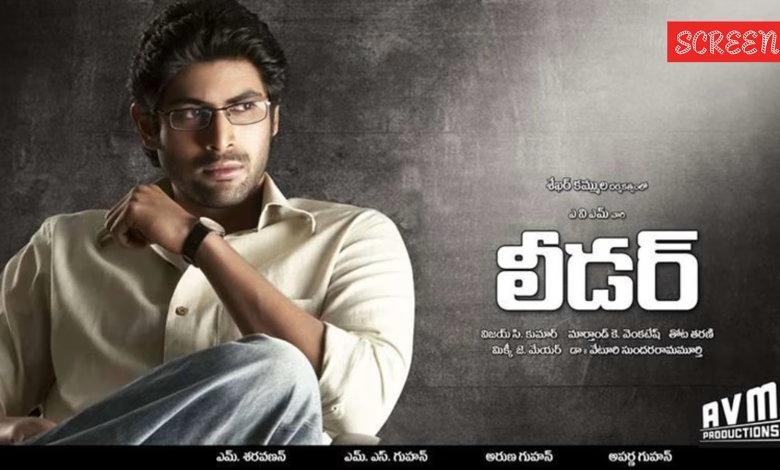
Rana Daggubati walked into his first acting role as a chief minister trying to fix a broken system. That was the idea at the heart of Leader, Sekhar Kammula’s 2010 political drama, and it is what separated it from almost every other Telugu film that had attempted the same subject.
ARTICLE CONTINUES BELOW VIDEO
The film was an unlikely combination from the start. Sekhar Kammula had built his reputation on intimate, character-driven dramas, Anand, Happy Days, Godavari. A political film was a departure. AVM Productions, a Chennai-based banner more associated with Tamil productions, backed it. And the lead role went to Rana Daggubati, the grandson of prominent Telugu producer D. Rama Naidu, in his acting debut. None of it was an obvious fit. It worked regardless.

Kammula wrote the script himself. The story follows Arjun Prasad, the US-based son of Andhra Pradesh Chief Minister Sanjeevayya, who is assassinated in a bomb attack at the film’s opening. Arjun returns, reads his late father’s diary, and realises that the political party his father led is corrupt from within. He decides to contest for the CM’s position, not out of ambition, but because he believes someone worse will take it if he does not.
Most Telugu political films of that era operated around a hero who fights the system from outside it. Leader put its protagonist inside the system and watched what happened to him there. Arjun takes office with a genuine anti-corruption agenda. He moves fast. His own party’s MLAs push back. His cousin Dhanunjay, played by Subbaraju, works against him from within. Every move Arjun makes that is principled creates a new political problem.
Also Read: Kerala CM slams The Kerala Story 2 trailer, calls it an attempt to ‘demonise our secular fabric’
The film’s most significant stretch comes in the second half. To hold his government together, Arjun agrees to protect an MLA’s son accused of raping and murdering a tribal girl. It is a direct compromise, he knows it, the audience knows it, and his mother Rajeswari, played by Suhasini Maniratnam, knows it. She does not forgive him. She dies without doing so. Kammula does not walk that back or soften it. The film holds the consequence of that decision and builds its entire third act around Arjun reckoning with what he gave up. He eventually resigns as CM, exposing the corrupt politicians around him, and contests a by-election as an independent.
What made Rana’s debut work was that he did not play the role as a hero. Arjun Prasad has no theatrical moments, no mass scenes, no speeches written to generate applause. He is a man who thinks carefully, acts strategically, and carries the weight of his decisions without externalising them into anger or defiance. Critics at the time noted it as “a surprisingly mature performance for a debutant.”
Story continues below this ad
Kammula later described Leader as a film that came directly from his daily encounters with that reality. In his own words, there are times when “everything you do is a reflection of what you encounter in your daily life”, and Leader was one such film.
The other thread running through the script was the idea of ideal leadership. Kammula drew inspiration from figures like Mahatma Gandhi. Arjun Prasad, the film’s protagonist, was written as a test of that ideal. What happens when someone genuinely committed to those values enters a political system that is structurally designed to corrode them?
Leader was, by his own admission, his “something else”, the film he made to step outside his established template of intimate personal drama. Kammula has since said he felt he could have dug deeper, that corruption was a convenient theme and that he was aware of the film’s limitations even as he made it.
Film Companion included Leader in its list of the 25 Greatest Telugu Films of the Decade. It was remade in Hindi in 2014 as Youngistaan, without comparable impact.