Is The Microfinance Giant Finally Out Of The Woods?
In microfinance, things can go from bad to worse before you even finish reading last quarter’s numbers.
Between mid-2024 and early 2025, that’s exactly what happened. Borrower over-leveraging, floods across key states, and tighter MFIN (Microfinance Institutions Network) guardrails sent the sector into a tailspin. MFI stocks fell 30-60% from their peaks. Credit costs surged.
CreditAccess Grameen, with a Rs 26,500 crore loan book, was not spared. In Q4 FY25, the company reported Profit After Tax (PAT) of just Rs 47 crore and Return on Assets (ROA) of 0.7%. Collection efficiency dipped to 91.9%. For a lender that had consistently delivered 4%+ ROA and 20%+ ROE, this was a dramatic fall.
Three quarters later, in Q3 FY26, PAT rebounded to Rs 252 crore, a 5.4x increase from the trough. ROA climbed to 3.5%.
So is the worst truly over? Or is this recovery too quick to trust?
What went wrong
The sector expanded too aggressively between FY22 and FY24. Industry AUM grew at 28-29% annually, with multiple lenders chasing the same borrowers. By August 2024, 25.3% of CreditAccess Grameen’s Gross Loan Portfolio (GLP) was exposed to borrowers with more than three lenders, a closely watched metric through this downcycle to gauge stress.
Then, MFIN introduced exposure caps per borrower. The RBI tightened norms further. Heavy rainfall hit Karnataka, Madhya Pradesh, and Maharashtra. Loans overdue by more than 15 days, a lead indicator of deteriorating loan book, spiked sharply.
Story continues below this ad
Subsequently, write-offs ballooned to Rs 518 crore, Rs 693 crore, Rs 683 crore and Rs 259 crore in the last four quarters. That’s more than Rs 2,100 crore, or 8% of the GLP as on March 2025.
The inflection point
Q3 FY26 is where things have turned:
Source: CreditAccess Grameen Investor Presentations, Q4 FY25 to Q3 FY26
What’s driving the recovery?
The deleveraging is largely done. The percentage of GLP exposed to borrowers having outstanding loans with more than three lenders simultaneously fell from 25.3% to 4.9%. Borrowers with over Rs 2 lakh unsecured debt declined from 19.5% to 7.8%.
Story continues below this ad
The MFIN guardrails worked. Rejection rates went up (new borrower approvals fell from 65% to 55-60%), and the quality of the surviving book improved dramatically.
Source: CreditAccess Grameen Investor Presentations & Earnings Calls
Karnataka, CreditAccess Grameen’s home state (30% of GLP), was among the worst hit, but it also recovered fastest. A 25-year presence with a branch every 30 km gave it a clear edge in resolving delinquencies. In its Q3FY26 conference call with investors, management said Karnataka is back to historical asset quality levels.
Meanwhile, the company hiked group loan pricing in Q2. Combined with falling borrowing costs (9.8% to 9.4% over four quarters), this resulted in a 120 bps expansion in NIM from the trough to Q3.
Current loans (not overdue by even 1 day) continue to improve significantly, hitting 99.71% in December. If this number drops, it means more of the current (not due) loan book is becoming stressed and vice versa.
Story continues below this ad
The retail finance pivot
The more interesting story for long-term investors isn’t just the credit cycle recovery. Those are cyclical by nature. It’s the structural shift in the product mix.
Source: CreditAccess Grameen Investor Presentations
In four quarters, Retail Finance expanded from 6% to 14% of GLP, totalling Rs 3,780 crore. This isn’t a single product but a ladder: Unnati Loans (avg. Rs 1.7 lakh), Vishesh Loans (Rs 80K), mortgage business loans (Rs 6.5-7 lakh), home loans, and two-wheeler finance.
Pricing is similar to MFI loans at 20-21% (except housing at 16.7%), so margins are comparable. But credit risk is lower: Loans overdue by more than 30 days across the entire retail book remain below 2%. These products are designed for the 10% of MFI customers who graduate to retail products annually.
Management is targeting 15% of AUM by FY28, but the current pace suggests it could get there sooner.
Story continues below this ad
This matters because it reduces dependence on the cyclical Joint Lending Group (JLG) business and deepens wallet share per borrower, all on the same 2,222-branch infrastructure.
FY27 outlook
Management guided for FY27 credit costs of 4.0-4.5%. However, December accretion was 18 bps (versus the 30-35 bps implied in guidance), suggesting potential upside.
Source: Q3 FY26 Earnings Call
Borrowing costs are expected to fall roughly 10 bps/quarter over the next 2-3 quarters, providing a direct tailwind to margins.
The Axis Bank wild card
In early 2026, reports suggested that Axis Bank was evaluating the acquisition of CreditAccess India BV’s 66.3% promoter stake, valued at roughly $2.3 billion per CLSA. The company has denied that any decision has been taken, calling the reports speculative.
Story continues below this ad
The promoter entity is backed by Olympus Capital Asia and the Asian Development Bank, both long-term holders who are now exploring liquidity options. The logic for Axis Bank makes sense: instant access to 2,222 rural branches, a high-margin priority sector business, and a proven team. For shareholders, a deal could potentially unlock a premium. But it also brings uncertainty. This is worth watching.
What could go wrong
Microfinance is cyclical. Political interference (Karnataka passed a microloan ordinance in early 2025), weather disruptions, and borrower behaviour are all unpredictable. The Rs 47 crore PAT in Q4 FY25 is still fresh memory.
Geographic concentration is a concern. Karnataka, Maharashtra, and Tamil Nadu still account for ~70% of GLP. The borrower base has shrunk from 47 lakh to 44 lakh, meaning the company needs higher ticket sizes to sustain growth. This is precisely the direction the MFIs need to be cautious about.
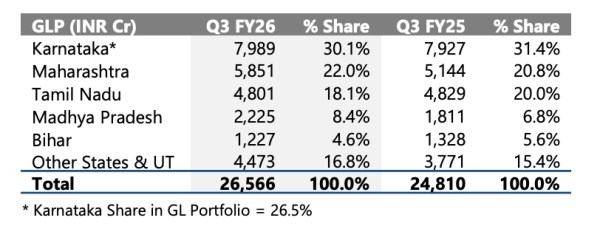 Source: CreditAccess Grameen Investor Presentations, Q3 FY26.
Valuation and what’s priced in
The stock trades around Rs 1,250-1,290 with a market cap of roughly Rs 20,000-20,500 crore. The 52-week range has been Rs 750 to Rs 1,490, reflecting how the sentiment has changed.
Source: BSE, NSE, Broker Reports, Company Filings
HSBC has a target of Rs 1,630. CLSA is at Rs 1,450. Both upgraded to Buy after Q3 results. At 27-29x forward earnings and 2.8x forward P/B, the stock isn’t cheap.
The current P/B is higher among NBFC-MFIs, but it’s still below the lenders’ long-term median value of 3.3x.
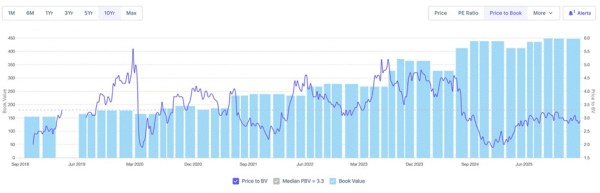 Source: http://www.screener.in
It’s pricing in continued normalisation, which appears likely but isn’t guaranteed.
In conclusion, CreditAccess Grameen’s turnaround from Q4 FY25 to Q3 FY26 ranks among the sharpest recoveries in recent Indian microfinance history. Collection efficiency is trending toward pre-stress levels. PAR accretion has collapsed. Margins and ROE are expanding.
The worst appears to be behind the company. Whether the best lies ahead depends on execution – and the next monsoon.
Story continues below this ad
Note: We have relied on data from http://www.Screener.in and http://www.tijorifinance.com throughout this article. Only in cases where the data was not available, have we used an alternate, but widely used and accepted source of information.
Rahul Rao has helped conduct financial literacy programmes for over 1,50,000 investors. He also worked at an AIF, focusing on small and mid-cap opportunities.
Disclosure: The writer or his dependents do not hold shares in the securities/stocks/bonds discussed in the article.
The website managers, its employee(s), and contributors/writers/authors of articles have or may have an outstanding buy or sell position or holding in the securities, options on securities or other related investments of issuers and/or companies discussed therein. The content of the articles and the interpretation of data are solely the personal views of the contributors/ writers/authors. Investors must make their own investment decisions based on their specific objectives, resources and only after consulting such independent advisors as may be necessary.