The AI Infrastructure Stock Riding India’s Data Centre Boom

The recent AI Impact Summit created new opportunities for Indian companies to build global AI data centres. Data-centre and AI stocks saw strong gains, with Netweb Technologies among the notable beneficiaries. The company manufactures AI systems and high-performance computing solutions designed to meet India’s growing demand for AI infrastructure.
Artificial Intelligence (AI) is reshaping the technology landscape, and traditional IT companies are beginning to feel the impact of this transformation.
On one side, fears of an AI bubble have pulled down the shares of tech companies such as Infosys and Tata Consultancy Services (TCS) on the NSE, as well as Microsoft and Amazon on the Nasdaq. Ironically, these companies are among the largest investors in AI infrastructure, aiming to unlock AI’s potential to transform the way we work, learn, and live. While they continue exploring the ways to harness the power of AI, the infrastructure for AI is where the money is flowing
India’s AI game plan
At the recent AI Impact Summit, India invited global leaders to build their data centres in the country. The invitation received a warm response, with Microsoft, Google, Reliance Industries, and Adani Group announcing multi-year investments in AI infrastructure. India’s push to become the world’s AI data centre is creating a new growth cycle for companies operating in the data centre space.
One company that stands out in this emerging cycle is Netweb Technologies India. The more than 20-year-old company launched its IPO in July 2023 at Rs 500 per share. Today, the stock trades above Rs 3,800.
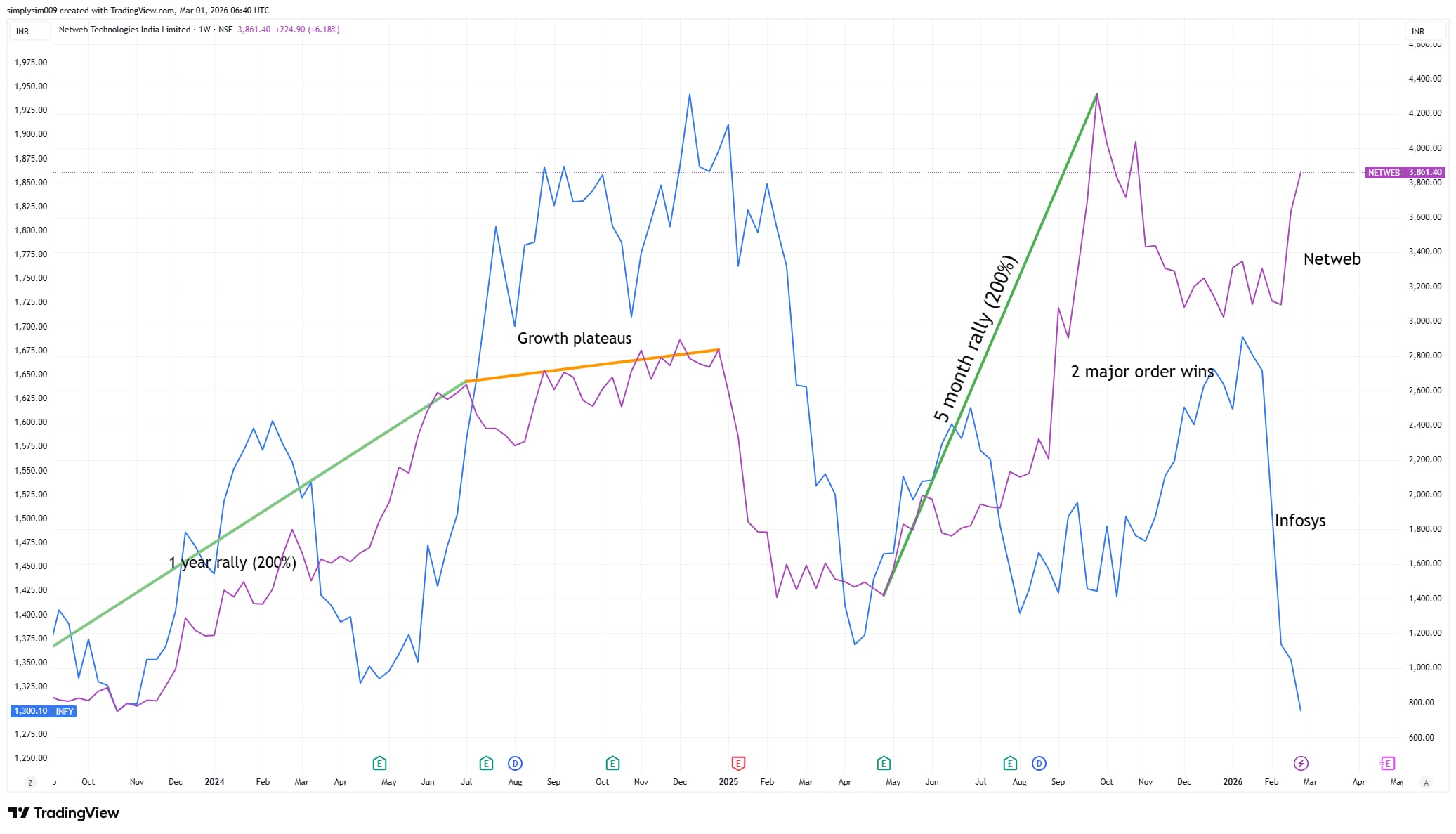
Unlike Infosys and TCS, which operate in the IT services sector, Netweb manufactures high-performance computing (HPC) solutions. Like most manufacturing businesses, its share is influenced by the order book. That explains the past two growth cycles that drove the stock up 200%.
Netweb Technologies India, Infosys Share Price Momentum (July 2023 to February 2026)
Source: Trading View
Story continues below this ad
In early September 2025, Netweb secured a Rs 1,734 crore order under the IndiaAI Mission, expected to be completed in the first half of FY27. In the same month, it secured another Rs 450 crore order to deploy AI infrastructure, expected to be completed by FY25-26. Netweb’s stock peaked in October 2025 before correcting 28% as the company went into the order execution phase.
Speaking during the Q3 FY26 earnings call, Chairman and Managing Director Sanjay Lodha said Netweb’s order billing cycle typically ranges from 12 to 16 weeks. If Netweb’s orders do not have long gestation periods or require heavy capital expenditure, why did the company raise funds through an IPO?
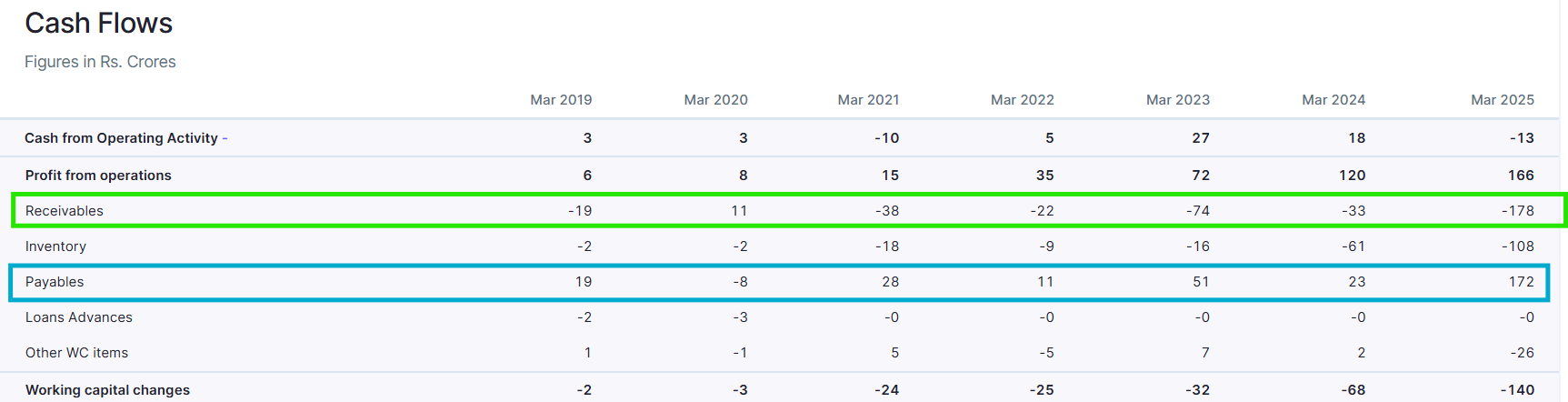
It is because of the high working capital requirement. To understand it better, it is important to examine the role of Netweb in the data centre supply chain.
What does Netweb do?
Netweb is more than just an original equipment manufacturer (OEM). It offers end-to-end solutions with software, hardware, workstations, and an entire system. Its offerings include HPC clusters, GPU-optimised computing systems, parallel file systems, and management tools. It has government and enterprise clients, including the Ministry of Defence, ISRO, UIDAI, Zoho, Yotta, and Infosys.
Story continues below this ad
Netweb receives graphics processing units (GPUs), memory chips, and other chipsets from technology providers like Intel, AMD, and Nvidia. It then integrates them into its designed and manufactured motherboards, servers, and software stack, and installs the system on the client’s premises.
In this entire process, Netweb doesn’t own the GPU. As a result, it doesn’t appear as depreciation or capital expenditure on the balance sheet. GPU and chipset procurement is a part of working capital, which it recovers when the client pays for the order. The company launched its IPO to meet working capital needs.
Netweb Technologies India Working Capital Breakup
Source: Screener.in
Netweb has a manufacturing plant where it produces servers and systems. The company does not expect to add more manufacturing plants until its revenue reaches Rs 3,000-3,500 crore, as most of its offerings are capability-driven and not capacity-driven.
Hence, it has limited capital expenditure requirements, which allows it to operate at zero debt. It has a cash balance of Rs 190 crore as of December 31, 2025, which it can use to invest in technology and capability.
Netweb’s valuation depends on its capability
Story continues below this ad
In capability-driven businesses, companies sometimes execute strategic low-margin orders to demonstrate their capabilities. Successfully delivering such projects helps attract higher-margin orders later and allows the company to command premium pricing. For instance, Nvidia and AMD GPUs are used in most supercomputers, which gives them an opportunity to showcase their capabilities.
Netweb has several capability achievements to its credit in its over 20 years of operations. It delivered India’s first indigenously built supercomputer, Kabru, and India’s fastest supercomputer, AIRAWAT.
At the AI Impact Summit this year, Netweb launched one of the world’s smallest AI supercomputers, Tyrone Camarero Spark. Packed with 1 petaflop of AI performance and 128GB of unified memory in a compact desktop form factor, Tyrone Camarero Spark will allow developers and enterprises to build AI agents and operate advanced AI software on-premises without the need for external cloud infrastructure. Netweb also introduced the Tyrone Camarero GB200 AI System for data centres that supports AI model training and real-time large language model (LLM) inference.
Following these launches, Netweb’s stock surged 25%, and it continues to grow as investors realise the revenue-earning potential of these products.
Netweb’s AI growth potential
Story continues below this ad
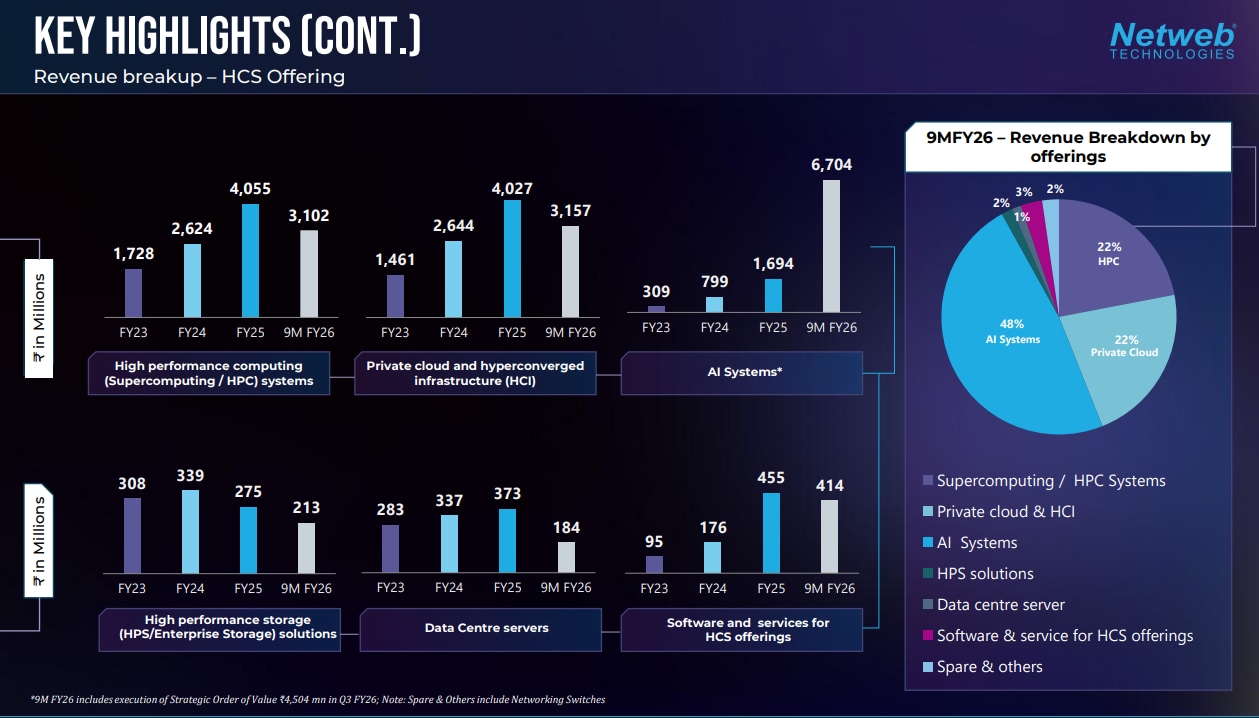
To understand AI’s growth potential, let’s look at Netweb’s latest earnings. Until FY25, supercomputing and private cloud were the biggest business segments of Netweb. However, AI has gained momentum in FY26, surging threefold over the nine months of FY26. It overtook the other two segments to become the single largest revenue contributor.
Netweb Technologies India Earnings Highlights
Source: Netweb Q3 FY26 Earnings Presentation
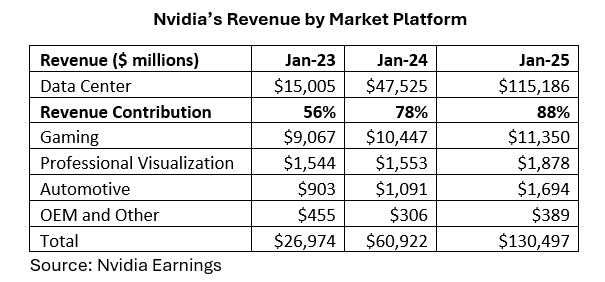
Netweb’s earnings resemble Nvidia’s earnings between FY23-FY25, when the share of data centre revenue jumped from 56% to 88%.
NVIDIA’s Revenue by Market Platform
Source: Nvidia Earnings
Does it mean Netweb could experience similar hyper growth? Not exactly.
Nvidia’s GPUs represent cutting-edge technology with minimal global competition. Netweb’s AI systems, in contrast, cater to the Indian market and are largely solution-driven rather than purely product-driven. While there is a stark difference in Nvidia’s and Netweb’s total addressable market, the latter has significant growth potential.
What will drive Netweb’s growth?
Story continues below this ad
The biggest growth driver for Netweb is the government’s AI investment. In March 2024, the government allocated over Rs 10,300 crore over the next five years for the IndiaAI Mission. One part of the mission is to buy GPUs and develop AI compute infrastructure. Being India’s only full-stack hardware provider, Netweb is well placed to benefit from this scheme.
The government’s GPU procurement will have two objectives: first, to provide high-end GPU services at subsidised rates to internal cloud service providers (CSPs); and second, to provide on-premise infrastructure. Most of Netweb’s orders are related to the first type of procurement. Procurement for the second category has not yet begun, said Hirday Vikram, Netweb’s chief sales and marketing officer, at the fiscal Q3FY26 earnings call. This shows scope for more orders from the government.
The tax holidays until 2047 for foreign cloud companies building data centres in India could boost investments in AI data centres and drive demand for Netweb.
In addition, Netweb’s strong relationship with OEMs allows it early access – 12-24 months – to Nvidia’s latest chips and architectures, giving it ample time to design and deploy advanced servers and AI systems. Moreover, its long-standing government relations and marquee clientele position it for a robust order book.
Growth drivers converting to Netweb’s order book
Story continues below this ad
At the end of Q3 FY26, Netweb had an order book of over Rs 800 crore, including organic and L1 order pipeline, which takes 8-10 weeks to convert into orders. In addition, it has a Rs 4,270 crore order pipeline, which gives it confidence to grow revenue at a compounded annual growth rate (CAGR) of 30-40% in the next 2-3 years.
The order pipeline does not include strategic orders for the government’s IndiaAI Mission. These are high-value, large-scale orders that depend on the government’s approval and are difficult to predict. Hence, when the company earned two strategic orders worth over Rs 2,000 crore in September 2025, its stock jumped 200%.
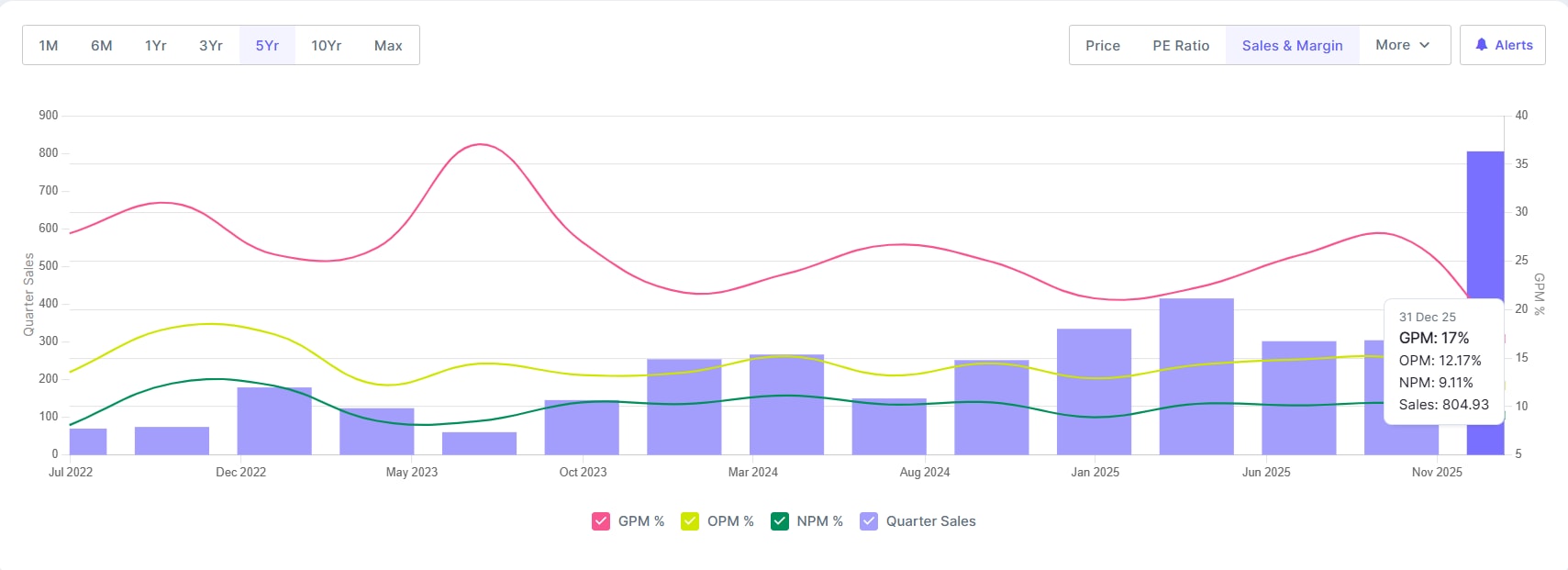
Netweb Technologies India Sales and Profit Margins Q2FY23 to Q3FY26
 Source: Screener.in
These strategic orders are executed on priority and have a 200-basis point lower operating EBITDA margin than non-strategic orders. It’s a volume versus margin trade-off, which explains Netweb’s 12.2% operating EBITDA margin in Q3 FY26 as compared to 15% in Q2 FY26. The company will spend the next 2-3 quarters executing strategic orders. The margin drop will be offset by 15% margin on non-strategic orders, resulting in annual margins of 13-14%.
Story continues below this ad
On the execution front, there were concerns around the global supply shortage of memory chips triggered by increasing demand for AI data centres. However, in the Q3 FY26 earnings call, management said its proactive supply chain planning and long-standing partnership have helped it secure the supply. The component prices will be higher, but that will be passed on to customers.
Is Netweb stock risky at current valuations?
While strategic orders from IndiaAI Mission act as a growth catalyst, significant dependence on these non-recurring orders makes Netweb stock cyclical.
Once the strategic order converts into revenue, there is no guarantee that a similar or another large order will follow. Hence, the stock falls after a growth cycle as the rally prices in the fundamentals from order execution.
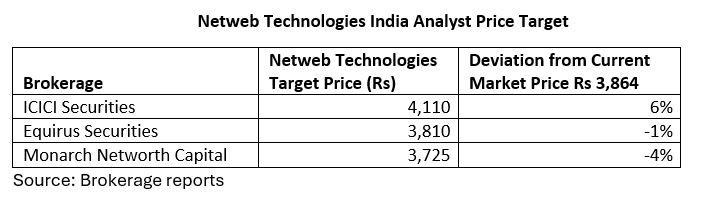
Analysts expect Netweb’s revenue to grow at a 50-60% CAGR between FY25 and FY28. Excluding strategic orders, ICICI Securities expects ~38% revenue CAGR for Netweb. The 25% rally in February after the product launch has already priced in these growth expectations, and the stock has achieved even the bullish price target.
Netweb Technologies India Analyst Price Target
Source: Brokerage reports
Netweb currently trades at a high price-to-earnings ratio of 128x, as the market has priced in the Rs 2,000 crore strategic order execution. This has reduced its upside and increased the chances of a correction. The next big growth spurt could come from another strategic order win or sales of its new desktop form AI supercomputer.
The company has strong execution, robust fundamentals, and the advantage of being the only indigenous company that manufactures AI systems. It is well placed to tap the AI growth cycle in the next two years. However, high valuations, increasing dependency on government orders, and chip imports pose a risk. It would be interesting to see the journey of this small-cap stock in India’s AI revolution.
Note: We have relied on data from http://www.Screener.in throughout this article. Only in cases where the data was not available have we used an alternate, but widely used and accepted source of information.
Puja Tayal is a financial writer with over 17 years of experience in the field of fundamental research.
Disclosure: The writer and his dependents do not hold the stocks discussed in this article.
The website managers, its employee(s), and contributors/writers/authors of articles have or may have an outstanding buy or sell position or holding in the securities, options on securities or other related investments of issuers and/or companies discussed therein. The content of the articles and the interpretation of data are solely the personal views of the contributors/ writers/authors. Investors must make their own investment decisions based on their specific objectives, resources and only after consulting such independent advisors as may be necessary.