
Why Styrenix’s stock has fallen 45% despite strong fundamentals | Smart Stocks News
Here’s a 52-year-old company whose founder built India’s first ABS (acrylonitrile butadiene styrene) factory, sold a majority stake to Bayer AG on the company’s silver jubilee (1997), and bought it back on its golden jubilee (2022).
It has a 29% return on equity (ROE) and minimal debt.
Styrenix Performance Materials Ltd manufactures ABS, the engineering plastic used in car dashboards, washing machine bodies, and refrigerator panels. On paper, Styrenix Performance Materials is one of Insia’s leading industrial businesses.
And yet, the stock has fallen 45% from its all-time high — from Rs 3,500 a share in June 2025 to about Rs 1,860 as of lastMarch 6’s close. In the latest quarter alone, profits dropped from Rs 44 crore to Rs 16 crore.
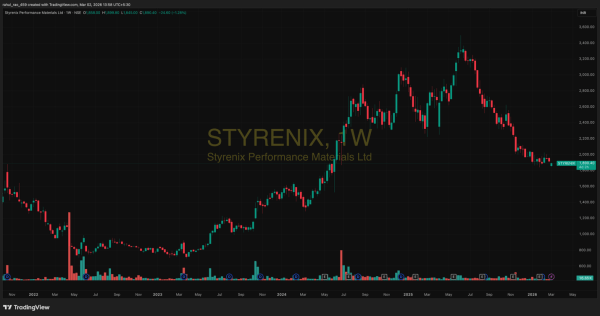 Source: http://www.tradingview.com
So, what’s happening?
First, a factory in Thailand bought for Rs 190 crore in January 2025 has been reporting losses every quarter since.
Second, the company is in the middle of a Rs 350 crore domestic expansion that will add 50% to its ABS (speciality plastics) capacity.
Story continues below this ad
Third, competitors are adding significant capacity of their own at the same time, all expected to commission/stabilise around FY28 beginning.
So is the sharp fall in the stock justified or is it collateral damage caused by a temporary market phenomenon?
The India machine
The Styrenix story begins with its founder buying back his own company.
Rakesh Agrawal started ABS Plastics Limited in 1973, building India’s first ABS manufacturing facility. The company changed hands over the decades, eventually becoming a subsidiary of INEOS Styrolution in 2012, a European chemical major.
Story continues below this ad
In November 2022, the Shiva Group, led by Agrawal’s sons Rahul and Vishal, acquired a 62.73% stake and took back control.
What followed was a transformation.
Volumes jumped from 124,000 tons (FY21) to 185,000 tons (FY25). Earnings Per Share (EPS) recovered from Rs 99 (FY24) to Rs 132 (FY25). All of this without compromising on margins or realisations.
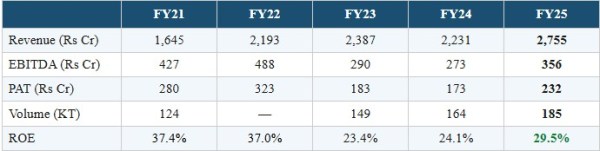 Source: Styrenix Performance Materials FY25 Annual Report, 5-Year Statistical Information.
The company has three segments: ABS, SAN, and Polystyrene (PS).
ABS, the speciality product, generates the bulk of the margins. Polystyrene fills the remaining capacity but operates on thinner spreads in a more commoditised market.
Story continues below this ad
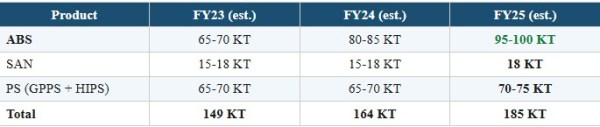 Source: Estimated from capacity utilisation data across Styrenix concalls (Q4 FY25 to Q3 FY26) and FY25 Annual Report. Company does not disclose product-wise volume split.
The Rs 190 crore bet
In January 2025, Styrenix acquired INEOS Styrolution Thailand for $21.9 million (about Rs 190 crore). On paper, it looked like a bargain. The plant’s assets were worth Rs 500 crore, resulting in a Rs 315-crore gain on Styrenix’s balance sheet.
In 9MFY26, the company’s Thailand unit contributed about 25% to consolidated sales.
It produces speciality grades: refrigerant-grade ABS for refrigerator liners, food-grade SAN, and high-heat ABS for automotive applications.
But cheap assets and good products don’t automatically translate into profits. Here’s what happened quarter by quarter:
Story continues below this ad
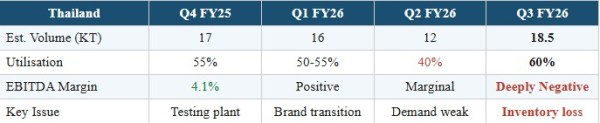 Source: Styrenix Investor Presentations and Conference Calls, Q4 FY25 to Q3 FY26. Thailand figures are approximate (consol minus standalone).
The Q4 FY25 start was promising. Thailand turned EBITDA-positive in its very first quarter under new management, something it had not achieved under INEOS. But Styrenix had built up inventory during the brand transition from INEOS’s product names to its own. When raw material and finished goods prices fell 20-25% through the year, those inventories resulted in a Rs 28 crore loss in Q3.
The management says over 75% of the Q3 loss was inventory-related and non-recurring.
The remaining loss comes from operating at 50-60% utilisation in a plant that needs 65-80% to break even. Additionally, since customer validation cycles in Asia run 6-18 months for automotive applications, the ramp-up is inherently slow.
Meanwhile, debt repayments are approaching. Styrenix took a Rs 194-crore term loan from HSBC Thailand to fund the acquisition. Quarterly repayments begin in April 2026, amounting to roughly Rs 11 crore every quarter. If Thailand is still running below breakeven when those payments start, India’s cash flows will have to cover the gap.
Story continues below this ad
Two P&Ls, one stock price
Thailand subsidiary is erasing Rs 23/share of earnings over nine months.
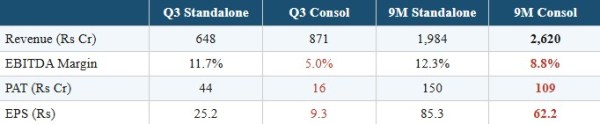 Source: Styrenix Q3 FY26 Investor Presentation. Standalone and Consolidated results.
The India business generated EPS of Rs 85/share for 9MFY26. On a consolidated basis, however, the EPS is Rs 62/share.
Not surprisingly, the market is pricing in the consolidated figure.
Is that fair?
If you believe the inventory losses are genuinely one-time and Thailand ramps to 70-80% utilisation over the next 18 months, the consolidated picture improves dramatically. At peak utilisation, Thailand’s revenue potential is 70-80% higher than current levels. But if validation cycles drag on and prices remain volatile, Thailand stays a quarterly drag with a debt repayment obligation on top.
Story continues below this ad
The FY28 question
Here’s what most investors are missing. Inventory losses are likely non-recurring, and the plant utilisation is ramping up.
In that backdrop, the real forward-looking opportunity/risk is something else entirely: FY 27-28 is when India’s ABS market faces its first real test of domestic supply.
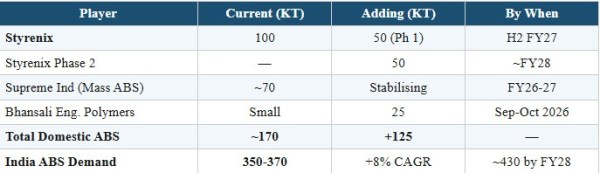 Source: Styrenix Concalls (Q1-Q3 FY26), FY25 Annual Report MD&A. Supreme capacity from analyst questions; exact figure unconfirmed by company. (~ means approximately).
India’s ABS demand currently stands at roughly 320,000 tons (FY25), of which domestic installed capacity covers about 170,000 tons, though actual production is lower given that not all capacity is stabilised.
By FY28, if Styrenix’s Phase 1, Bhansali’s expansion and Supreme’s stabilisation materialise, domestic capacity could rise to approximately 245,000 tons (295,000 if Styrenix Phase 2 is also included).
Demand at 8% CAGR reaches roughly 400,000 tons.
Story continues below this ad
So, the import gap narrows. The management insists India would still remain a net importer. But the question isn’t whether India still imports. It’s whether pricing power shifts when domestic supply goes from covering 46% of demand to 69%.
For a company where 70%+ of ABS contracts are formula-based with protected conversion margins, the existing ABS book is somewhat insulated. The risk lies in filling 50,000 tons of new Phase 1 capacity. Will those additional volumes be placed at historical spreads, or will Styrenix have to compete harder for incremental volume share?
Two buffers soften this risk.
First, Styrenix’s speciality ABS grades (60-70% of ABS sales) face less competition than commodity ABS. According to the management, Supreme’s mass ABS process has not yet been validated in the Indian market, and no mass ABS is currently sold in India.
Second, a hybrid power agreement signed in early 2026 will reduce energy costs starting Q4 FY26, providing Rs 15-20 crores of annual Earnings Before Interest, Depreciation, Tax, and Amortisation (EBITDA) uplift independent of volume.
Valuation and outlook
Over the past nine months, the stock has swung between Rs 3,500/share and Rs 1,860/share.
At the current price, the market is effectively valuing the India business at a reasonable multiple while treating Thailand’s 120,000-ton plant as near-free optionality.
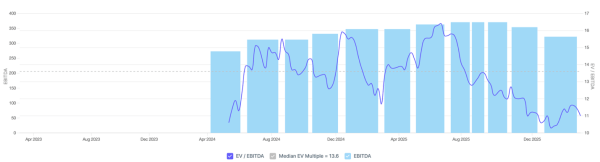 Source: http://www.screener.in
That optionality is real: speciality grades, Asian OEM relationships, and a facility acquired at less than 40% of its asset value. But optionality also comes with a cost. Thailand’s HSBC loan repayments start next month.
The risks are clear: Thailand stays a drag longer than expected, FY28’s domestic capacity additions could compress spreads for new volumes, and potential Phase 1 execution delay.
In conclusion, Styrenix, a 52-year-old company, is in the middle of its most ambitious transformation: doubling domestic capacity, integrating an international acquisition, and navigating India’s first serious wave of ABS import substitution. The next 12-18 months will determine whether the market leader stretched itself one factory too far, or whether it positioned itself perfectly for the decade ahead.
Disclaimer: We have relied on data from http://www.Screener.in and http://www.tijorifinance.com throughout this article. Only in cases where the data was not available, have we used an alternate, but widely used and accepted source of information.
Rahul Rao has helped conduct financial literacy programmes for over 1,50,000 investors. He also worked at an AIF, focusing on small and mid-cap opportunities.
Disclosure: The writer or his dependents do not hold shares in the securities/stocks/bonds discussed in the article.


