
What’s holding Finolex Cables back?
The electrical cables business (86% of FY25 sales) is experiencing margin compression due to a structural mix shift.
The communication cables segment has been a drag on performance for two years, but a global fiber shortage and backward integration could transform it.
Hanging over everything is an unresolved promoter dispute between two branches of the Chhabria family.
The core business: Strong volumes, shrinking margins
Story continues below this ad
Finolex’s electrical cables segment is the company’s engine. It delivered Rs 1,400 crore in Q3 revenue alone, up 44% year-on-year. The volume story was broad-based: electrical wires grew 28%, auto cables surged 42%, and solar cables are running at 80-85% of the capacity built last year.
But here’s the catch. The Earnings Before Interest and Tax (EBIT) margin has been sliding.
It used to be 15-16% a few years ago. Now, management is guiding for 11-12% as the sustainable level after the company shifted to a distributor-led model, which costs 2-3 percentage points in the form of distributors’ margins.
However, even that target has been elusive lately.
Electric cables: Segment data
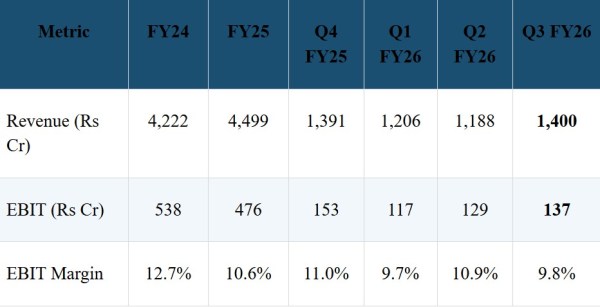 Source: Finolex Cables Investor Presentations (Q4 FY25 to Q3 FY26)
The margin compression is structural, not cyclical. Two forces are at work here.
Story continues below this ad
First, the sales mix has shifted towards project business (builders, infrastructure developers), which runs at 4-5% lower margins than retail. Project sales have gone from roughly 20-25% of wire revenue to about 40% over the past few years.
Copper prices, too, have been volatile. While the company has taken as many as 12 price hikes, those are passed on with a lag, which hits margins.
Competition is another concern. While management believes the industry still has room for multiple players, new entrants from large conglomerates could intensify pricing pressure over time.
If the outlook is so grim, why are we talking about the company? Here’s why.
Story continues below this ad
The fiber bet: From dead weight to potential game changer
Finolex’s communication cables segment, which contributes roughly 8% of revenue, has been underwhelming. EBIT margins have hovered around 1.3% for four consecutive quarters, translating to negligible operating profits.
However, recent developments suggest a potential inflection point.
Global fiber prices, the key raw material for optical fiber cables (OFC), have surged from around $3 per fiber kilometer during Q3 to approximately $5 as of February 2026. In the latest conference call with investors, management said “neither fiber nor preform is available for literally any amount of money.”
That marks a reversal from FY25, when fiber prices hit a multi-year low of $2.50 due to Chinese oversupply.
Story continues below this ad
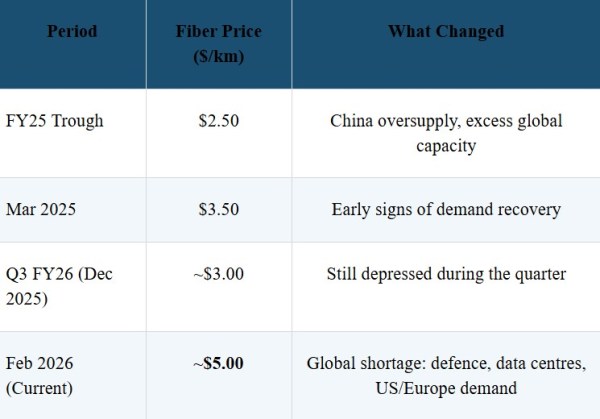 Source: Management commentary across Q4 FY25, Q1-Q3 FY26 Earnings Calls
The timing couldn’t be better for Finolex, because two capacity investments are coming online simultaneously.
First, a glass preform factory is currently under production trials and expected to be commissioned by March 2026. This would make Finolex only the second company in India capable of manufacturing preforms domestically. It eliminates import dependence.
Second, fiber drawing capacity is expected to double from 4 million to 8 million fiber kilometers per year, with full capacity expected by the end of Q1 FY27.
The financial impact, if it plays out, is significant. Management has guided for a total OFC segment revenue of Rs 600-700 crore at full capacity, with EBIT margins recovering to 8-9%, the historical norm when utilisation exceeded 75%. That’s potentially Rs 50-60 crore of incremental EBIT from a segment currently generating Rs 5-6 crore annually. Put differently, this single segment could add 10-12% to the company’s total operating profit.
Story continues below this ad
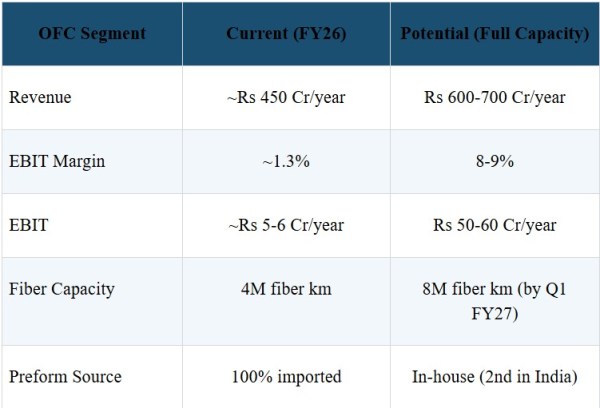 Source: Management guidance, Q2 & Q3 FY26 Earnings Calls
BharatNet Phase 3 adds further optionality. Finolex didn’t win any of the 16 direct BSNL tenders, but many winners lack their own fiber or cabling capacity and are now approaching Finolex for supply. With global fiber in short supply, Finolex’s bargaining position has strengthened.
But the risks remain. Fibre prices could soften if global supply normalises, telecom projects face delays, and backward integration into preforms introduces execution risk.
The promoter dispute
Beyond operations, governance remains a critical concern. The ongoing dispute between Deepak Chhabria and Prakash Chhabria over control of the company continues to cast a shadow. The matter is sub judice and has been in the courts for years.
When asked directly on the Q1 FY26 call whether the dispute has impacted business, management’s response was careful: “some impact, but not overall.”
Story continues below this ad
Why does the outcome matter? Because control ultimately hinges on Orbit Electricals, which holds 30.7% of Finolex Cables. Prakash Chhabria controls ~78% of Orbit, giving him effective control over that entire block.
Finolex Industries, a separately listed associate company, holds another 14.51% of Finolex Cables. While Finolex Industries has its own board, Orbit also holds 18.80% of Finolex Industries, giving Prakash significant influence there, too.
At the September 2023 AGM, both Orbit and Finolex Industries voted against Deepak Chhabria’s reappointment as Executive Chairman. He was ousted with 72% of the votes against him. With promoter group shareholding at 35.86%, control of the company runs through Orbit. So, whoever wins the court battle over those shares effectively decides the future of Finolex Cables.
What it all adds up to
At roughly Rs 960 per share, Finolex Cables trades at about 18 times trailing earnings and 2.3 times book value. On a relative basis, too, the company trades at a big discount to peers.
Story continues below this ad
Source: http://www.tijorifinance.com
This discount might be justified, given Polycab and KEI have grown EPS at a much faster clip than Finolex. Their ROCE numbers are also superior to Finolex.
The investment thesis for Finolex hinges on whether this gap can close.
Finolex’s balance sheet is one of the strongest in the Indian cables industry sector: Rs 5,700 crore of consolidated net worth, Rs 2,713 crore of cash and liquid investments (as of November 2025), zero long-term debt, and annual cash generation of Rs 350 crore (3-year average).
But for the stock to re-rate, what is needed is higher volume growth, margin recovery, and successful scaling of the optical fibre segment.
The next 4-6 quarters will determine whether Finolex is finally reaching its potential or continues to underwhelm.
Note: We have relied on data from www.Screener.in and www.tijorifinance.com throughout this article. Only in cases where the data was not available, have we used an alternate, but widely used and accepted source of information.
Rahul Rao has helped conduct financial literacy programs for over 1,50,000 investors. He also worked at an AIF, focusing on small and mid-cap opportunities.
Disclosure: The writer or his dependents do not hold shares in the securities/stocks/bonds discussed in the article.
The website managers, its employee(s), and contributors/writers/authors of articles have or may have an outstanding buy or sell position or holding in the securities, options on securities or other related investments of issuers and/or companies discussed therein. The content of the articles and the interpretation of data are solely the personal views of the contributors/ writers/authors. Investors must make their own investment decisions based on their specific objectives, resources and only after consulting such independent advisors as may be necessary.


