
Beyond dal baati churma: The flavours of Rajasthan’s ker sangri and safed maas | Food-wine News
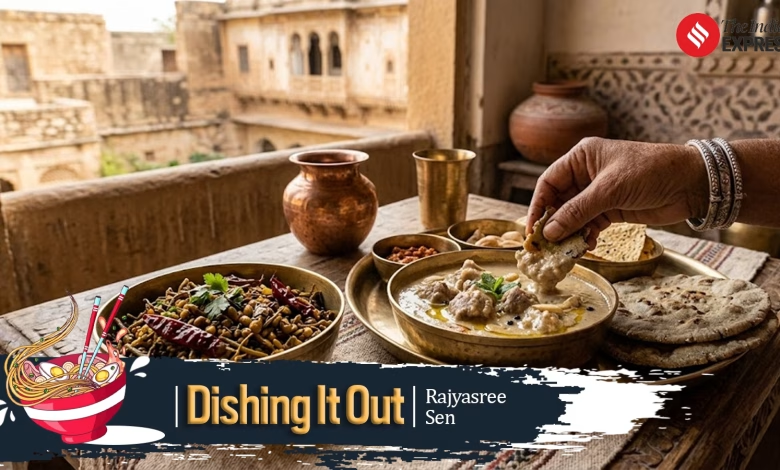
This week, I spent two days at a beautiful palace on the way to Jaipur. Patan Mahal is not only a balm for the senses—given that we were there in the middle of the week and there was no one in sight—it is also a great place to ease your taste buds into the world of Rajasthani cuisine.
While I became well-acquainted with vegetarian Marwari cuisine because I lived in Calcutta and had friends in the right places, Rajasthani cuisine was something I encountered only when I travelled to the state for the first time in my teens. Rich, earthy, and exotic – thanks to the desert vegetables that form a part of the daily fare – it also boasts of some of the most delicious meat preparations I have ever had. This trip was no different.

Traditional Rajasthani cuisine embodies the hardships of living in a desert and the desire to eat tasty food. I want to start with one of my favourite preparations, the underrated Safed Maas. Everyone talks about Lal Maas, but the subtlety of Safed Maas is not to be dismissed. Unlike Lal Maas, which is fiery in appearance and which I will discuss later, Safed Maas is cooked in a nutty, creamy sauce and has a slight sweetness that acts as a perfect foil to the spice. Slow-cooked, velvety, and rich, this is as celebratory as it gets.

For the more herbivorous inclined, the Ker Sangri is a must-try. This dish is innovation at its best. Rajasthanis prepare a sturdy, hearty vegetable using dried sangri beans and ker berries that grow in the desert. No European or even non-Rajasthani vegetable resembles the sangri bean’s thick, grass-like structure. It is cooked in a yoghurt gravy or as a dry vegetable with potatoes and berries. Easily available in the desert, this is a staple in Rajasthani homes.
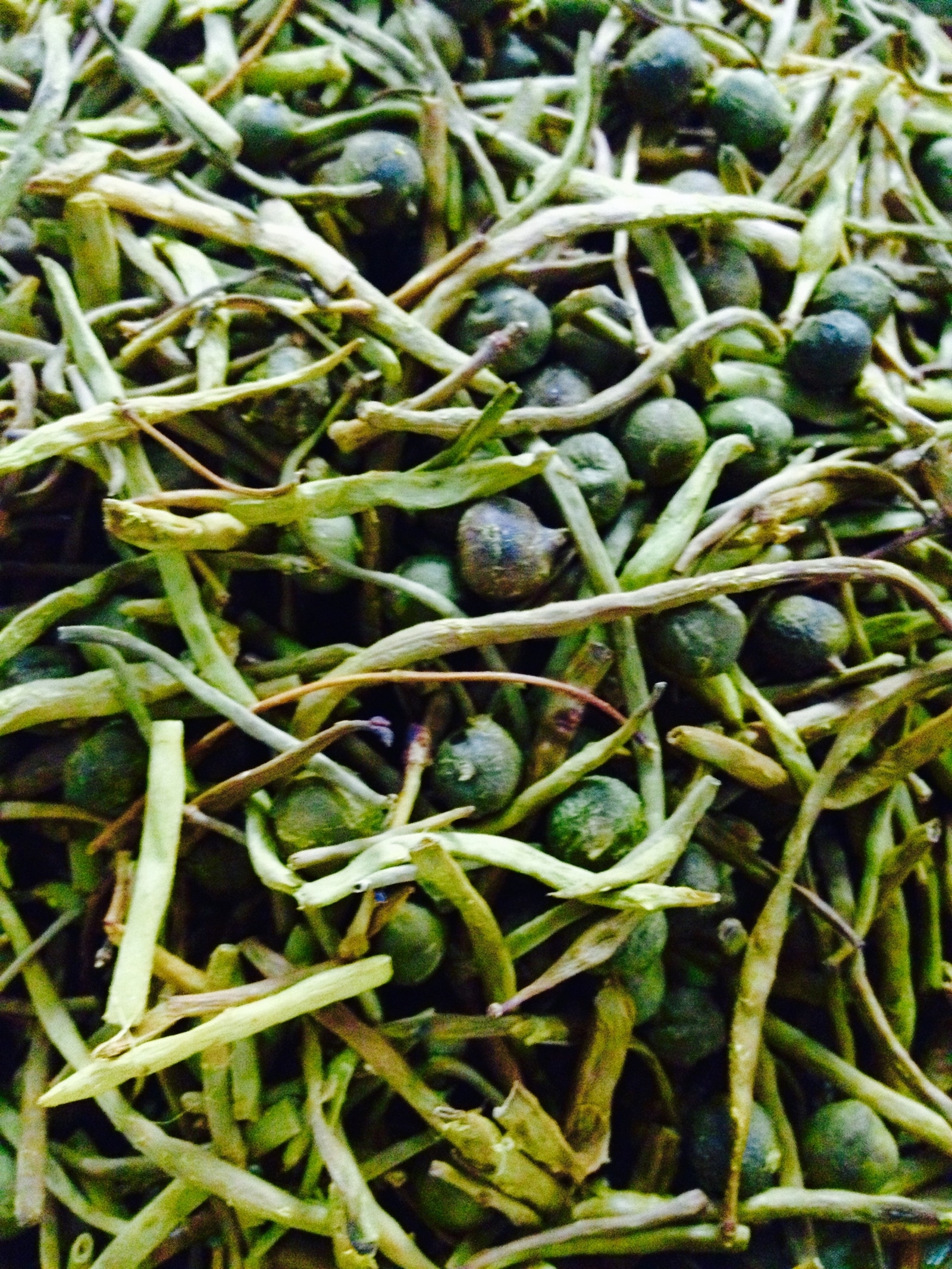 Rajasthanis prepare a sturdy, hearty vegetable using dried sangri beans and ker berries that grow in the desert. (Wikimedia Commons)
Another common preparation, and quite the delicacy, is Gaanth—a porridge made from wheat, milk, and sugar. Breads are usually made from makki (corn) or bajra (pearl millet), and generously slathered with butter or ghee, and topped with mushti khand, a raw, unprocessed sugar unique to the region that tastes of honey and caramel.
Even the ingredients used in Rajasthani cuisine are evocative of the desert they come from and the one they survive in. Mathania red chillies impart flavour and colour but very little heat, kachri powder made from dried and powdered wild melon—used to tenderise meats—fresh cumin, turmeric root, aniseed, and coriander seeds carry the stamp of the desert.
Another popular Rajasthani preparation is Gatte ki Sabji, where soft gram flour dumplings are simmered in a lightly flavoured yoghurt gravy. The gram flour is mixed with spices, oil, and yoghurt.
Story continues below this ad
A dessert I tried for the first time on this trip was the Rajasthani Lapsiisa. It resembled a finer version of the Bengali Bondey, but was made with daliya (broken wheat), ghee, and jaggery (or sugar). Small balls of this mixture are served plain and make for a less-sweet, more delicious dessert that is considered nutritious, healthy, and easily digestible.
It is impossible to have a Rajasthani meal without being served Dal Baati Churma. Each of these is a different component of the holy troika of the region’s cuisine. The dal is a mixture of lentils, which includes toor dal, chana dal, moong dal or urad dal, which is cooked with spices and sometimes a little jaggery. The baati is a hard, round bread made from wheat flour, either baked or fried, but ideally cooked over a coal fire or in an oven. The churma is made from coarsely ground wheat flour, bajra, or semolina, mixed with ghee, powdered sugar, and sometimes dry fruits. To savour Dal Baati Churma, you would need to break the baati, top it with lots of dal, then add the churma to the bowl. Each spoonful should include all three components.
I must end with my second-favourite Rajasthani delicacy—the first being Junglee Maas. Lal Maas is a true celebration of Rajasthani culture and history. It is a throwback to the era of maharajas who rode out to war or hunt. This fiery red preparation is made by slow-cooking mutton in yoghurt, garlic, and Mathania chillies, which give the meat its red colour and heat. Traced back to the 8th century, Lal Maas is said to have originated during shikaars, or hunting expeditions.
The anecdote goes that the maharajas were accompanied on these trips by an entourage, including their khansamas (royal cooks). With no refrigeration or vehicles, rations and produce that could be carried had to be simple and light. Chillies, garlic, water, and yoghurt were easy enough to take along.
Story continues below this ad
The day’s hunt—wild boar, jungle fowl, or deer—would be sent back to the camp kitchen where it would be cooked and served for dinner. The addition of chillies was said to mask the gamey smell of meat. Slow-cooked, rich, and succulent, Laal Maas is a dish for those who truly love meat. There are two versions: the one cooked with ghee in Jodhpur and the other cooked in mustard oil, which is more common in Udaipur.
While the repertoire of Rajasthani cuisine may be more limited than that of other regions of India, it epitomises the country’s kitchen innovation, where even in a stark desert state, surrounded by unending dunes, delicious food is prepared using the most basic of ingredients.
Next week, I’ll write about the world of secret pincodes, doors leading into tunnels leading into beautiful bars, and the growth of speakeasy bars across the country.


