How a Silicon Valley pioneer is scaling India’s social startups.
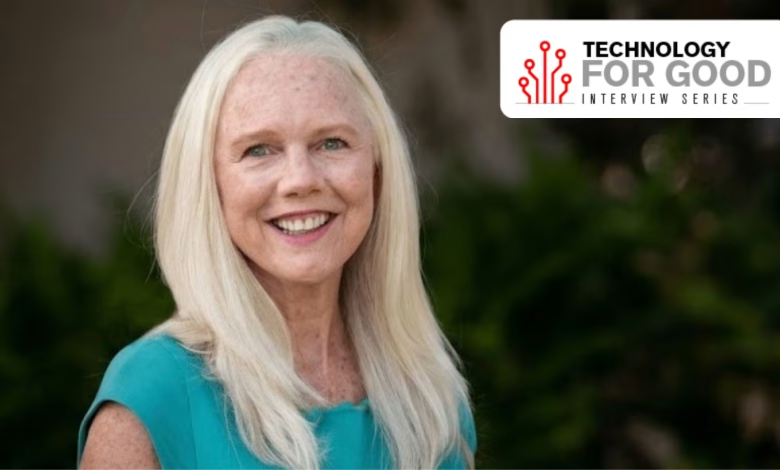
Brigit Helms is the Executive Director of the Miller Center for Global Impact at Santa Clara University, where she also holds the Howard and Alida Charney Professorship for science, technology, and society.
The Miller Center is a global leader in accelerating social enterprises.
Over a career spanning more than three decades, Brigit has designed and delivered solutions to social and environmental challenges in Africa, Asia, and Latin America.
She has held leadership roles at DAI, the Multilateral Investment Fund (now IDB Lab), McKinsey, and the World Bank Group, where she was a founding executive at the Center of Excellence for Financial Inclusion. She is also the author of Access for All: Building Inclusive Economic Systems.
Brigit holds a PhD and MA in development and agricultural economics from Stanford University, an MA in Latin American studies from Johns Hopkins, and a BS in political science from Santa Clara University.
In a conversation with indianexpress.com, Brigit spoke about the work of the Miller Center, the social enterprises it mentors, and how these enterprises are using technology to solve problems at scale. Edited excerpts:
Venkatesh Kannaiah: Tell us about the Miller Center and the work you do with social enterprises.
Brigit Helms: Founded 30 years ago, the Miller Centre is one of the original organisations supporting the social enterprise ecosystem. Its founders wanted to leverage the innovation and entrepreneurship of Silicon Valley and combine that with the social justice philosophy of Santa Clara University to solve global problems. We launched our first accelerator programme in 2003, nearly three years before Y Combinator.
Story continues below this ad
India has historically been the Miller Center’s largest footprint country. We worked with many entrepreneurs in the early 2000s, and are now in the process of revitalising both our pipeline and our portfolio of companies.
The incubator and accelerator ecosystem in India is robust, and there is a decent amount of very early-stage funding. But it’s sort of a cliff, a drop-off after that. And until the impact investors become interested in you, and that tends to be once you’ve reached a million or two in revenue, you are in an early valley of death. I am referring here to social enterprises and not to other startups in general.
So we specialise in solving the problem of the early valley of death for social enterprises. This normally happens when they have reached around $50,000 to $100,000 in revenue, and up to about $2 million. We take these enterprises through an investment readiness programme.
Most of the work is done through a network of about 500 executive mentors, who have built companies themselves and who manage P&Ls within larger companies. So the typical entrepreneur is mentored, and we accompany them across that valley of death until they get their cheque.
Story continues below this ad
We do have a small fund, but the main point is connecting them with funding that might be out there.
Venkatesh Kannaiah: Could you share numbers that illustrate the impact you’ve had?
Brigit Helms: We have accelerated more than 1,600 companies across 100 countries that have a substantial impact on the ground. Our impact metric is the number of lives improved, and last year, we crossed 200 million. In the last five years, entrepreneurs in our network have raised about $300 million within three years of engaging with us.
Our active global network of 280 entrepreneurs, whom we’ve engaged in a significant way within the last three years.
Venkatesh Kannaiah: Where does tech fit into your vision of change?
Brigit Helms: When people in the West talk about technology, they often mean artificial intelligence, blockchain, or advanced software. But in many of the countries and communities where social entrepreneurs work, technology can mean something much broader.
Story continues below this ad
Social entrepreneurs are using tools available to them to solve problems related to poverty, inequality, and climate vulnerability. Sometimes it does involve AI tools that predict and optimise sustainable energy production, digital platforms that connect smallholder farmers to markets, or mobile finance systems that expand access to capital.
Often, the innovation is low-tech or context-appropriate. We see entrepreneurs using cement and microbial material to construct durable bio-toilets or engineered systems to re-use wastewater for irrigation or simple SMS-based market and trade information platforms to empower low-income merchants.
For us, workable tech often combines the ingenuity of local entrepreneurs with tools that are affordable and scalable.
Venkatesh Kannaiah: Tell us about your global partners/mentees who are using tech in an impactful way.
Brigit Helms: There are quite a few. Someone Somewhere, a Mexico-based social enterprise and lifestyle brand, connects indigenous artisans with global markets by integrating traditional handicraft techniques into modern apparel.
Story continues below this ad
In 2023, the company introduced AI to accelerate product design and build scalable supply chains to connect large corporate partners with rural artisan communities. A viral AI-generated concept image helped put them on Adidas’ radar and ultimately led them to a major contract with the company.
Rio Fish, a Kenya-based social enterprise, sources fish from smallholder farmers, mostly women, and distributes it through a cold-chain network and digital marketplace. They ensure a reliable supply of fish for women fish traders while strengthening food security and livelihoods around Lake Victoria.
Rio Fish has built a digital platform connecting fish farmers, traders, and distribution outlets. The platform supports procurement, farm management, and e-commerce while coordinating cold-chain logistics and market demand. By digitising the supply chain, Rio Fish has improved transparency, reduced post-harvest loss, and enabled thousands of smallholder farmers and women traders to participate in a more reliable and equitable market.
Loop is a women-led digital platform that connects households in Peru with professional cleaners, primarily migrant women, creating safe and dignified work opportunities while providing customers with a trusted and convenient home cleaning service.
Story continues below this ad
Founded in 2021, Loop integrates AI and data-driven tools into its platform to improve how customers and cleaners are matched. The technology also works to optimise scheduling and routing, and enhances trust and safety features within the app. These tools have helped automate bookings, improve service efficiency, and support the scaling of decent work opportunities for women.
Flamingo Foods, a climate-smart agri enterprise in Tanzania, uses satellite, weather, and machine learning data to anticipate food surplus and deficit regions across East and Southern Africa. This business model enables the company to purchase staple crops from farmers in surplus areas and distribute them to drought-affected regions before shortages occur.
Flamingo Foods connects AI tools with its satellite imagery and climate data to identify emerging supply and demand imbalances across the regions’ food systems. Their model analyses rainfall patterns and crop conditions to predict where maize and rice surpluses or shortages will occur before they appear in the market, helping the company make procurement and distribution decisions to reduce food waste and improve market access for farmers.
Hola Tractor connects small-scale farmers in Bolivia with affordable tractor services through a digital platform that allows them to request, schedule, and monitor mechanisation services. By improving access to equipment that would otherwise be out of reach, the social enterprise helps smallholder farmers increase productivity while creating income opportunities for rural women through its network of local booking agents.
Story continues below this ad
Hola Tractor’s platform uses tech to match demand for mechanisation with nearby tractor operators, improving scheduling efficiency and reducing idle time for equipment. It incorporates data-driven insights from usage patterns and farm activity to improve fleet deployment, better predict service demand, and guide future expansion.
Venkatesh Kannaiah: Could you tell us about a Miller Center company which has grown really big?
Brigit Helms: Husk Power Systems is one of our longest-standing Miller Center social enterprises. They first came through the programme in 2009 and have remained deeply engaged with us.
Husk Power is based in India and integrates AI and machine learning tools to optimise its solar-hybrid mini-grids that provide clean electricity to rural communities.
They have mini-grids across households, communities and schools. And they are using predictive AI to determine where to put the next grid. It could very well be one of the largest profitable distributed mini-grid power companies in the world. Their last capital raise was over $100 million, and they’re currently raising around $400 million. That’s pretty big for the social sector.
Story continues below this ad
Their AI systems forecast demand, manage batteries and backup biomass generation, and improve power flow efficiency across their network. This has reduced operating costs, improved reliability, and helped Husk scale to hundreds of distributed power plants. Husk was named the world’s most innovative energy company by Fast Company in 2024, and its promoter, Manoj Sinha, was listed as TIME’s 100 Most Influential Climate Leaders in Business.
Venkatesh Kannaiah: Could you tell us about your India partners/mentees who are using tech in an impactful way?
Brigit Helms: There are quite a few. Apart from Husk Power, there is Farmers for Forests, whose co-founder, Krutika Ravishankar, went through our accelerator in 2023.
Farmers for Forests uses AI-powered monitoring to track tree growth and carbon stock, helping smallholder farmers transition to climate-resilient agroforestry. Their open-source technology increases transparency, unlocks carbon financing, and has shown early results of income growth while strengthening climate resilience and carbon sequestration.
Awaaz.De develops mobile communication tech that enables organisations to reach underserved communities in India through simple voice and messaging tools. Its platform helps microfinance institutions, NGOs, and development organisations engage last-mile customers and deliver services through accessible phone-based interactions.
They are developing AI tools that enable natural, real-time voice interactions for users with limited digital literacy or internet access. Their models help automate conversations, respond to user questions, and analyse large volumes of voice data to generate insights for partner organisations.
Venkatesh Kannaiah: Has tech become an integral part of impact-creating social enterprises?
Brigit Helms: Technology is certainly becoming an increasingly important part of how social enterprises create impact, but I think it’s important to remember that technology is just one tool among many.
Sometimes tech like AI, mobile platforms, or data systems can dramatically increase the scale and efficiency of a solution. For example, they can help entrepreneurs reach more customers, analyse data to improve services, or connect farmers and small businesses to markets and financial services.
But technology isn’t always the right tool for the problem. Many social entrepreneurs are creating powerful impact through innovative business models, creative product design, and new ways of reaching underserved communities, even when the solution itself is relatively low-tech.
At Miller Center, we are exploring new ways to connect social enterprises with technical expertise. We work with the Santa Clara University School of Engineering to co-design technology solutions and with our business school to use tools like AI to generate actionable insights from real-world data. So while technology isn’t the whole story, it’s increasingly becoming a powerful amplifier.
Venkatesh Kannaiah: How will AI impact social enterprises, and what changes is it bringing about?
Brigit Helms: AI is likely to be both positive and challenging for social enterprises.
On the positive side, AI tools are becoming more affordable and accessible, and many social enterprises are already using them to improve their work.
However, history shows that new technologies don’t always benefit everyone equally. While people often say that technology is a “rising tide that lifts all boats,” in reality, the benefits of new technologies have often been captured disproportionately by those who already have resources, capital, and access to infrastructure. And that is a real challenge for social entrepreneurs.
There are also broader systemic issues. AI data centers that power large-scale models require large amounts of water and energy. For communities already dealing with energy poverty or climate vulnerability, this raises important questions.
AI and related technologies, such as robotics, are likely to reshape labour markets. Some jobs will disappear, while new ones will emerge. Social entrepreneurs need to play a role in helping societies navigate this transition.
The challenge is to see that these AI tools are used in ways that expand opportunity rather than deepen inequality.