
Air India Express losses rise: Is Air India’s 2027 profitability target now in turbulence? | Smart Stocks News
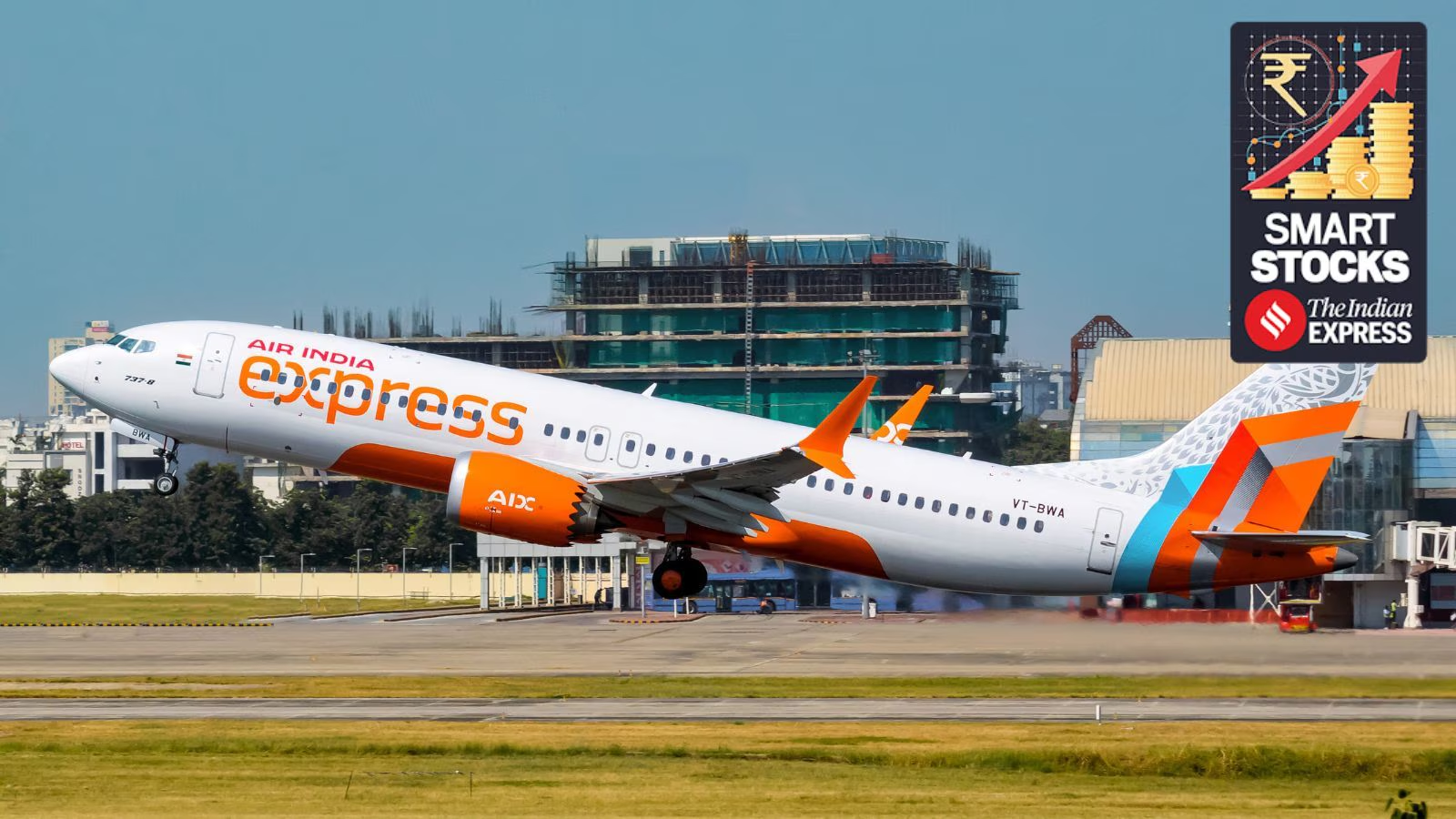
It has been over three years since the Tata Group began the recovery of Air India and the journey has been far from smooth. Tata Sons agreed to acquire Air India in October 2021 and formally took charge in January 2022. In the same year, it fully acquired AirAsia India, later renaming it AIX Connect. In September 2022, the company launched its five-year revival strategy, “Vihaan,” under the leadership of former Singapore Airlines executive Campbell Wilson.
The strategy’s key objectives included consolidating Tata’s four-airline portfolio into the Air India (AI) Group, modernising the fleet, upgrading IT systems, training crew, and standardising customer experience. However, implementing a merger of this scale comes with challenges, and they are visible in the earnings figures. Notably, the AI Group does not publicly release its annual report.

As per the figures obtained from Tata Sons’ annual report and Directorate General of Civil Aviation (DGCA), AI Group’s revenue surged to Rs 76,754 crore in FY25, and losses widened to Rs 10,975 crore from Rs 4,444 crore a year ago. Of the total losses, Rs 5,678 crore was reported by AI Express, up from Rs 1,357 crore a year ago.
Fig 1: Air India Group’s Revenue and Net Profit (FY21-25)
Source: Tata Sons annual reports
For an outsider, seeing these losses in isolation may come as a shock. On one side, AI Express’ losses swelled fourfold. On the other, rival InterGlobe Aviation’s profit fell 11% to Rs 7,200 crore in FY25.
At first glance, these figures may seem alarming. AI Express’ losses have quadrupled, while its rival InterGlobe Aviation’s profit declined only 11% to Rs 7,200 crore in FY25.
Story continues below this ad
What explains the stark contrast in the earnings of India’s two largest low-cost carriers?
Behind Air India Express’ ballooning losses
The AI Group completed the merger of low-cost carrier (AI Express + AirAsia India) on October 1, 2024, and of full-service carrier (AI + Vistara) on November 12, 2024. These mergers increased operational costs. In addition to the merger cost, AI Express rapidly increased its fleet size from 28 to over 100, including 50+ Boeing 737 Max jets.
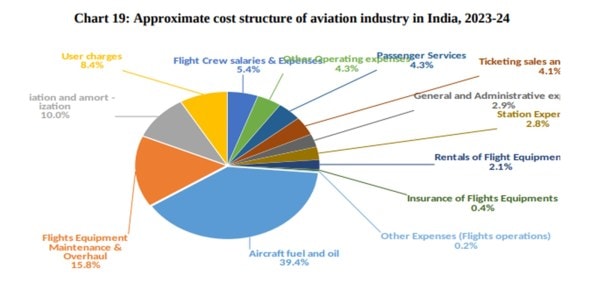 Fig 2: Indian aviation industry’s cost structure
For an airline, the biggest operating expense is air turbine fuel (ATF) and maintenance, repair and overhaul (MRO). The cost of operating and maintaining a three times bigger fleet, plus the merger-related costs, ballooned AI Express’ losses. The older fleet further added to MRO.
This is where AI Group’s next leg in the revival plan, fleet modernisation, comes in.
Story continues below this ad
AI Group’s fleet modernisation faces supply chain constraints
When Tata Sons took over Air India, it knew the fleet needed modernisation. Hence, it placed an order for 470 aircraft with Airbus and Boeing in 2023. However, supply chain shortages in key components such as engines, avionics, and semiconductors, along with workforce constraints, shipping delays, and quality issues at Boeing, have slowed aircraft deliveries.
Despite these challenges, Indian airlines added a record 120-130 aircraft to their fleets in 2024, of which around 70 were inducted by Air India and 52 by IndiGo. Air India also placed an additional order for 100 aircraft in December 2024, with deliveries expected by 2030. However, the ongoing supply crisis could slow new aircraft additions by 15-25% in 2025 and affect Air India’s fleet-modernisation plans.
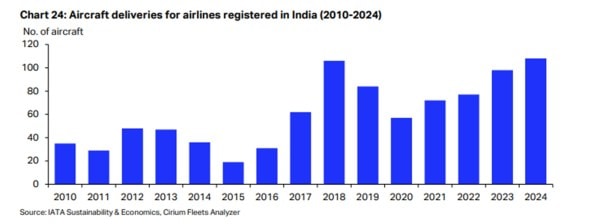 Fig 3: Aircraft Deliveries for Indian Airlines
Source: International Air Transport Association (IATA)
Delayed aircraft deliveries could slow capacity expansion and force Air India to lease older aircraft at higher costs. Older aircraft also entail higher MRO expenses.
Story continues below this ad
Meanwhile, Indian airlines are grappling with external headwinds such as Pakistan’s continued closure of its airspace to Indian carriers, resulting in an estimated Rs 4,000 crore in losses to Air India.
IndiGo Airlines’ net profit fell 20% year-over-year to Rs 2,176.3 crore in Q1 FY26 as total cost rose 10.2%, faster than total income at 6.4%, because of rising ATF and a depreciating rupee.
Working on thin margins amid external turbulence is business as usual for airlines. What sets market leaders apart is their ability to sustain turbulence, absorb losses, and convert them into profits.
Is Tata’s ambition to turn Air India profitable by 2027 facing turbulence?
In just three years, the AI Group has expanded its route network and increased its fleet size. The latest monthly DGCA data shows the Group’s domestic market share rose to 27.3% in August from 26.2% in July, while IndiGo’s dipped to 64.2% from 65.2%.
Story continues below this ad
However, the June plane crash, slowing fleet modernisation, and rising MRO costs could delay the Group’s ambition to turn profitable by 2027. It is still too early to judge the revival based solely on financial performance. Volatility is likely to persist for another two to three years, with sharp swings in profitability. Tata Sons undertook this ambitious turnaround through privatisation because the airline required rapid and difficult decisions, which may cause heavy losses in the short term but deliver cost benefits in the long run.
Instead of putting a timeline on the profits, investors and competitors may look at the long-term benefit of the group’s actions.
In the meantime, Indigo’s profits thrive
The Indian transport sector poses unique challenges for airlines, largely because the country imports most of its ATF, which accounts for nearly 40% of operating costs in India, compared to the global average of around 30%. Despite this, IndiGo has consistently emerged as the most profitable airline in the country, whose profits thrived even when Kingfisher, Jet Airways, and GoAir collapsed.
So what does IndiGo do differently?
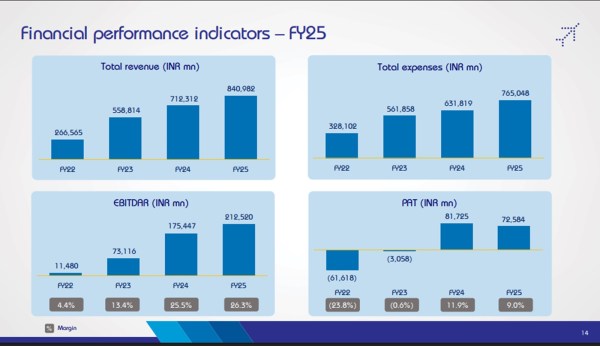 Fig 4: IndiGo’s Financial Performance (FY22-FY25)
Source: InterGlobe Aviation FY25 Investor Presentation
Story continues below this ad
IndiGo has perfected the sale-and-leaseback (SLB) business model to control 3Cs: capacity, cash flow, and cost. The airline places bulk orders for a “fit-for-purpose” Airbus A320 fleet model, which is used by most global airlines, and avails itself of a heavy discount. These orders are then delivered gradually over several years. For example, IndiGo’s 2005 order of 100 Airbus A320s helped it induct roughly 12 aircraft per year, each leased back on a six-year term.
During 2012-13, when India’s airline industry suffered an estimated loss of Rs 12,200 crore, IndiGo generated a profit of Rs 787 crore, of which Rs 300 crore came from SLB, according to the Centre for Asia Pacific Aviation (CAPA).
How SLB achieves capacity, cost, and cash flow
The bulk aircraft order allows IndiGo to increase its capacity. The sale of aircraft to a lessor does not block its cash flow, which it can use for its working capital needs. The airline keeps modernising its fleet with new low maintenance, fuel-efficient aircraft, reducing its operating costs.
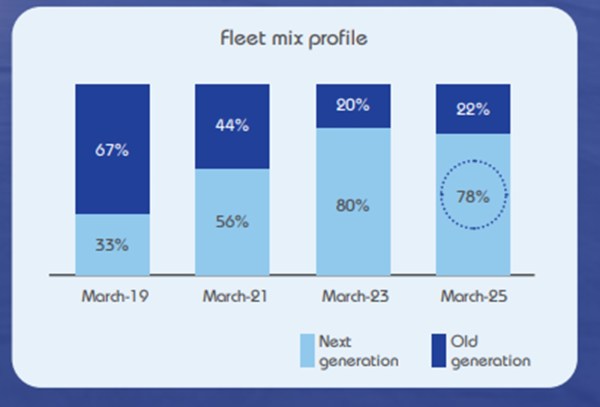 Fig 5: IndiGo’s Fleet Mix FY19-FY25
Source: InterGlobe Aviation FY25 Investor Presentation
Story continues below this ad
As of March 31, 2025, IndiGo boasts India’s largest (434 aircraft) and youngest (average fleet age of 4.9 years) fleet. This is where Air India is struggling. It has an older fleet that demands more maintenance, thereby increasing operating costs.
The SLB has made IndiGo’s balance sheet asset-light, but debt heavy. At the end of March 31, 2025, IndiGo had a total cash balance of Rs 48,170.5 crore and a total debt (including capitalised operating lease liability) of Rs 66,809.8 crore. On the other hand, AI Group had a debt of Rs 26,879.6 crore.
The question arises, why doesn’t Air India adopt the SLB model and turn profitable?
Air India is a full-service airline that focuses on customisation to offer a unique and premium passenger experience. The problem with leasing is that the lessor imposes unnecessary maintenance requirements. Moreover, leasing is expensive in the long run compared to ownership. Expenses reduce over the aircraft’s economic lifespan (20-30 years), bringing operational efficiency.
Story continues below this ad
Can Air India Express losses compete with Indigo’s profits?
It took IndiGo three years from its inception to become profitable. Air India Express could take longer as the merger synergies are realised. It had reported profits in three out of the nine years of its service. The Rs 5,800 crore loss in FY25 is probably its bottom as merger costs and capacity expansion accumulated in a single year.
The next three to five years could see normalisation of expenses, capacity expansion, and a slowing of losses. AI Group is building an entire aviation ecosystem, with training and MRO facilities, and adding new routes, largely international. AI is bringing line maintenance in-house as it expands its fleet with an order for 570 new planes.
IndiGo senses competition from AI Group and is buckling up to sustain its market leadership. It has ordered 920 planes scheduled to be delivered over the next 10 years. The airline that focuses on narrow-body aircraft has ordered 30 A350 wide-body aircraft, scheduled to arrive in 2027, to tap international routes. Until the wait period, IndiGo is servicing international routes by acquiring some wide-body aircraft on damp lease. In FY25, it added seven international routes and also introduced its business class service, IndiGo Stretch. So far, the response to Stretch is good.
Jefferies India has a Buy rating on InterGlobe Aviation, with a price target of Rs 6,925, representing an upside of 21% from the current market price. The brokerage values the stock at 11x June 2027 Enterprise Value/Earnings Before Interest, Taxes, Depreciation, and Amortization (EV/EBITDA). It expects the airline to sustain a 25% EBITDA margin with its superior cost efficiency, dominant position in the domestic market, consistent capacity expansion, and strong execution.
In its 19 years of existence, IndiGo has never competed with Air India as a private player. The air race for profits is attracting investors’ attention. It is a good time for Air India to tap the growing air travel market and make decisions with focus on profits and customer experience.
The next four years would be an interesting phase for the two Indian airlines as they modernise their fleet, take to the international skies, and compete not only in economy, but also in business class.
Note: We have relied on data from http://www.Screener.in throughout this article. Only in cases where the data was not available have we used an alternate, but widely used and accepted source of information.
Puja Tayal is a financial writer with over 17 years of experience in the field of fundamental research.
Disclosure: The writer and his dependents do not hold the stocks discussed in this article.
The website managers, its employee(s), and contributors/writers/authors of articles have or may have an outstanding buy or sell position or holding in the securities, options on securities or other related investments of issuers and/or companies discussed therein. The content of the articles and the interpretation of data are solely the personal views of the contributors/ writers/authors. Investors must make their own investment decisions based on their specific objectives, resources and only after consulting such independent advisors as may be necessary.


