
Vodafone Idea’s debt crisis: Time to buy or back away? | Smart Stocks News
4 min readNew DelhiUpdated: Jul 1, 2025 08:39 AM IST
Investors often chase multibaggers that have grown from small-cap to mid-cap. But what about companies that have fallen from large-cap to mid-cap, losing 80–90% of their value? Do they present an investment opportunity?
Sometimes, they do, but the way to look at their fundamentals is different. The focus shifts from revenue and earnings per share (EPS) growth to the balance sheet. Reducing debt and raising new capital takes centre stage. Addressing the so-called ‘elephant in the room’ is what drives their share price.

One such stock is Vodafone Idea (Vi), which has been losing market share to rivals Reliance Jio and Bharti Airtel, and is trading at a 60% discount from its previous peak on June 28, 2024. The ‘elephant in the room’ in this case is Vi’s accumulated interest and penalties on the unpaid spectrum charges and Adjusted Gross Revenue (AGR) dues to the Department of Telecommunications (DoT).
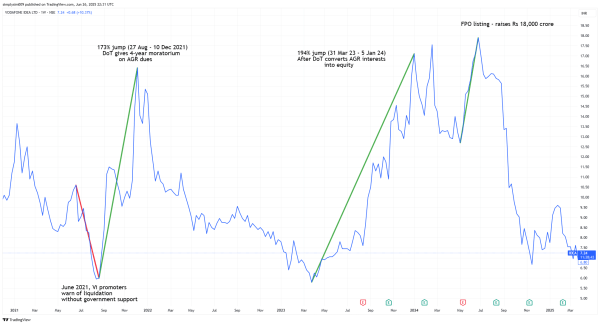
Vi’s deferred payment obligations now total a staggering Rs 1.83 lakh crore, more than twice its market cap of Rs 78,874 crore and over four times its FY25 revenue of Rs 43,571 crore. This mountain of debt has left Vi struggling to raise funds, invest in 4G and 5G infrastructure, improve services, and contribute to India’s digital growth.
Vi’s past dues haunt its future growth
Vi plans to raise Rs 50,000-55,000 crore to invest in 4G and 5G infrastructure over the next three years, increase subscriber counts, and average revenue per user (ARPU).
Last year, it raised Rs 24,000 crore through follow-on public offer (FPO) and equity infusion by promoters and vendors. It used this money to make the biggest capital expenditure of Rs 9,500 crore since the merger of Vodafone and Idea in 2018. This capex slowed the subscriber churn rate.
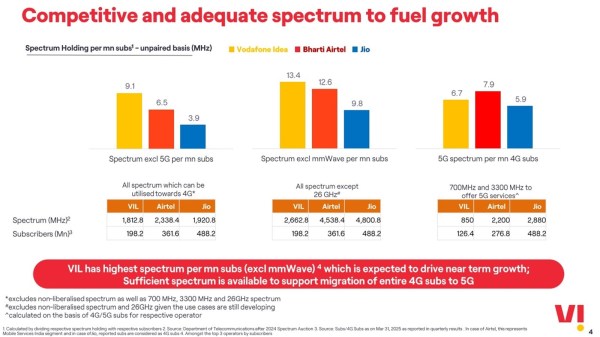
The company is looking to raise Rs 25,000 crore in bank debt to fund its capex. However, the ghost of AGR and spectrum payments from 2021 is affecting Vi’s ability to raise debt.
Story continues below this ad
What Vi needs is a solution to the Rs 1.83 lakh crore AGR and spectrum obligation that is attracting 8% interest per year. Only the Department of Telecommunication (DoT) can resolve this, but finding a resolution to the problem is easier said than done.
Understanding the timeline of Vi’s AGR and spectrum woes
The legal battle on the definition of AGR
1999-2016: It all began in 1999, when India’s telecom sector shifted from a fixed license fee model to a revenue-sharing fee model, leading to a debate between DoT and telecom operators over the definition of AGR.
While DoT said AGR includes revenue from both telecom and non-telecom services, operators said it should include only the revenue from core services. The issue reached the Supreme Court.
The Jio moment
2016-2018: Meanwhile, the telecom industry witnessed the Jio moment. Reliance Jio Infocomm disrupted the market in 2016 by offering data plans at predatory prices. Before Jio, voice services accounted for 70% of the telecom revenue. But with data plans, voice calls became free. Vi and Bharti Airtel’s average revenue per user (ARPU) fell as they were caught in the price war. To sustain, they had to upgrade their network for data, which increased their debt.
Story continues below this ad
Wireless Subscriber Base of Reliance Jio, Bharti Airtel, and Vi (in Rs crore)
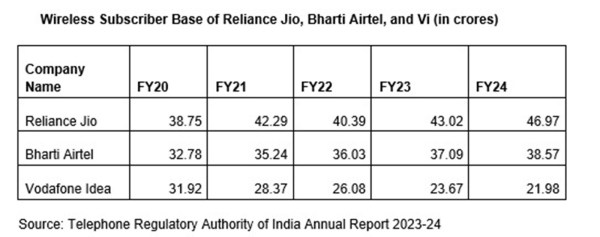 Source: Telephone Regulatory Authority of India Annual Report 2023-24
© The Indian Express Pvt Ltd


