
A friend in need: Behind Elavenil Valarivan and Arjun Babuta’s team rifle gold at Asian Shooting Championships, a familial bond | Sport-others News
5 min readUpdated: Feb 8, 2026 08:14 PM IST
There was a moment at the Paris Olympics when Arjun Babuta was one trigger-finger away from winning a precious Olympic medal. But his nerve deserted him in that moment of need. His friend Elavenil Valarivan, though, didn’t.
Elavenil, who had faced her own disappointment at the Olympics, saw Babuta break down in front of media at the Chateauroux shooting range and quickly whisked him away from the stage where the shooter could privately grieve the moment.

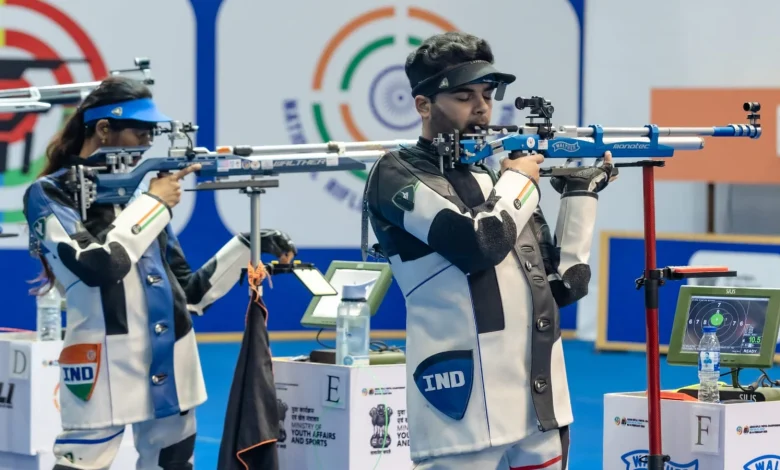
“When somebody is down, you can see that is not the right moment. I think a friend is what they needed,” said Elavenil after her second gold medal at the Asian Shooting Championships at the Dr Karni Singh Shooting Range on Sunday. She had won the individual 10m air rifle women’s event earlier and added the 10m air rifle mixed team title with Babuta.
It was in 2017 that both Babuta and Elavenil started shooting together in the same ranks as juniors. Almost ten years and two Olympic Games have passed since then. Both shooters have grown up together and experienced the same ecosystem. This is now the third time they’ve won a mixed team gold at the Asian Championships, a ‘streak’ that they had earlier discussed as a goal.
Both share the commonality of being extremely consistent shooters. Most will taper their performances based on the time of the year, but both Elavenil and Babuta have a set template of being dead on the mark no matter what tournament, or where. In an Indian team where churn is a given, they continue to steadfastly maintain their top billings in the rifle team of the country.
“I have looked up to Arjun. When I came into the team, Arjun was already winning medals. I remember having so many conversations with him regarding his medals, regarding his performances. It has been a good bond over the years,” says Elavenil. Babuta chimes in and says, “We learned together. We grew up together. We’ve sort of become like family now.”
Babuta then explains how watching the approach of a shooter like Elavenil shaped his own transformations in the sport. “Whoever new is coming up, I like to interact with them and learn about their mindset. I take a lot of enthusiasm back to my own process from it. Whatever new ideas or techniques they are trying, I try to learn about it too. And Ela has always been a great help to me,” said Babuta.
Story continues below this ad
Shooting has always been a highly individual sport, even when participating in a mixed team event. A shooter rarely thinks about the scores that their partner is putting up.
But the Elavenil-Babuta partnership goes a different way where if there is a lull in one person’s scores, the other tries to make up for it. “I’m glad he was able to peak when I was stumbling a bit,” she said. “I think we were compensating each other well.”
New format
In the new mixed team format, shooters are no longer in a playoff but rather in a four-team final, with even the fourth-place team having a chance to win a gold medal. Previously, the teams that topped and came second in qualification had a guaranteed gold or silver and the third-place and fourth-place teams fought for bronze.
But for Elavenil, this format, with three series of five shots, followed by elimination shots, allows for shooters to catch up in case of a slow start. “I think I have always enjoyed this format of finals because it’s easier for us to cover up. We have quite a number of shots, not like the one where if one of us is having a bad shot, then the score drops. It’s not like that. So I feel that I am going to enjoy this,” said the 26-year-old.
Story continues below this ad
“I mean, given the chance that now even a fourth-ranked country can compete for the gold. I think that is something really exciting because back then it was like third and fourth could only fight for bronze. And one and two have short shot medals. So I think this keeps us on the edge to keep our performance up to par,” she added.
On Sunday, the pace that duo kept, repeatedly scoring over 21 points in each tandem shot, put them well above the challenge of South Korea and Japan – who were staying on track but just couldn’t match the consistently top scores that the Indians were jotting up. In the end, the 505 combined total was four points ahead of their nearest rivals.


