Is the downside over for Indian IT stocks?

These are tough times for the IT sector. IT stocks are navigating uncharted territory, with no map to guide them, marked by twists, turns, bumps, and detours.
The sector underperformed the Nifty 50 as it lagged in the artificial intelligence (AI) race. This was followed by concerns around H-1B visas, US tariffs, mass layoffs, and restructuring to adapt to a changing market. As a result, the Nifty IT Index fell 12.6% in 2025, underperforming the Nifty 50 Index, which rose 10.5%.
The latest twist in the IT saga came from Anthropic, a US-based AI startup that questioned the relevance of conventional IT and software services. This dragged the Nifty IT Index down 7.3% over two days (February 5 and 6). Sector leaders Tata Consultancy Services (TCS) and Infosys fell around 9% each, dragging their 2025 dips of 21% and 16%, respectively.
This knee-jerk reaction to AI-related uncertainty triggered a sharp valuation correction in IT sector leaders. Infosys and TCS are now trading at price-to-earnings (P/E) multiples of 21.2x and 20.8x, respectively, below their 10-year medians of 22.8x and 26.7x.
This broke the stocks’ resilience to average valuations amid muted revenue growth and a slowdown in discretionary IT spending. The short-term weakness has turned brokerages bearish on IT services stocks, with Citi maintaining an underweight stance on the sector.
Understanding AI disruption in the IT sector
AI is real, and it is changing IT pricing and operational structures. Industry experts have argued that AI will replace process-driven work, and Anthropic’s latest launch appears to validate that view. Anthropic claims its latest update on its workplace productivity tool, Claude Cowork, can automate legal tasks such as reviewing contracts, sorting non-disclosure agreements, managing compliance processes, drafting legal briefs, and generating standardised responses.
So why is it making investors nervous? Wasn’t AI supposed to increase productivity?
Story continues below this ad
Anthropic is doing exactly that. Each of these tasks is standardised, process-driven, and requires limited analytical thinking. Anthropic has also clarified that the plugin is not intended to provide legal advice, stating: “AI-generated analysis should be reviewed by licensed attorneys before being relied upon for legal decisions.”
However, investors remain concerned that AI could disrupt Indian IT services, which are largely process-driven rather than research- or innovation-driven.
Is IT disruption paving the way for a new growth cycle?
AI-led disruption could witness the decline of the labour-intensive pyramid model, forcing companies to rethink existing structures, renegotiate contracts, and build an outcome-focused pricing model.
Story continues below this ad
It could also give rise to smaller, AI-native firms with niche capabilities that can deliver innovative solutions faster than large organisations. This may compel large companies to partner with such firms, pursue acquisitions rather than organic growth, and develop an AI culture and specialisation.
How is India tackling AI disruption?
Union Minister for Electronics and Information Technology Ashwini Vaishnaw, speaking at a panel discussion at Davos 2026, said that instead of building expensive and large AI models, India is building a bouquet of efficient AI models to improve productivity and service delivery across sectors. Anthropic’s latest launch increases competition even in this space.
While changing geopolitical conditions offered some relief, after the US agreed to reduce tariffs on India from 50% to 18% following the India-US trade deal, technological disruption continues to challenge the relevance of traditional IT services.
The long-term growth trend of Indian IT stocks
Historically, IT services stocks, particularly Infosys and TCS, have delivered predictable long-term returns. Their growth has been shaped by technological disruptions and global economic cycles that influence IT spending.
Story continues below this ad
Over the past 15 years, TCS has witnessed four growth cycles: the 2010 global financial crisis recovery, the 2014 US shale oil and gas boom, the 2018 US-China trade war, and the pandemic-led digital transformation in 2021. Each cycle was followed by roughly three years of flat performance for investors who entered at the cyclical peak.
Fig 2: TCS Stock Price Momentum from 2010 to 2025. Source – Trading View
Infosys, too, has experienced prolonged downturns during periods of global uncertainty, the most severe being the dot-com bubble. Both companies have withstood the crises by realigning their workforce with demand, anticipating future trends, and reskilling employees.
Fig 3: Infosys Stock Price Momentum from 2000 to 2025. Source- Trading View
The current phase of Indian IT stocks
IT stocks corrected sharply in February 2023 as pandemic-driven demand cooled. After strong double-digit revenue growth in FY23 (Infosys surged 21% and TCS 17.6%), the sector is again facing a slowdown as economic uncertainty has reduced discretionary spending. Infosys expects its FY26 revenue growth of 3%-3.5%, up from its previous guidance of 2%-3%.
Story continues below this ad
Historical trends show that the IT spending slowdowns last three years on average. With the last growth cycle ending in FY23, the key question is: are we nearing the end of the downturn?
To answer this, we need to look at three indicators: workforce trends, deal activity, and future growth prospects.
IT workforce optimisation
In IT services, job cuts are typically seen as a negative signal, as the sector relies on billable hours. Workforce utilisation rates and net employee additions are key indicators of demand. For instance, net employee additions reached an all-time high in FY22 as there was a strong demand for digitisation post-Covid. As demand cooled, there was a correction in employee additions.
Fig 4: IT Services Companies’ Net Employee Additions from Q1 FY21 to Q2 FY25
The top six Indian IT companies cut around 72,000 jobs in FY24 to optimise their workforce in response to the economic slowdown and sustain profit margins. There was some recovery in net employee additions in Q2 FY25. However, FY26 shows a stark contrast in the strategies of TCS and Infosys.
Story continues below this ad
TCS has reduced its workforce by 31,000 so far in FY26 as it adopts AI and new-age technologies. About 1% of the cuts were at mid and senior levels due to skill mismatches, according to Chief Human Resources Officer Sudip Kunnumal. Infosys, by contrast, added 13,000 employees in calendar 2025 and plans to hire 20,000 freshers in FY26.
Both companies are investing heavily in reskilling, recalibrating human skills with changing client demands.
Deal activity shows a technological shift
The contrasting workforce trends reflect differences in order books. In FY25, TCS’s order book fell 8%, while Infosys’s surged 53%. In Q3 FY26, Infosys reported strong momentum, with deal wins rising 55% sequentially to $4.8 billion, 57% of which were net new deals, including a large contract from NHS UK. TCS, meanwhile, saw order wins decline 7% sequentially to $9.3 billion.
Despite such deal wins, Infosys’s share price has remained under pressure as heavy investment in hiring and reskilling has affected its margins and lowered return on equity (ROE) to 29% from 32.1% in FY24. TCS, in contrast, increased its ROE to 52% from 51.3% in FY24.
Future growth prospects
Story continues below this ad
Both companies report strong demand from Europe and flat demand in North America. Client interest in AI-driven return on investment (ROI) is growing rapidly.
TCS and Infosys are testing various AI pricing and delivery models. TCS published its annualised AI revenue, which rose 17.3% sequentially to $1.8 billion (Rs 16,200 crore) as of Q3 FY26, accounting for 5% of its total revenue. Infosys did not reveal the AI revenue numbers, but noted it has over 4,600 AI projects in the pipeline and is working on AI-related projects with 90% of its top 200 clients.
Is AI the next growth cycle for Indian IT stocks?
While India remains cautious, signs of an AI bubble are emerging in the West. Unlike the dot-com era, today’s AI investments span physical infrastructure — data centres, semiconductors, large language models and energy — raising concerns about sustainability.
Story continues below this ad
At the 2026 World Economic Forum meeting in Davos. Microsoft CEO Satya Nadella, drawing parallels with the internet, said that AI’s huge computing power can only give returns when it is cheaper and accessible to every company and delivers real-world results. The focus is shifting from spending billions on creating expensive AI infrastructure to deriving ROI from AI through real-world use cases.
That could be India’s opportunity to become the world’s AI factory that requires efficiency.
Ernst and Young’s AIDEA report estimates that AI could upend 3.8 crore jobs in India across sectors, especially software and IT support roles, by 2030. However, enterprise AI adoption also requires clean, vast datasets, niche AI solutions for specific sectors, and compliance with evolving AI regulations. All that will require human intervention, and that is where new job opportunities lie. There is a growing demand for research and innovation jobs that can create AI-driven intellectual property and commercial products for real-world applications.
Analysts take on the two IT stocks
Coming back to the average three-year cyclical recovery from global economic uncertainties. Could history repeat itself? This time, analysts will look at AI-related revenue.
Motilal Oswal expects AI-related deals to reflect in revenue in H2 FY27, with full deployment of AI services in FY28. The deflation from the increase in AI-linked productivity will begin to be offset by new AI services work. Even HDFC Securities expects AI-led recovery to play a key role in H2 2026.
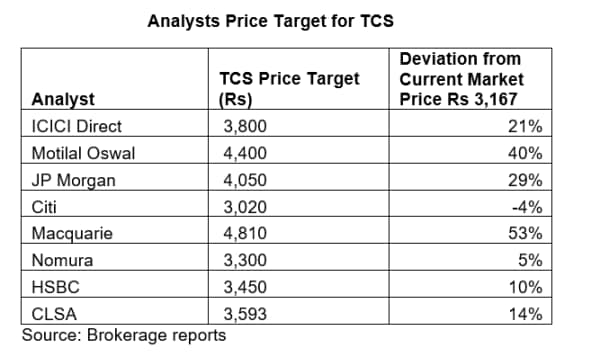 Analyst’s price target for TCS
Macquarie and Motilal Oswal expect TCS to reach its previous all-time high of Rs 4,522 in the medium term. CLSA pointed to TCS AI revenue but kept its target price low amidst a decline in new orders.
Meanwhile, analysts maintain a Buy rating on Infosys as momentum in key verticals and clients’ growing interest in embedding AI into business functions support revenue growth. However, increasing investment in sales and marketing, hiring and re-skilling is keeping short-term profit margins flat.
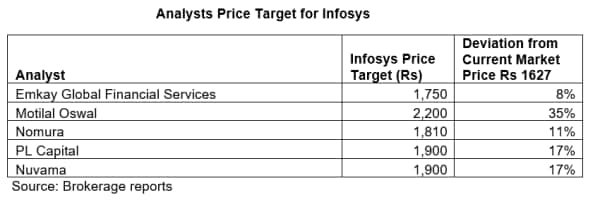 Analyst’s Price target for Infosys
Both TCS and Infosys are experimenting with different AI strategies and pricing structures to achieve the same end goal of end-to-end AI adoption of Agentic AI and Physical AI. Cost efficiency and faster turnarounds will be the growth drivers in the first phase of AI adoption, and startups like Anthropic could intensify competition.
AI is no longer just an indicator; it is emerging as a structural growth driver shaping workforce trends, deal activity, and growth.
The next two years could be a defining moment for IT stocks.
Note: We have relied on data from http://www.Screener.in throughout this article. Only in cases where the data was not available have we used an alternate, but widely used and accepted source of information.
Puja Tayal is a financial writer with over 17 years of experience in the field of fundamental research.
Disclosure: The writer and his dependents do hold stocks discussed in this article.
The website managers, its employee(s), and contributors/writers/authors of articles have or may have an outstanding buy or sell position or holding in the securities, options on securities or other related investments of issuers and/or companies discussed therein. The content of the articles and the interpretation of data are solely the personal views of the contributors/ writers/authors. Investors must make their own investment decisions based on their specific objectives, resources and only after consulting such independent advisors as may be necessary.