
Wuthering Heights movie review: Margot Robbie, Jacob Elordi-starrer is an overwrought, oversexualised, oversimplified Valentine’s Day release | Movie-review News
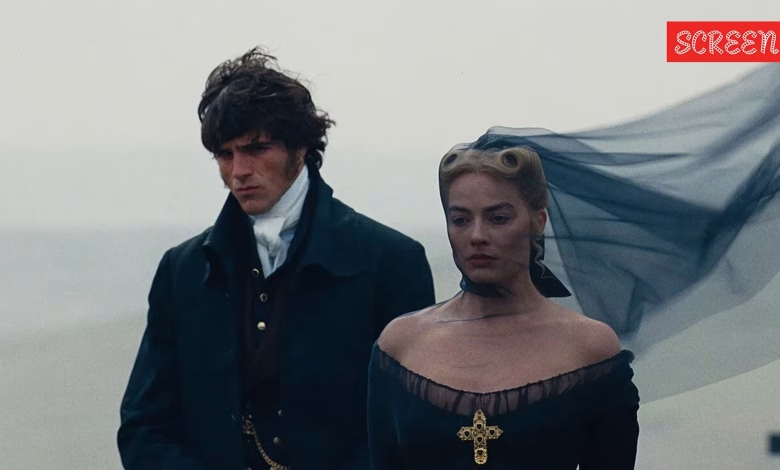
Whither Wuthering Heights? You may be left wondering as the Emily Brontë classic about an obsessive-destructive love and hate relationship is repurposed as an overwrought, oversexualised, oversimplified Valentine’s Day release.
Repurposed may seem an unfair word to use for Fennell, who now has two much-talked-about films behind her – Saltburn and the Oscar-nominated Promising Young Woman. However, it is a word you must grapple with as you try to understand why remake a novel that has been brought to screen so many times, and then shear it of its essence.
Even though it came out in 1847, Brontë’s novel was braver, more unconventional compared to this (without the sex), with its complex interweaving of two hard-to-like protagonists bound in life, and, famously, in death. Cathy and Heathcliff’s love did not fall into any neat category, which is evident from the struggles of the two narrators who recount their story in the novel.
If Fennell, who has adapted it for the screen – putting quote marks around the title in a loftily empty nod – is to be believed, all the two soulmates wanted to do was “get it on” everywhere, every time. Even while saying “I Love You” ad infinitum. The vast, rugged expanse of the Heights does offer privacy, but Robbie’s Cathy and Elordi’s Heathcliff prefer their rolls in the hay with as little hay around as possible.
ALSO READ | Why Wuthering Heights is not a romance. The misreading of Emily Brontë’s classic
Cathy’s cuckolded husband Edgar (Latif) and his “ward” Isabella (Oliver) have to be blind and deaf, unaware as they are of all the passionate heaving happening under their roof.
It’s also hard to say what Fennell is getting at with the other changes besides this too. Cathy’s brother is done away with, with their father Earnshaw (Clunes, living up a delicious meanness) now a one-in-two, standing in for both. So it’s kind of tricky for us to believe that a drunkard, abusive man like him would “rescue” an urchin off the streets (Owen Cooper, of Adolescence fame, playing Heathcliff as a boy) and decide to raise him, when the dubious Earnshaw fortune is leaking due to his gambling.
Story continues below this ad
Consequently, Wuthering Heights, the family home for 300 years, is conceived by the film as a structure jutting out and crumbling at angles no different than the rocky landscape around it. It may be hard to imagine as a living quarter, but at least it is closest in spirit to Brontë’s Wuthering Heights.
Nelly (Chau) is no longer an all-in-one maid at the house, but Cathy’s “companion”. The fact that she is an Asian in this decidedly English territory is explained away by making her the “bastard child” of a Lord, now doomed to play a nobody in the social structure.
While Heathcliff is not “gypsy like” anymore, but hunk-de-jour Elordi – with perhaps the longest cleft chin in the business – the “pale” Edgar is now played by the brown Latif. The actor of mixed Pakistani-British descent can be very charming, as he was in What’s Love Got to Do With It, but here he has to blend into the background (sometimes literally) as Edgar.
The worst fate is reserved for Isabella, Edgar’s sister in the novel but here for some reason only a “ward”. She is played for a fool and often just for laughs. Isabella of Brontë’s Wuthering Heights is a kind creature who seeks a sister in Cathy, after Edgar falls for her. Isabella of Fennell’s “Wuthering Heights” is a simpering, almost crazily obsessed, admirer of Cathy.
Story continues below this ad
Had all this tinkering even added something to the story, Fennell could have been pardoned for giving a shot at a novel that is notoriously hard to adapt due to its changes of tone, and its refusal to give a crowd-pleasing ending to Cathy and Heatchliff – even if Fennell, like some others before her, chooses to skip the second half where the story makes its real departure from the expected (for that, watch Peter Kosminsky’s 1992 version, with its brooding Ralph Fiennes).
Instead, Fennell is focused on shocking (from the get-go), titillating, obsessing with textures and surfaces and liquids (we get the sexual undertones, alright), and impressing with the film’s unquestionably visual lushness – from Edgar and Isbella’s baroque Thrushcross Grange home, to Cathy’s elaborate hairdos and costumes and jewellery.
On top of it, for all their secret, fervid encounters, Robbie (who can be effortless at this) and Elordi (who seems jejune in comparison) hardly set the windy, wet, bleak Wuthering Heights on fire.
The ever-practical Nelly remonstrates in the film, with reason: “I will not stand for this grotesque performance any more.”
Story continues below this ad
Grotesque may be not, but a performance this certainly is.


