OpenAI Chief Economist Ronnie Chatterji on India’s AI Leadership at 2026 Summit
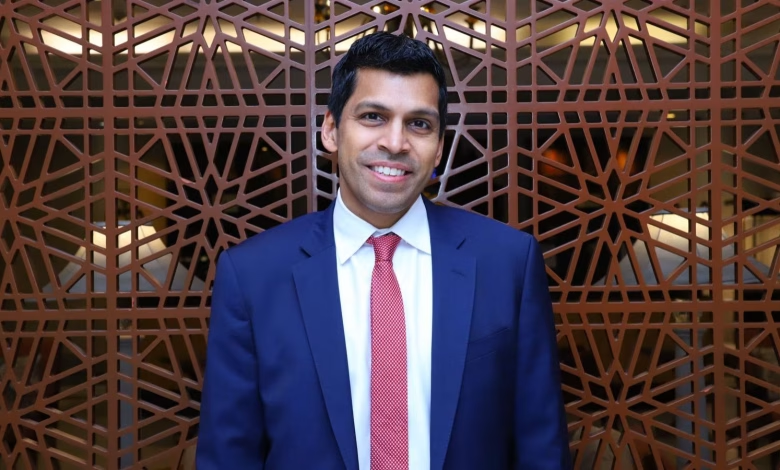
The world is witnessing a barrage of predictions about the trajectory of artificial intelligence (AI), with no simple answers in sight. At a time when news feeds are awash with relentless speculation, OpenAI’s Chief Economist, Dr Ronnie Chatterji, offers a simple prescription: “Just look at the data.” Based on the sheer scale and growth of AI usage, the OpenAI executive believes that India is well placed to drive global AI adoption.
The noted American academic and policymaker occupies one of the most consequential positions in the global AI economy. He is the Mark Burgess & Lisa Benson-Burgess Distinguished Professor of Business and Public Policy at Duke University and joined OpenAI in 2024 to spearhead research on AI’s economic impact. Chatterji’s role is not so much about forecasting the future as it is about assessing what is actually happening right now, as AI integrates itself into the way the world works.

He has held senior economic policy positions in both the Biden and Obama administrations. Chatterji has won the Kauffman Prize Medal for Distinguished Research in Entrepreneurship, the Rising Star Award from the Aspen Institute, and the Strategic Management Society Emerging Scholar Award, along with multiple teaching awards at Duke.
Speaking on the sidelines of the AI Impact Summit 2026 in New Delhi, Chatterji was candid about both the scale of the opportunity and the distance still to travel.
Below are edited excerpts from the conversation:
Q: As the Chief Economist at OpenAI, how do you really separate economic impact from AI hype when almost every productivity claim today sounds maybe overstated or inflated?
Dr Ronnie Chatterji: It’s a very good question. My job at OpenAI as Chief Economist requires me to stick close to the data. I think the way you avoid getting caught up in the hype cycle is by looking at the economic indicators that are available. Collect some new data if you have an opportunity to do that – like we’re doing – and try to estimate what’s actually going on. I feel like this is exactly why I’m in this position and what my role is today.
Just for an example: later, we’re going to release something called Signals. It is going to be a database that shows how people are using AI. Not hype, not meetup data, not a forecast, but the actual data. And while there are many others who get excited about AI and talk about AI, for me, sticking close to the data is part of the job.
Story continues below this ad
My advice to anyone who wants to cut through the hype is to look at the data. And what the data will show is that AI usage is increasing a lot. Even coming to Delhi, I was just looking at AI everywhere. Three years ago, we weren’t even using that word. Things are moving really fast. You have 100 million weekly active users in India, and that’s huge, from a product that people hadn’t heard about even a couple of years ago.
At the same time, it’s going to take a while for AI to permeate throughout the economy and society and deliver all these productivity gains people are talking about. So the second part of it is that as much as I pay attention to how AI is being used, I’m also looking at GDP and other statistics to think about how AI is showing up there as well. Some of that is going to take a longer time than the usage statistics are indicating. We’re just beginning to see some of the early signs of that. So that’s how I stay grounded in the data and not caught up with what people are talking about.
Q: As an economist, what indicators are you looking at closely to judge whether AI adoption is actually improving productivity and not just merely cutting costs?
Dr Ronnie Chatterji: The key distinction is whether AI is creating new value or just cutting costs. I start by looking at who is using AI and how they are using it. In India, usage has grown about two-and-a-half times over the past year, with a very young user base. Around 80 per cent of messages come from people aged 18–34, and they are using AI largely for writing, coding, data analysis and other work-related tasks.
Story continues below this ad
We can analyse this without reading individual messages by using LLMs to classify usage, which also preserves privacy. This same approach applies in enterprises. There, you see a clear gap between power users, who integrate AI deeply into their work, and median users. Understanding who these users are and what roles they occupy helps explain productivity differences.
The final test is whether companies are actually producing more – launching new products, moving faster, or improving processes in ways customers value. Cost-cutting matters, but so does value creation. It’s hard to measure this at the economy-wide level, but within companies, these indicators help distinguish real productivity gains from simple efficiency savings.
Q: What are your thoughts on current GDP and productivity metrics? Are they adequate or outdated in order to capture the actual economic value of AI?
Dr Ronnie Chatterji: Right now, those statistics are not really capturing the full scope of AI. A lot of AI so far is helping people make better decisions or giving them assistance and information. Those are things that don’t always show up in GDP, particularly because so many of our tools are free for users. This is what consumer economists call ‘consumer surplus’, and we see massive consumer surplus from the data that we’re looking at with ChatGPT.
You are also seeing, though, what’s showing up: the capital expenditures, such as investments that companies like ours are making in the infrastructure for AI. And that infrastructure is showing up through capital expenditures in the national accounts and the GDP calculations. So there is one way in which it is being captured. But I would say a lot of the value of AI has not yet been captured in statistics.
Story continues below this ad
Over the next two or three years, I think you will start to see those productivity benefits that we were talking about, as companies are doing more with the same amount of inputs but creating a lot more in terms of output. That’s kind of where we’re going. But that is not showing up right now in the statistics around the world.
Q: From an economic perspective, how should developing economies like India approach AI adoption differently from the US or Europe?
Dr Ronnie Chatterji: I think India has figured it out well, with the five-pronged approach that the Prime Minister laid out earlier this week. You’re thinking about the full stack, all the way from investing in infrastructure, things like chips and data centres, toward applications. I think India has the capabilities and the resources to think about the full-stack approach, and that’s exciting. You have a strong plan in place.
On the talent side, every country needs to think about whether they have the adequate talent to build these applications. And India is very blessed in that area, with so many graduates coming out with technical skills every year and the potential to build with AI. I’ve seen this this week, engaging with so many young people who are coming out of school, building companies, and getting funding, and all of these often with AI. I think that’s probably where India has a really distinctive energy vis-à-vis the rest of the world: the sheer amount of talent that is trained to do this work.
On the infrastructure investment side, it’ll take capital, and it will take reforms in how you approve the permitting of new factories and how you connect to the grid – all the things they’ve been talking about at this conference. So I think that’s where India is right now, but it is very well positioned given some of the key inputs, and talent is definitely one of them.
Story continues below this ad
Q: Can you briefly talk about how compute costs, energy constraints, and infrastructure bottlenecks actually factor into OpenAI’s long-term economic modelling?
Dr Ronnie Chatterji: We think a lot about infrastructure as being destiny. If you, as a country or a region, can invest in adequate infrastructure to support the scaling of intelligence and can provide, both for training and inference, the kind of compute needed to harness advanced capabilities, those places are going to benefit. So in many ways, as much as we think about AI on the software side, hardware is going to be really, really important. And these infrastructure investments are going to be historic in their proportion. You’re already seeing that, and the countries that can bring the most to bear to build that infrastructure are going to be well positioned in the AI era.
For us, in terms of how we’re thinking about economic impact, as much as we think every day about how AI is going to transform the way we work and make us more productive, we’re also thinking about the infrastructure investments and the jobs that will be created along the way, whether it’s building data centres or making the hardware that goes inside them. There are a lot of opportunities in the supply chain for AI infrastructure that we’re paying attention to in our economic modelling.
Q: Referring to one of your older interviews, you mentioned that part of your role is to identify the most vulnerable sectors that would be impacted by this mega transformation. Can you elaborate on that?
Dr Ronnie Chatterji: When I think about sectors that AI is going to be complementing, but where I would be surprised if it ever substituted for those jobs, I think about education and healthcare. Why those? They are responsible for a good proportion of jobs. In the United States, and I’m sure here too, they’re a huge part of the job picture. Education and healthcare require, in many cases, human-to-human contact – the teacher at the front of the classroom helping the children learn, the nurse at your side helping you when you’re sick. And while I think that machines will have more capabilities in these areas, and you’re already seeing AI enter the inputs into education and healthcare, I think there’s going to be, as far as I can see in my work, a strong preference for the human touch in those areas. I think we might actually wish to add more humans in healthcare delivery and education, where they can add a lot of value.
In other places where people are working a job that is remote, based on very structured data and repetitive tasks, those are more vulnerable to AI, and we need to be honest about that. If you’re doing the same thing again and again and there’s not a lot of people interaction, then an agent could be spun up to do that kind of work. The question will be, for folks who are in that category: what skills can they gain? How can they leverage that into new opportunities? An organisation like OpenAI cannot solve that question on its own. What we’re doing is releasing versions that can help people look for jobs and get certifications and new skills. But we’re going to have to work everywhere in the world – with workers, governments, and civil society – to ensure that we can be part of the solution. It won’t just be our solutions alone; it’s too big of a problem. But those are the sectors we need to focus on, and those are the kinds of jobs that I think are most vulnerable, and we’ll have to focus on helping those people first.
Story continues below this ad
Q: There is this growing concern that AI would likely concentrate power in the hands of a few big companies. In your opinion, is that an economic inevitability, or are we staring at a policy stalemate in the making?
Dr Ronnie Chatterji: I think it depends on how we develop the technology and the business models. I can speak for our organisation because this is the one I know best. Our explicit goal is to democratise intelligence; we want to push the capabilities out to as many people as we can. That’s why you have so many free users. That’s why we’re focused on giving people that power. For us, that’s the approach, that’s the model, and that’s what we think is right. That’s why we’ve developed the way we have.
I think that when you give intelligence to more people, you’ll see people building on it, building on top of our APIs, and doing new things with these tools. That’s a way to democratise the power that comes from AI too. If you keep it closed to a smaller group of users, or only to the people who can afford it on a subscription plan, you’re not going to have the economic impact, and you’re also risking concentrating power among a smaller group of users.
This is where training and education come in. We need to make sure people know how to use it and have access to the tools. This is how I think we should be thinking about it. I do think this is a risk that we need to think about as a society, and companies need to think about too – how do we make sure people share in the benefits from AI, rather than having those benefits concentrated in the hands of just a few individuals or organisations? That’s a big part of our mission and kind of what we’ve been working on.
Q: Jobs are likely to be impacted in the next two to three years. How should the world prepare – organisations, leaders, and professionals? And if AI is going to create new jobs, will that require an overhaul of our education system, especially higher education?
Dr Ronnie Chatterji: I think we should be really clear that there will be positives. AI will create new jobs. There will be types of jobs that didn’t exist before. And there will also be disruption as jobs will change, and some will be disrupted, and people in those jobs will have to adjust as well. I think we have to help them do that. We have to give them the skills – here’s the new technology that’s growing, here’s how to use it, and here’s how to use your skills and interests to apply them in a good direction.
Story continues below this ad
The education system is going to be a key part of it. It’s actually why I think India is a place that we’re going to keep focusing on, because a large percentage of students using it are an amazing laboratory to understand how younger people are using AI to take the next step in their careers. We have to learn from that. We have to study that. I’ve been really excited to see the associations we’ve built up, the partnerships with universities here in India that are training the leaders of tomorrow.
I think higher education, speaking as a professor myself, will have to change how we train students, how we assess them, and how we help place them in their careers because of AI. I think a lot of higher education institutions are taking up that mantle and working with lots of the frontier labs to develop these ideas.