
Can Better Running Shoes Really Make You Faster?
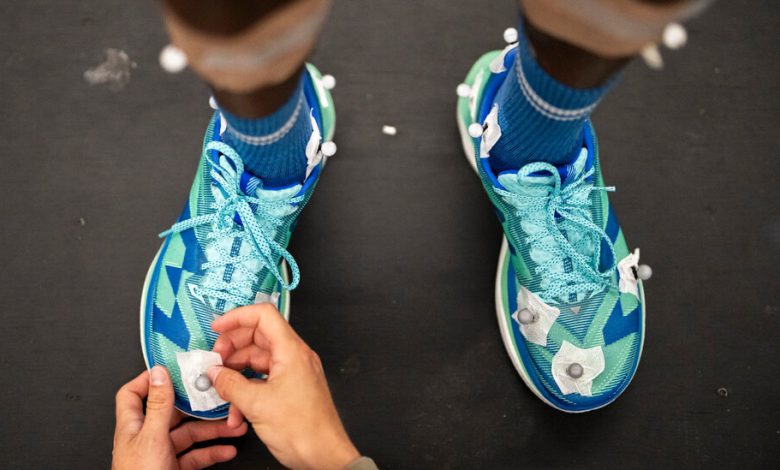
But promoting a new shoe with an academic study elicited skepticism.
“If Nike had just put out an ad that said, ‘Our shoes are 4 percent better,’ or, ‘Our runners say that their runs feel 4 percent easier,’ nobody would have paid attention,” Kram said. “When you put out a study, that’s different. That’s making a pretty bold claim.” Even as athletes began to set world records in the shoes, “healthy doubt was hard to kill,” the journalist Matt Hart wrote in his book “Win at All Costs.” “Owing to the fact that Nike had funded the study.”
“People said we were shills,” Kram said. “But then the study got replicated.” In 2019, a New York Times analysis found that the advantage conferred by the Vaporfly might actually be even higher than concluded by Kram.
Vaporfly’s success ushered in an era in which every brand was hurrying to develop a super shoe that combined high-stack supercritical foams with carbon fiber plates. It also put a new emphasis on scientific analyses, as every company looks for ways to prove, with hard data, that its shoe has something that the others don’t. “A lot of those people have worked with Rodger and me, so it’s becoming omnipresent at the shoe companies,” Hoogkamer said.
Some brands, like Under Armour, have built state-of-the-art laboratories in pursuit of a competitive advantage. Tom Luedecke, Under Armour’s senior director of footwear innovation, described its newly constructed mechanical testing lab in Baltimore as “world-class, and as good or better than everyone else in the industry,” crediting it with the success of the brand’s Velociti Elite line of marathon-running shoes. Other brands have deepened their relationships with universities to leverage their resources and expertise.
“Working with these labs makes us a lot smarter,” said Kevin FitzPatrick, the vice president for running at New Balance.
Not every brand relies on external data. When Adidas revealed its Adios Pro Evo 3, which Sabastian Sawe wore in April when he ran the London Marathon in under two hours, it boasted that the shoe “improves running economy by 1.6 percent compared to its predecessor.” But they didn’t share any studies or data, which raised eyebrows.